
The Rainbow Hole
A Theoretical Cosmic Phenomenon

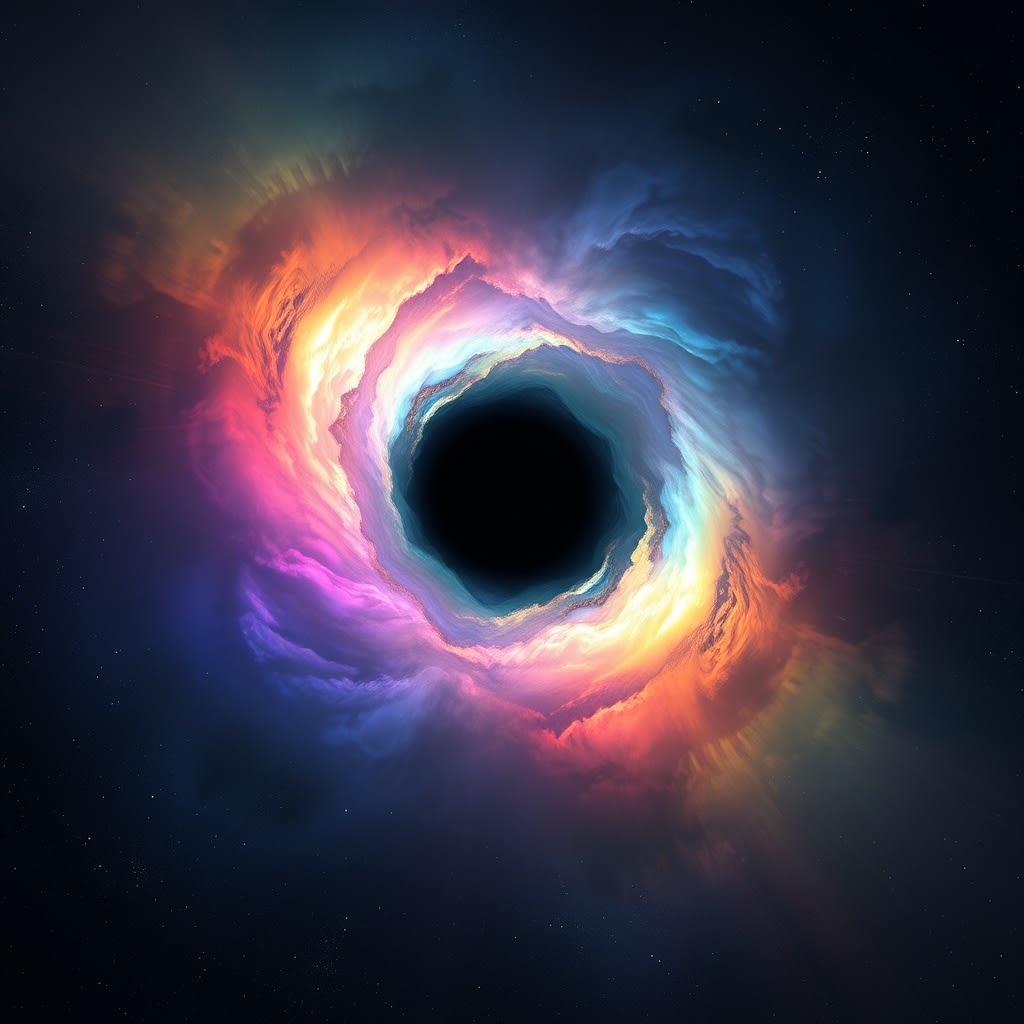
In the vast expanse of the universe, black holes have long fascinated scientists for their immense gravitational pull and mysterious nature. But what if, somewhere out in the depths of space, there existed something even more peculiar—something as beautiful as it is terrifying? Enter the concept of the "Rainbow Hole," a theoretical cosmic phenomenon that functions similarly to a black hole, yet is entirely different in appearance and behavior. Instead of being a void that consumes everything in its path, a Rainbow Hole radiates a kaleidoscope of colors, offering a dazzling display that hints at unknown physical laws and realities.
Part 1: The Origin of the Rainbow Hole Theory
The idea of the Rainbow Hole emerged as a thought experiment by theoretical physicists attempting to reconcile certain unresolved mysteries in quantum mechanics and general relativity. Black holes, with their overwhelming gravity and event horizons, present paradoxes about the nature of information, entropy, and space-time. These singularities seem to violate known laws of physics, particularly when it comes to quantum information loss, which has sparked debate for decades.
One day, Dr. Lila Kovacs, an astrophysicist specializing in multi-dimensional theories, proposed a radical concept. During a seminar on quantum field interactions in black holes, she suggested that not all singularities need to be black voids that trap light. Some, under very specific circumstances, could bend or refract light rather than absorb it. What if there existed cosmic singularities that bent light across the spectrum, dispersing it in such a way that the resulting phenomenon appeared as a swirling vortex of rainbow colors? Thus, the idea of the Rainbow Hole was born.
Part 2: Structure and Functionality
At its core, a Rainbow Hole operates similarly to a black hole in terms of gravitational strength and the bending of space-time. However, instead of simply consuming light and matter with an event horizon of pure darkness, the Rainbow Hole refracts light into an array of colors, much like a cosmic prism. Its “event horizon” does not present as a single boundary, but rather as a constantly shifting, multi-colored field, where photons are broken down and scattered in all directions.
This scattering occurs because of the highly unusual gravitational interactions taking place inside the Rainbow Hole. Scientists theorize that a Rainbow Hole would form in regions of space where extreme gravitational forces are interacting with high levels of electromagnetic radiation, perhaps near the collision of neutron stars or in the presence of exotic matter. This unique environment could create a phenomenon where instead of collapsing light inward, the singularity bends it outward, producing a spectrum of color visible from immense distances.
The event horizon of a Rainbow Hole would likely be unstable, fluctuating in size and intensity as the gravitational field continuously refracts the incoming light. Observing a Rainbow Hole from afar would be akin to watching a massive, glowing vortex in space, swirling with all the colors of the electromagnetic spectrum—from infrared to ultraviolet. The closer one gets, the more complex the patterns of light become, creating a dazzling yet disorienting effect.
Part 3: The Physics Behind the Rainbow Hole
Understanding how a Rainbow Hole might exist requires delving into the quantum and gravitational mechanics that could produce such a phenomenon. One theory posits that Rainbow Holes could be the result of a unique interaction between dark matter and dark energy, two enigmatic forces that dominate the universe but remain largely mysterious.
In the case of a Rainbow Hole, dark matter might act as a lens, focusing incoming light in such a way that it doesn’t collapse into the singularity but instead escapes through various channels, breaking into different wavelengths. This process would resemble gravitational lensing, a well-documented phenomenon in which massive objects like galaxies bend light around them. However, in the case of the Rainbow Hole, the process is much more extreme, creating a spectacular array of colors as the light gets stretched and distorted by the intense gravitational forces.
Dark energy, which is thought to be responsible for the accelerated expansion of the universe, might also play a crucial role in stabilizing the Rainbow Hole, preventing it from collapsing into a typical black hole. Some researchers hypothesize that these two forces could form a delicate balance around the singularity, creating an environment where space-time warps differently than in a standard black hole.
Part 4: Types of Rainbow Holes
Just as black holes come in various sizes—stellar, supermassive, and miniature—the Rainbow Hole could have multiple versions, each with its own unique properties.
Micro Rainbow Holes
These would be the smallest types of Rainbow Holes, perhaps no larger than a planet. They would refract light primarily in the visible spectrum, creating a beautiful yet eerie glow that could be mistaken for a distant nebula or star cluster. Due to their size, they would pose little direct danger to surrounding celestial objects, but their gravitational pull could still disrupt the orbits of nearby planets and moons.
Stellar Rainbow Holes
These medium-sized Rainbow Holes could form from the remnants of collapsed stars or neutron star collisions. They would refract a much broader range of light, from infrared to ultraviolet, creating a radiant vortex of swirling colors. Observing a Stellar Rainbow Hole from a safe distance would reveal a hypnotic, ever-shifting array of colors that change with every moment. These Rainbow Holes could potentially attract interstellar matter, creating colorful accretion disks that spiral into the singularity.
Supermassive Rainbow Holes
These behemoths would rival the supermassive black holes found at the center of galaxies. Supermassive Rainbow Holes could span thousands of light-years across, bending not only light but even entire star systems with their immense gravitational fields. Unlike their smaller counterparts, these Rainbow Holes could radiate across the entire electromagnetic spectrum, creating a blindingly bright phenomenon visible from millions of light-years away. Their presence would disrupt entire galaxies, causing stars to orbit in complex, erratic patterns, their light fractured into rainbows across the cosmos.
Part 5: Implications for Space Travel and Exploration
If Rainbow Holes exist, their discovery could revolutionize our understanding of gravity, light, and the fabric of the universe. They might also represent both danger and opportunity for space travel. Approaching a Rainbow Hole would be treacherous, as the gravitational pull would be just as deadly as that of a black hole, dragging spacecraft into its event horizon.
However, some speculative theories suggest that, because of the Rainbow Hole’s ability to warp space-time in unique ways, it could potentially serve as a natural gateway or wormhole. Its complex gravitational field might connect distant parts of the universe, allowing objects to travel vast distances instantly, though such travel could be extraordinarily risky, given the instability of the singularity.
Part 6: The Mystery of the Rainbow Hole
The Rainbow Hole remains a purely theoretical construct for now, but its potential discovery would reshape how we view the cosmos. It represents not just a new type of singularity, but a more complex and beautiful interaction between light, gravity, and space-time. In the end, the Rainbow Hole could be the universe’s way of reminding us that beauty and danger often go hand-in-hand, and that the mysteries of the cosmos are far from fully understood.
In a universe full of black holes that devour light, perhaps the Rainbow Hole is the anomaly that returns it—a cosmic prism at the heart of a dark and mysterious universe.
About the Creator
Cosmic Dread
A cosmic horror writer. I blend real science with chilling possibilities, exploring the terrifying forces of the universe—black holes, rogue planets, and cosmic horrors lurking in the cold void of space.
Keep reading
More stories from Cosmic Dread and writers in Fiction and other communities.
The Neptune Incident
On June 7, 2041, a mysterious and terrifying event occurred on Neptune, one that defied scientific explanation and left the world in a state of shock and fear. What began as a routine observation of the distant ice giant turned into a cosmic nightmare, as Neptune became the epicenter of an inexplicable phenomenon that threatened to rewrite the laws of astrophysics.
By Cosmic Dreadabout a year ago in Chapters
Miss Persephone's Manual to a Seemingly Ordinary Life
Miss Persephone was found at the dining table, her blue eyes swollen, her tears arriving and retreating like the tides of the ocean. Earlier that day, her family had visited her in the retirement home where she had lived for eight years. It was her eightieth birthday.
By Imola Tóth5 days ago in Fiction
Simple Sammy
Exposition Sammy Frederickson lived in a small, quiet town. He was a small, quiet boy who kept himself to himself. As his family had next to nothing, his friends were animals in the forest surrounding his shack of a home. With no modern gadgets, his entertainment was communing with nature, no matter the weather.
By Julie Lacksonenabout 17 hours ago in Fiction


Comments
There are no comments for this story
Be the first to respond and start the conversation.