
"The Saturn Apocalypse: Earth’s Final Reckoning"
When the Rings Shatter and the Skies Fall, No One Survives

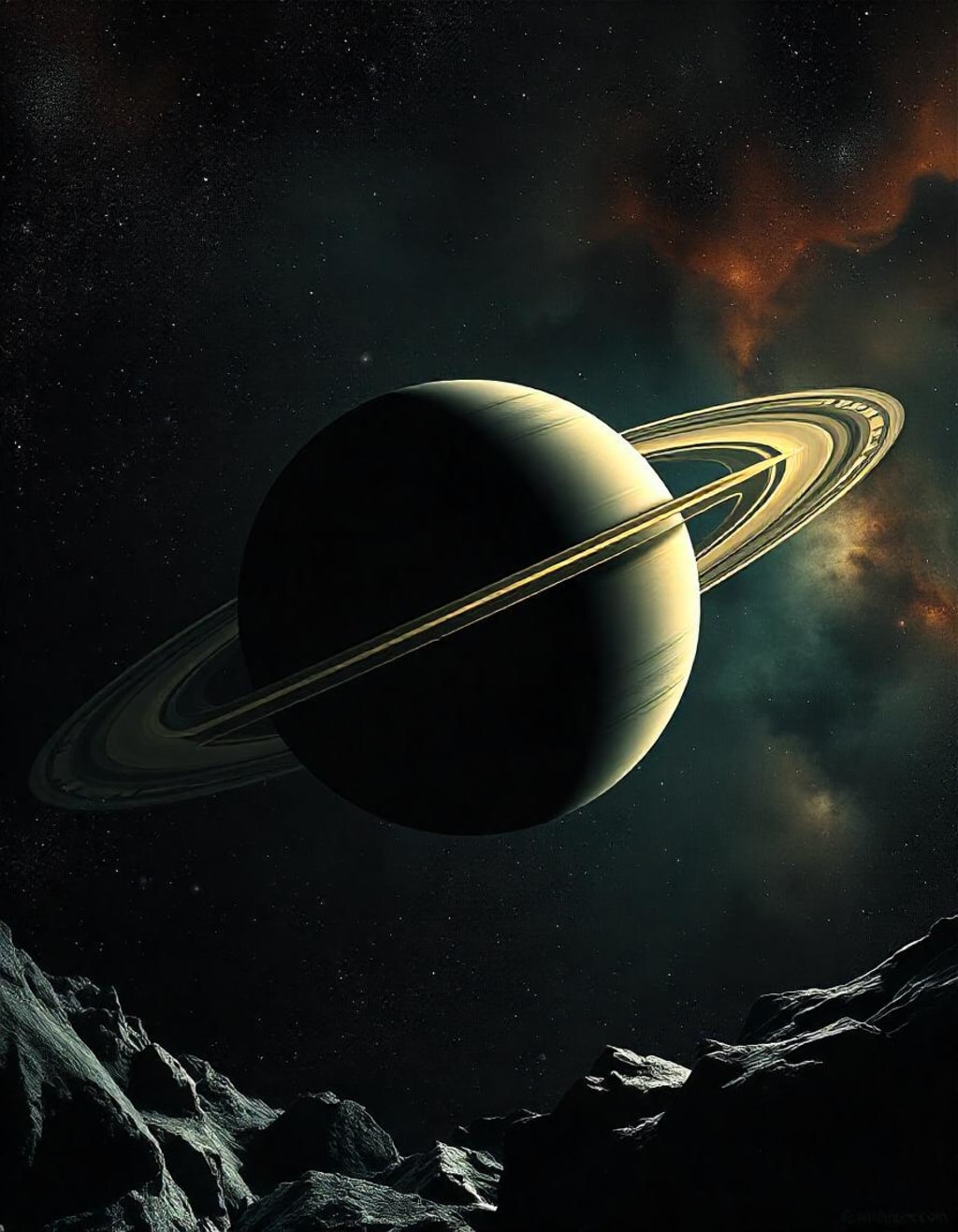
Saturn—one of the most iconic planets in our solar system, renowned for its magnificent rings—has long fascinated scientists and the public alike. Its tranquil presence, millions of miles away, has lulled humanity into a false sense of security. But what if that peace were to be shattered? Imagine a catastrophic event where Saturn, a gas giant nine times wider than Earth, begins to disintegrate. The consequences of such an astronomical disaster would be unimaginably terrifying, and Earth would be thrust into a cosmic nightmare.
The Beginning of the End
Saturn is composed primarily of hydrogen and helium, with a dense core surrounded by layers of gas. In this hypothetical scenario, an unknown and extreme cosmic force—perhaps a rogue black hole or an immense asteroid of unthinkable size—collides with Saturn, disrupting its delicate balance. The gas giant begins to break apart, with its core collapsing under gravitational forces while the surrounding layers of gas explode outward in a violent chain reaction. Saturn’s iconic rings, composed of countless ice and rock particles, are ejected into space, turning them into lethal projectiles.
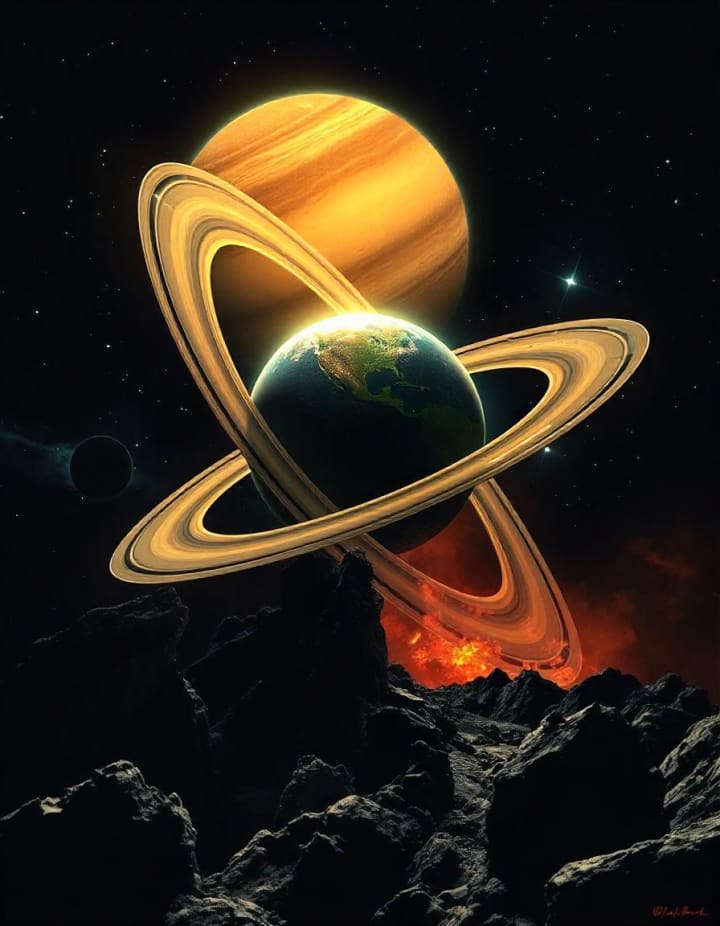
While Saturn is located about 1.2 billion kilometers from Earth, this distance would not save us from the devastating effects that follow. As Saturn’s disintegration accelerates, the shockwave of the explosion and the release of untold amounts of energy would unleash destructive forces that could ripple across the solar system, affecting every planet in its wake.
Saturn’s Rings Turn Into Projectiles
The first and most immediate consequence of Saturn’s collapse would be the fragmentation of its rings. These rings are made up of countless particles, some as small as dust grains, others as large as mountains. Once set free, these fragments would be propelled through space at speeds of up to 70,000 kilometers per hour. The debris would become a massive cloud of destruction, moving in all directions.
As this expanding cloud of debris reaches the outer planets, the sheer volume and velocity of the particles would devastate anything in their path. For moons like Titan and Enceladus—Saturn's most prominent satellites—this would mean total annihilation. But the destruction wouldn’t stop there. As the debris continues to spread, the once-stable orbits of celestial bodies around Saturn could be thrown into chaos. If even a fraction of this ring material were to cross Earth’s orbit, it would be akin to Earth passing through an interplanetary minefield.
Massive chunks of ice and rock, some hundreds of kilometers wide, would be hurled toward our planet at breakneck speeds. Upon impact, these fragments could deliver the equivalent force of multiple nuclear bombs, creating craters larger than cities and unleashing global earthquakes, tsunamis, and firestorms. The skies would darken with dust and ash, causing temperatures to plummet and plunging Earth into an immediate winter, resembling a nuclear winter scenario.
A Shift in Gravitational Balance
Saturn’s disintegration would also have a profound impact on the gravitational balance of the solar system. Saturn, with its massive gravitational pull, plays a vital role in stabilizing the orbits of surrounding planets and objects in the outer solar system. As it breaks apart, its gravitational influence would weaken, creating a dangerous imbalance.
The disintegration of Saturn could send planets like Uranus and Neptune on erratic paths, disrupting the orbits of asteroids and comets in the Kuiper Belt and beyond. Some of these objects, previously held in stable orbits, could be knocked loose and sent careening toward the inner solar system—toward Earth.
A torrent of incoming comets and asteroids would overwhelm Earth's atmosphere. The planet would be bombarded by these celestial objects, far more destructive than the ring fragments alone. Each impact would vaporize huge swathes of land and boil the oceans, sending shockwaves around the globe. Entire cities, continents, and ecosystems could be wiped out in a matter of hours, while the long-term fallout could lead to a mass extinction event rivaling the one that killed the dinosaurs.
Saturn’s Gas Cloud: A Toxic Breath
The gases released from Saturn’s disintegration would pose an equally lethal threat. While hydrogen and helium, Saturn’s primary components, are not inherently toxic to humans, the sheer volume and speed at which they would flood the solar system could have unpredictable effects. These gases could interfere with Earth's atmosphere, potentially destabilizing the delicate balance of oxygen, nitrogen, and carbon dioxide needed to sustain life.
Worse still, the remnants of Saturn’s core, composed of heavier and potentially more toxic elements, could create massive clouds of dangerous materials. These clouds, combined with the debris from the planet’s disintegration, would darken the sky, blocking sunlight for years and triggering a global cooling event far worse than any human-caused climate change.
Temperatures would plummet, crops would fail, and ecosystems would collapse. The entire food chain, from the smallest plankton in the ocean to the largest mammals on land, would be disrupted. Humanity would be plunged into a fight for survival as resources dwindled and the world entered a new ice age.
Electromagnetic Chaos and Atmospheric Disasters
Saturn is not only a massive planet but also a highly magnetic one. It generates a powerful magnetic field, far stronger than Earth’s. As Saturn disintegrates, its magnetic field would collapse, sending shockwaves through the solar system's magnetosphere. The ripple effects of this collapse could destabilize the magnetic fields of neighboring planets, including Earth.
On Earth, such electromagnetic disruptions could knock out communication systems, satellites, and power grids. GPS systems would malfunction, planes would fall from the sky, and global trade would grind to a halt. The technological infrastructure that modern society relies upon would be crippled, plunging Earth into a technological dark age. The combination of environmental disasters and societal collapse would make recovery almost impossible.
The Earth's atmosphere could also experience intense geomagnetic storms, akin to those caused by solar flares but far more severe. The ozone layer, which protects life from harmful solar radiation, could be stripped away, exposing life on Earth to lethal levels of ultraviolet radiation. Cancer rates would skyrocket, and the fragile ecosystems that sustain human life would crumble under this relentless bombardment.
The Slow Agony of Planetary Doom
Saturn’s disintegration would not be a quick event. The collapse could take years, even decades, to fully unfold. But the effects would be felt immediately and progressively worsen. Earth would be at the mercy of an astronomical disaster beyond anything we’ve ever imagined.
Every day, new waves of debris would reach our planet, and the skies would continue to grow darker and colder. Humanity would face the unimaginable—a planet slipping into a frozen wasteland, under constant bombardment from space, with no way to escape or reverse the damage.
Ultimately, the disintegration of Saturn would mark the beginning of a slow, agonizing extinction for all life on Earth. The solar system, once a stable and harmonious environment, would become a chaotic and deadly place. Earth, our once-thriving home, would be reduced to a desolate, lifeless rock, endlessly pelted by the remnants of a planet that was never supposed to die.
In this nightmare scenario, the collapse of Saturn would not just destroy the gas giant—it would set the stage for the end of the world as we know it. The terror lies not just in the destruction itself, but in the certainty that, against the forces of the cosmos, humanity would be utterly powerless.
In Earth’s final days, as Saturn’s destruction ravages the skies, humanity would face a harsh, terrifying truth: we are powerless in the face of cosmic fury. No technology, no prayers, nothing could stop the relentless onslaught from a dying giant. As the world falls into darkness and cold, civilization crumbles, and silence takes hold.
Saturn’s death would mark not just the end of a planet, but the end of us all—Earth, a lifeless husk adrift in an uncaring universe, forgotten in the vast, silent void.
About the Creator
Cosmic Dread
A cosmic horror writer. I blend real science with chilling possibilities, exploring the terrifying forces of the universe—black holes, rogue planets, and cosmic horrors lurking in the cold void of space.
Keep reading
More stories from Cosmic Dread and writers in Horror and other communities.
The Darkness of Space: An Analysis and Creepy Facts
Space is vast, mysterious, and hauntingly dark. Its sheer scale, the profound emptiness, and the unknown forces at play have fascinated humanity for centuries. The darkness of space, though seemingly simple, carries unnerving truths that fuel our deepest fears. This analysis explores why space is so dark, what it reveals about the universe, and some chilling facts that highlight the eerie nature of the cosmos.
By Cosmic Dreadabout a year ago in Horror
Something Is Living Under My Bed
I used to believe monsters only existed in a child’s imagination. Sharp teeth, glowing eyes, clawed hands reaching from the dark—things parents dismiss with a laugh before turning off the lights. I believed that too, once. Until the night I realized the fear under my bed wasn’t imaginary.
By David John5 days ago in Horror
Miss Persephone's Manual to a Seemingly Ordinary Life
Miss Persephone was found at the dining table, her blue eyes swollen, her tears arriving and retreating like the tides of the ocean. Earlier that day, her family had visited her in the retirement home where she had lived for eight years. It was her eightieth birthday.
By Imola Tóth4 days ago in Fiction



Comments
There are no comments for this story
Be the first to respond and start the conversation.