Adnan Rasheed
Bio
Author & Creator | Writing News , Science Fiction, and Worldwide Update| Digital Product Designer | Sharing life-changing strategies for success.
Stories (475)
Filter by community
China’s Secret Spaceplane Exposed Austrian Amateur Snaps Stunning Image as Mysterious Craft Soars Over Europe
China’s Secret Spaceplane Exposed Austrian Amateur Snaps Stunning Image as Mysterious Craft Soars Over Europe In a surprising development that has electrified the global aerospace community an Austrian amateur astronomer has captured a rare and stunning image of what is believed to be China’s highly classified spaceplane as it streaked across the night sky over Europe. The sighting has reignited debates about the secretive nature of China’s military space program and the broader implications for the future of space security.
By Adnan Rasheed10 months ago in Futurism
Curiosity Rover Captured in Action for the First Time
Curiosity Rover Captured in Action for the First Time In an extraordinary event that has thrilled scientists and space enthusiasts alike NASA’s Curiosity rover has been captured in action for the very first time on the Martian surface. Although images of Curiosity have been taken before what makes this moment historic is that it was photographed while actively conducting its exploration tasks. This remarkable achievement offers not just a stunning visual but also critical insights into the operations and endurance of the rover, which has been tirelessly working on Mars since 2012.
By Adnan Rasheed10 months ago in Earth
Giant Life Found Beneath the Waves Scientists Stunned by Discovery of Massive Animals Hidden in the Ocean Crust
Giant Life Found Beneath the Waves Scientists Stunned by Discovery of Massive Animals Hidden in the Ocean Crust In a discovery that has left the scientific community astonished researchers have found massive previously unknown life forms hidden deep within the Earth's ocean crust. This groundbreaking revelation not only challenges what we know about life on our planet but also opens up exciting possibilities for life beyond Earth. The discovery was made during an expedition led by the Schmidt Ocean Institute using their advanced remotely operated vehicle (ROV) called SuBastian. The team was exploring hydrothermal vent systems along the East Pacific Rise a region known for its extreme underwater conditions. These vents release mineral rich fluids heated by magma beneath the Earth's surface creating one of the harshest environments on Earth. To their amazement when researchers lifted portions of the ocean crust they uncovered vast underground cavities teeming with life. Inside these hidden chambers giant worms snails and crustaceans thrived in complete darkness under crushing pressure and in temperatures that would be deadly to most known species. For decades scientists believed that life in the deep sea was mostly confined to the areas immediately surrounding hydrothermal vents. These ecosystems already considered extreme depend on chemosynthesis a process where bacteria convert chemicals from the vent fluids into energy rather than sunlight. However this new discovery suggests life not only survives but flourishes beneath the actual ocean floor living inside the crust itself. These organisms have adapted to live in small cracks and porous rocks where hot fluids circulate. This subsurface world previously thought to be nearly sterile is now revealed as a vibrant ecosystem populated by creatures larger and more complex than anyone had imagined. Among the species discovered were giant tubeworms reaching lengths of up to three meters. These colossal creatures anchor themselves in the rocky cavities relying on symbiotic bacteria to provide nutrients. Alongside them were strange types of bristle worms and large snails all perfectly adapted to life in darkness high temperatures and extreme chemical conditions.
By Adnan Rasheed10 months ago in Earth
Archaeologists Unveil Medieval Inscriptions in Jerusalem’s Cenacle A Glimpse into Pilgrimage History. AI-Generated.
Archaeologists Unveil Medieval Inscriptions in Jerusalem’s Cenacle A Glimpse into Pilgrimage History In a remarkable archaeological breakthrough researchers have uncovered a series of medieval inscriptions within the Cenacle also known as the Room of the Last Supper located on Mount Zion in Jerusalem. This discovery offers a rare glimpse into the lives of Christian pilgrims who visited this sacred site between the 14th and 16th centuries.
By Adnan Rasheed10 months ago in History
A "Living Fossil" Has Been Found Swimming Off California
A "Living Fossil" Has Been Found Swimming Off California In a groundbreaking discovery, scientists have reported sighting a "living fossil" a coelacanth swimming off the coast of California. This prehistoric fish once believed to have been extinct for millions of years has amazed researchers and marine biologists offering a rare glimpse into Earth’s distant past. The encounter occurred during a deep sea research expedition led by scientists from the Monterey Bay Aquarium Research Institute (MBARI) and the Scripps Institution of Oceanography. Their mission intended to study deep sea biodiversity took an unexpected turn when their remotely operated vehicle (ROV) captured footage of a strange fish with lobed fins a large body and a unique swimming style characteristics matching that of the ancient coelacanth.
By Adnan Rasheed10 months ago in Earth
Egypt Launches $51 Million Revamp of Pyramids of Giza Amid Vendor Protests and Animal Welfare Concerns
Egypt Launches $51 Million Revamp of Pyramids of Giza Amid Vendor Protests and Animal Welfare Concerns Egypt has embarked on an ambitious $51 million project to revamp the Pyramids of Giza one of the world's most iconic and visited heritage sites. The massive overhaul aims to improve the visitor experience introduce sustainable tourism practices and modernize the surrounding area without compromising the historical and cultural value of the ancient wonder. However the initiative has also sparked significant protests from local vendors and animal rights concerns making the restoration effort a complex balancing act between modernization and tradition.
By Adnan Rasheed10 months ago in The Swamp
The Mammoth Discovery in Michigan A Window into Earth's Ancient Past
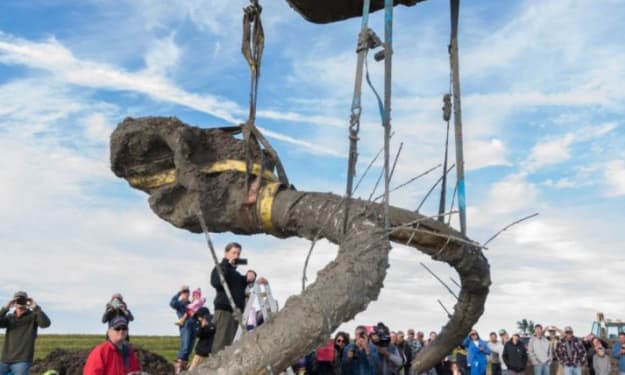
The Mammoth Discovery in Michigan A Window into Earth's Ancient Past In 2015 an extraordinary discovery on a Michigan farm provided a rare glimpse into Earth's ancient history. James Bristle a farmer from Lima Township was digging a natural gas line on his property when he struck something unusual. What he initially thought was a bent piece of wood turned out to be the skull and massive tusks of a woolly mammoth a species that once roamed vast regions of North America during the Ice Age.
By Adnan Rasheed10 months ago in History
What Happened to American Soldiers After the End of World War II. AI-Generated.
What Happened to American Soldiers After the End of World War II When World War II ended in 1945, millions of American soldiers, sailors, and airmen were scattered across Europe, the Pacific, and other parts of the world. Bringing them home and transitioning them back into civilian life was a massive challenge for the U.S. government. Yet, the process of demobilization, although complex and sometimes frustrating, is remembered largely as a great success. It changed countless lives and shaped the postwar world.
By Adnan Rasheed10 months ago in History
The Deadly Legacy of German U-Boats From World War I to World War II
The Deadly Legacy of German U-Boats From World War I to World War II The First World War marked the beginning of a new era in naval warfare. Traditional battleships and fleets still played crucial roles but lurking beneath the waves was a new and terrifying threat the German U-boat. Short for Unterseeboot meaning undersea boat these submarines wreaked havoc on Allied shipping lines and changed maritime conflict forever. By the end of World War I the numbers told a chilling story. A total of 274 German U boats were responsible for sinking 6,394 merchant ships and approximately a hundred warships. This was not just a disruption of military logistics it was an assault on civilian supply chains crucial for sustaining Britain and its allies. Food arms fuel everything needed to sustain a war effort and civilian life was at constant risk. The U-boat campaign pushed Britain to the brink of starvation and remains one of the key examples of the effectiveness of unrestricted submarine warfare. However despite their success Germany's U-boat campaign in the First World War ultimately failed to secure victory. The Allies countered with convoy systems improved anti submarine tactics and technological innovations like sonar limiting the submarines' effectiveness in the later stages of the war. Still the psychological and strategic lessons were clear submarines had the power to tilt the scales of war.
By Adnan Rasheed10 months ago in History
Orion Comes Alive: NASA Capsule Throws Off Its Cover in Major Test. AI-Generated.
Orion Comes Alive: NASA Capsule Throws Off Its Cover in Major Test NASA has achieved a major breakthrough in its ambitious Artemis program with a successful and critical test of the Orion spacecraft's forward bay cover (FBC) separation system. This achievement marks an essential milestone toward the goal of returning humans to the Moon, and eventually venturing further into deep space, including Mars.
By Adnan Rasheed10 months ago in History
How Planet Smashing Collisions Stole Earth’s Life Essential Elements
How Planet Smashing Collisions Stole Earth’s Life Essential Elements The Earth teeming with life and natural beauty is a product of billions of years of cosmic evolution. But many people are unaware that the very elements critical to sustaining life such as carbon nitrogen and sulfur might have once been much more abundant here. Intriguingly recent scientific research suggests that planet smashing collisions in the early solar system might have robbed Earth of a significant portion of these vital ingredients. Understanding this cosmic theft offers deep insights into how rare and precious life on Earth truly is. The early solar system was a chaotic violent place. After the Sun formed about 4.6 billion years ago countless rocky bodies planetesimals orbited around it frequently crashing into one another. These collisions played a crucial role in building the planets including Earth. However they were not always constructive. Some impacts were so massive that they did not add material but instead stripped planets of their outer layers vaporizing minerals and elements critical to life. One particularly famous collision is the hypothesized giant impact that led to the formation of the Moon. Scientists believe that a Mars sized body named Theia slammed into the early Earth about 4.5 billion years ago. The debris from this cataclysmic event coalesced into the Moon. However it wasn’t just the Moon that formed. The violent energy of the impact also likely vaporized significant amounts of Earth's surface material sending essential volatile elements such as water carbon and nitrogen hurtling into space. Modern Earth is relatively poor in volatile elements compared to what scientists would expect based on the original building blocks of the solar system which are preserved in primitive meteorites known as chondrites. These meteorites are rich in carbon nitrogen sulfur and other life essential materials. Given that the early Earth should have started with a similar composition scientists have long wondered where did all the volatiles go? The idea that massive impacts could have vaporized and ejected these elements into space offers a compelling explanation. Studies using computer simulations show that high energy collisions could easily strip away a planet’s atmosphere and upper crust both of which would have contained high concentrations of volatile elements. In particular elements with low boiling points like carbon and sulfur would have been especially vulnerable to being lost during such catastrophic events.
By Adnan Rasheed10 months ago in Earth
Artificial Intelligence Solves One of Archaeology’s Greatest Puzzles.
Artificial Intelligence Solves One of Archaeology’s Greatest Puzzles. For centuries archaeology has been a discipline built on patience careful excavation and painstaking analysis. Every shard of pottery ancient inscription and ruined structure tells a story but understanding these fragments often requires years if not decades of study. Today however a new player has entered the field Artificial Intelligence (AI). In a groundbreaking development AI has recently helped solve one of archaeology’s greatest puzzles revolutionizing the way we uncover humanity’s ancient past. One of the most elusive challenges in archaeology has been the deciphering of ancient scripts. Languages like Egyptian hieroglyphs were famously decoded with the help of the Rosetta Stone but many others such as Linear A the Indus Valley script and early Mesoamerican glyphs have remained stubbornly mysterious. Traditional methods of decipherment often rely on finding bilingual inscriptions or large amounts of contextual material luxuries that are not always available.
By Adnan Rasheed10 months ago in History