
The Mammoth Discovery in Michigan A Window into Earth's Ancient Past
A Michigan farmer’s incredible discovery of a mammoth skull and tusks uncovers secrets of Earth's Ice Age giants and ancient human history.

The Mammoth Discovery in Michigan A Window into Earth's Ancient Past
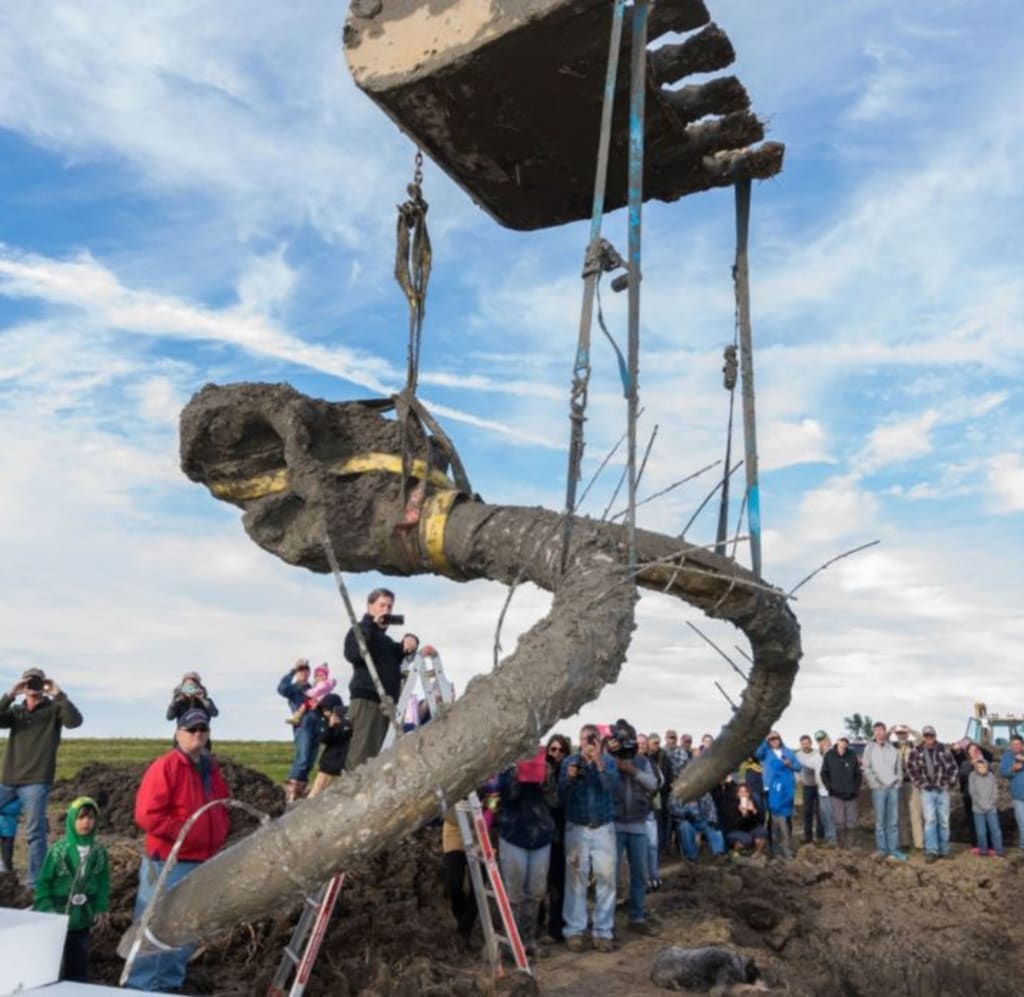
In 2015 an extraordinary discovery on a Michigan farm provided a rare glimpse into Earth's ancient history. James Bristle a farmer from Lima Township was digging a natural gas line on his property when he struck something unusual. What he initially thought was a bent piece of wood turned out to be the skull and massive tusks of a woolly mammoth a species that once roamed vast regions of North America during the Ice Age.
The skull along with its impressive curved tusks was carefully excavated and lifted onto a trailer marking a moment of awe and excitement for archaeologists paleontologists and history enthusiasts around the world. This finding not only highlighted the rich prehistoric life that once thrived in North America but also provided crucial insights into the environment and ecosystems of the past.
The Magnificent Mammoths
Mammoths were majestic elephant like mammals that lived during the Pliocene Epoch starting about 4.8 million years ago and survived until roughly 3,500 to 4,000 years ago in isolated regions such as Wrangel Island in the Arctic Ocean. These creatures were adapted to the cold climates of the Ice Age sporting thick layers of fat and a dense woolly coat that protected them from freezing temperatures. Their large curved tusks could grow up to 15 feet long and were used for defense digging through snow to find food and perhaps even for dominance displays among males. The woolly mammoth (Mammuthus primigenius) is the most famous species but mammoths came in various forms and sizes depending on where they lived.
Interestingly despite their ancient extinction mammoths lived relatively recently in Earth's timeline. Some populations coexisted with early humans and there is evidence that human hunting and environmental changes contributed to their decline.
The Michigan Discovery A Rare Find
The discovery on Bristle's farm is considered one of the most significant finds in the state of Michigan. The University of Michigan quickly dispatched a team of paleontologists led by Professor Daniel Fisher to the site. Over a few intensive days they excavated not just the skull and tusks but also other bones including vertebrae and ribs. What made this discovery even more fascinating was the suggestion that early humans might have played a role in the mammoth's death. Marks found on the bones hinted at the possibility that humans had butchered the animal for food suggesting it was not simply a natural death. If confirmed this would add to the growing body of evidence showing that ancient humans in North America were interacting with hunting and utilizing mammoths much earlier than previously thought.
Why Mammoth Discoveries Matter
Every mammoth discovery adds valuable pieces to the puzzle of Earth's prehistoric climate, ecosystems and human migration patterns. The bones and tusks can tell scientists about the animal's age health and even what it ate during its lifetime. Chemical analysis of mammoth tusks can reveal migration patterns and environmental conditions over decades of the animal’s life.
Moreover sites like the Bristle farm provide a rare opportunity to understand how ancient humans lived. Discoveries of tools cut marks on bones and nearby artifacts can show how early societies hunted scavenged and adapted to their environments. In the broader context studying mammoths also offers clues about extinction a topic of urgent relevance today. Understanding how climatic shifts and human activity led to the mammoth’s extinction can inform conservation efforts for modern species facing similar threats. Standing before the massive skull and tusks of a mammoth it’s impossible not to feel a deep connection to the Earth’s distant past. These creatures once roaming in vast herds across the frozen landscapes of the Ice Age are a reminder of the planet’s ever changing history and humanity’s place within it. The Michigan mammoth discovery is not just a story about an ancient animal it’s a bridge between eras. It invites us to imagine a world where humans armed only with stone tools faced towering giants of fur and bone. It challenges us to consider the delicate balance of nature and how easily monumental species can vanish from the face of the Earth. James Bristle’s find is a testament to the wonders lying hidden beneath our feet waiting to reveal the incredible stories of a world long gone but never forgotten.
About the Creator
Adnan Rasheed
Author & Creator | Writing News , Science Fiction, and Worldwide Update| Digital Product Designer | Sharing life-changing strategies for success.
Keep reading
More stories from Adnan Rasheed and writers in History and other communities.
What Happened to American Soldiers After the End of World War II
What Happened to American Soldiers After the End of World War II When World War II ended in 1945, millions of American soldiers, sailors, and airmen were scattered across Europe, the Pacific, and other parts of the world. Bringing them home and transitioning them back into civilian life was a massive challenge for the U.S. government. Yet, the process of demobilization, although complex and sometimes frustrating, is remembered largely as a great success. It changed countless lives and shaped the postwar world.
By Adnan Rasheed11 months ago in History
The Reluctant Nationalist
In the turbulent history of South Asia’s struggle against colonial rule, few figures stand as uniquely as Abdul Ghaffar Khan. Known to many as the “Frontier Gandhi,” Khan was a Pashtun leader who devoted his life to nonviolence, social reform, and the dignity of his people. Yet what makes his story even more remarkable is that he was often described as a “reluctant nationalist.” Rather than chasing political power or personal glory, Abdul Ghaffar Khan saw nationalism as a responsibility forced upon him by the suffering of his people.
By Irshad Abbasi 2 days ago in History
My First Time Skiing and I Got Lost, Alone, in the French Alps
Looking back, I can trace some of my life’s biggest adventures to a simple action from my sister. She’d introduced me to Tommy (a very long time ago), a colleague of hers, who had overshared his penchant for Italian-looking women, and I ticked that box.
By Chantal Christie Weiss2 days ago in Humans




Comments
There are no comments for this story
Be the first to respond and start the conversation.