
Artificial Intelligence Solves One of Archaeology’s Greatest Puzzles.
How Machine Learning and Ancient Mysteries Are Merging to Rewrite Human History

Artificial Intelligence Solves One of Archaeology’s Greatest Puzzles.
For centuries archaeology has been a discipline built on patience careful excavation and painstaking analysis. Every shard of pottery ancient inscription and ruined structure tells a story but understanding these fragments often requires years if not decades of study. Today however a new player has entered the field Artificial Intelligence (AI). In a groundbreaking development AI has recently helped solve one of archaeology’s greatest puzzles revolutionizing the way we uncover humanity’s ancient past. One of the most elusive challenges in archaeology has been the deciphering of ancient scripts. Languages like Egyptian hieroglyphs were famously decoded with the help of the Rosetta Stone but many others such as Linear A the Indus Valley script and early Mesoamerican glyphs have remained stubbornly mysterious. Traditional methods of decipherment often rely on finding bilingual inscriptions or large amounts of contextual material luxuries that are not always available.
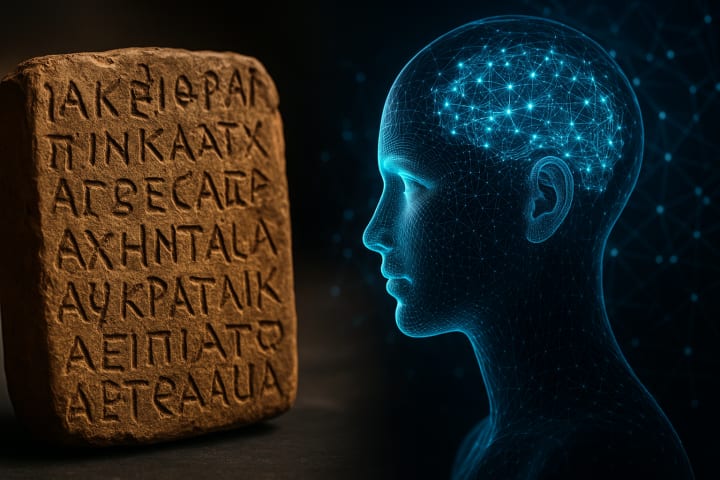
Recently researchers used AI to make a significant breakthrough with a previously undeciphered ancient script. Through advanced machine learning algorithms they were able to analyze patterns grammatical structures and potential phonetic values leading to a partial but unprecedented understanding of the language. This achievement not only sheds light on the culture that used the script but also opens new avenues for studying other undeciphered texts worldwide.
How AI Achieved the Impossible
The key to AI’s success lies in its ability to process massive datasets far faster and more accurately than any human ever could. Using deep learning models researchers trained AI systems on known languages and scripts. The algorithms learned how different languages evolve over time how symbols are used and how grammatical structures are built. Once trained the AI was presented with thousands of fragments of the ancient script. It compared symbol frequencies analyzed the spatial distribution of characters and even predicted likely syntactic structures. Importantly the system didn’t require a Rosetta Stone to make connections it leveraged statistical models to hypothesize meanings and functions of words and sentences. The AI’s findings were then cross referenced by human experts in ancient languages who verified that many of its hypotheses made linguistic and cultural sense. This collaboration between AI and human expertise proved to be the magic formula for cracking the code. This success represents more than just a single victory it signals a new era for archaeology. AI is not replacing human archaeologists rather it is becoming an indispensable tool that complements traditional methods. Tasks that once took lifetimes can now be accomplished in a fraction of the time. AI can scan satellite images to find lost cities reconstruct damaged artifacts digitally and even predict where undiscovered ruins might be located.
For example another project used AI to analyze aerial and satellite imagery to detect subtle land formations invisible to the naked eye. This method has already led to the discovery of previously unknown Roman roads Mayan temples and ancient irrigation systems many hidden beneath dense forests or modern developments.
Ethical and Practical Considerations
While the potential is thrilling it also raises important ethical and practical considerations. Data biases misinterpretations and over reliance on technology could lead to errors or misunderstandings of the past. Archaeology is deeply tied to culture identity and heritage and the human element the ability to contextualize findings emotionally and historically remains vital. Furthermore questions arise about who controls the AI models and the information they uncover. There is a growing need for guidelines ensuring that AI powered discoveries are shared responsibly and that local communities connected to these ancient sites are respected and involved in the interpretation process. The fusion of AI and archaeology is still in its early stages but the possibilities seem limitless. Researchers envision AI models that can not only translate texts but also simulate ancient spoken languages reconstruct virtual cities and even predict the lives of ordinary people based on historical patterns. Imagine walking through a digital reconstruction of an ancient marketplace hearing the buzz of long forgotten languages restored by AI or reading lost poems written thousands of years ago. These once impossible dreams are now within reach. In solving one of archaeology’s greatest puzzles AI has not only unlocked a lost chapter of human history but has also paved the way for countless more discoveries. As we stand at this new frontier one thing is clear the past once buried and silent is finding its voice again thanks to the intelligent machines of the present.
About the Creator
Adnan Rasheed
Author & Creator | Writing News , Science Fiction, and Worldwide Update| Digital Product Designer | Sharing life-changing strategies for success.
Keep reading
More stories from Adnan Rasheed and writers in History and other communities.
900 Year Old Crusader Sword Discovered Off Israel’s Coast A Glimpse Into the Medieval Past
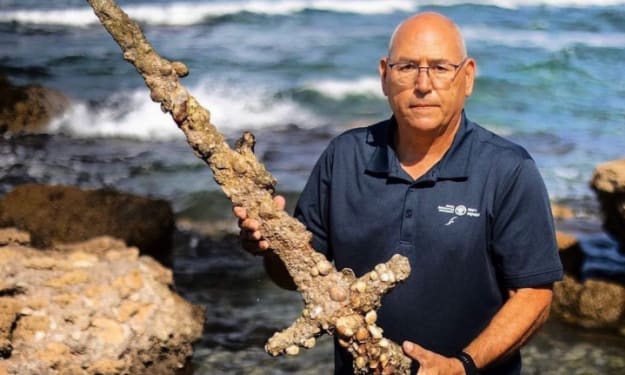
900 Year Old Crusader Sword Discovered Off Israel’s Coast A Glimpse Into the Medieval Past In October 2021 an extraordinary archaeological discovery was made off the northern coast of Israel a 900 year old Crusader sword lying on the seabed encrusted with marine life and remarkably well preserved after centuries underwater. This iron sword measuring just under four feet in length is believed to have belonged to a Crusader knight who was journeying to the Holy Land around 1100 AD during the early years of the Crusades. The find has captivated historians and the public alike offering a tangible link to a pivotal era in medieval history. The sword was found by Shlomi Katzin a recreational diver from the town of Atlit. While exploring a popular diving site near Haifa he came across ancient stone and metal anchors pottery fragments, and finally a sword covered in marine organisms. Understanding the significance of the object and the risk of it being buried again by sand or taken by looters Katzin retrieved the artifact and immediately contacted Israel's Antiquities Authority (IAA). Upon examination the IAA confirmed the sword to be approximately 900 years old. It was discovered in a natural anchorage used by ships since ancient times. The site had been monitored by the IAA due to its archaeological richness but the sword had only recently become visible due to shifting sands.
By Adnan Rasheed11 months ago in History


Comments
There are no comments for this story
Be the first to respond and start the conversation.