
How Planet Smashing Collisions Stole Earth’s Life Essential Elements
Discover how ancient cosmic collisions stripped Earth of vital elements like carbon and nitrogen and why it made life on our planet so rare and precious.

How Planet Smashing Collisions Stole Earth’s Life Essential Elements
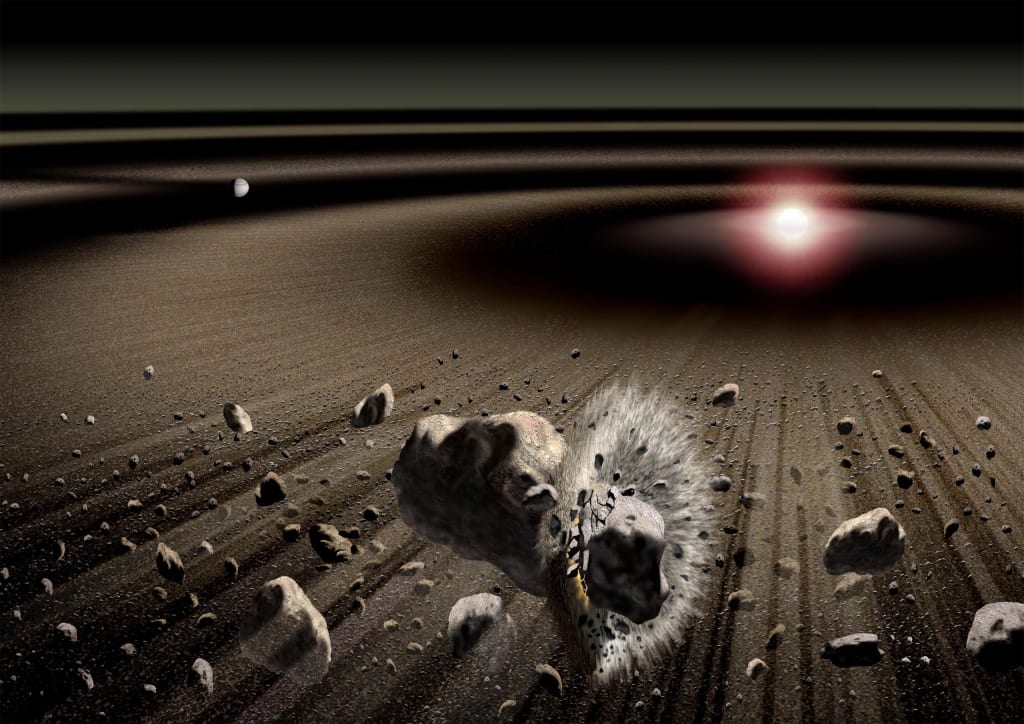
The Earth teeming with life and natural beauty is a product of billions of years of cosmic evolution. But many people are unaware that the very elements critical to sustaining life such as carbon nitrogen and sulfur might have once been much more abundant here. Intriguingly recent scientific research suggests that planet smashing collisions in the early solar system might have robbed Earth of a significant portion of these vital ingredients. Understanding this cosmic theft offers deep insights into how rare and precious life on Earth truly is. The early solar system was a chaotic violent place. After the Sun formed about 4.6 billion years ago countless rocky bodies planetesimals orbited around it frequently crashing into one another. These collisions played a crucial role in building the planets including Earth. However they were not always constructive. Some impacts were so massive that they did not add material but instead stripped planets of their outer layers vaporizing minerals and elements critical to life. One particularly famous collision is the hypothesized giant impact that led to the formation of the Moon. Scientists believe that a Mars sized body named Theia slammed into the early Earth about 4.5 billion years ago. The debris from this cataclysmic event coalesced into the Moon. However it wasn’t just the Moon that formed. The violent energy of the impact also likely vaporized significant amounts of Earth's surface material sending essential volatile elements such as water carbon and nitrogen hurtling into space. Modern Earth is relatively poor in volatile elements compared to what scientists would expect based on the original building blocks of the solar system which are preserved in primitive meteorites known as chondrites. These meteorites are rich in carbon nitrogen sulfur and other life essential materials. Given that the early Earth should have started with a similar composition scientists have long wondered where did all the volatiles go? The idea that massive impacts could have vaporized and ejected these elements into space offers a compelling explanation. Studies using computer simulations show that high energy collisions could easily strip away a planet’s atmosphere and upper crust both of which would have contained high concentrations of volatile elements. In particular elements with low boiling points like carbon and sulfur would have been especially vulnerable to being lost during such catastrophic events.
Rebuilding a Life Friendly Earth
If Earth lost so many essential elements early in its history how did it become such a hospitable place for life? One theory suggests that after the era of giant impacts Earth was reseeded with life-essential elements. As the chaos of planet formation died down smaller objects rich in volatile materials bombarded Earth in what is known as the Late Heavy Bombardment about 4 billion years ago. Asteroids and comets laden with water carbon compounds and nitrogen crashed into the planet replenishing the supplies that had been lost. This cosmic delivery service may have provided Earth with enough of the necessary ingredients to set the stage for life to eventually emerge. Understanding how planet smashing collisions can strip planets of their life essential elements has huge implications for the search for life elsewhere in the universe. Many exoplanets discovered by astronomers appear to have undergone similarly violent histories. Some of them might have lost too much of their volatile content making them barren and inhospitable despite being located in the so called habitable zone around their stars. It also underscores how special Earth's history may have been. Not only did Earth survive the violent early years but it also managed to retain or regain enough volatile elements to develop oceans an atmosphere and a biosphere.
A Precious Balance
The story of Earth’s missing elements is a reminder of the delicate balance that underpins our existence. Our planet’s ability to host life is not simply a matter of being the right distance from the Sun or having the right size. It is also a story of surviving and recovering from cataclysmic events that could have easily rendered it lifeless. Without the massive yet oddly fortunate sequence of collisions and reseeding Earth might have ended up a dry barren world like Mercury or the Moon. Instead against the odds it became a vibrant oasis in a vast mostly inhospitable universe. As scientists continue to study ancient rocks simulate planetary formation and explore distant worlds we will undoubtedly learn even more about how rare and precious Earth's life supporting environment truly is. For now the lesson is clear cosmic violence shaped the cradle of life but it could have just as easily destroyed the potential for life before it even began.
About the Creator
Adnan Rasheed
Author & Creator | Writing News , Science Fiction, and Worldwide Update| Digital Product Designer | Sharing life-changing strategies for success.
Keep reading
More stories from Adnan Rasheed and writers in Earth and other communities.
NASA Releases Most Stunning Mars Footage Yet Captured from 140 Million Miles Away
NASA Releases Most Stunning Mars Footage Yet Captured from 140 Million Miles Away In a monumental leap for space exploration and planetary science NASA has released the clearest and most detailed footage ever captured of Mars despite the Red Planet being approximately 140 million miles away from Earth. This new footage taken by the Perseverance and Curiosity rovers reveals stunning views of Martian landscapes in unprecedented detail showcasing everything from rocky terrains and ancient riverbeds to massive craters and mountainous ridges. This release is more than just a visual treat it is a scientific breakthrough that has the potential to change our understanding of Mars its history and its potential to support life past or present. The high definition video and images were captured using advanced imaging systems aboard the Perseverance and Curiosity rovers. NASA’s Perseverance rover which landed on Mars in February 2021 is equipped with Mastcam-Z a camera system capable of capturing 3D high resolution color images and videos. Similarly the Curiosity rover uses its Mast Camera (Mastcam) and the Mars Hand Lens Imager (MAHLI) to capture intricate details of the Martian surface. The conditions during the time of recording were ideal with exceptionally clear Martian skies and minimal dust interference enabling the rovers to transmit sharp high resolution images back to Earth. These visuals give scientists and space enthusiasts alike a crystal clear view of Mars’ terrain comparable to drone footage from Earth.
By Adnan Rasheed10 months ago in Earth
Scientists Probe How Long-Term Spaceflight Alters Immunity
On Earth, a human body with a properly functioning immune system will work to overcome an infection. But in space, that same immune system will have to work a bit harder to overcome the same infection. In the isolated environment of the International Space Station, many factors — physiological stress, disrupted circadian rhythms, radiation, microgravity, and other spaceflight factors — can alter an astronaut’s immune response.
By Voice of Reality6 days ago in Earth
Review of 'Man on the Run'
My wife and I saw Man on the Run, a nearly 2-hour documentary on Amazon Prime, about Wings, Paul McCartney's group that flew around the world from shortly after The Beatles broke up in early 1970 to shortly after John Lennon was murdered at the end of 1980, making a Beatles reunion forever impossible.
By Paul Levinson5 days ago in Beat




Comments (1)
Very interesting article and well written.