politics
Politics does not dictate our collective cultural mindset as much as it simply reflects it; We've got to look in the mirror sometimes, and we've got one.
Quote of the Day by Plato: “Do Not Train a Child to Learn by Force or Harshness, but Direct Them to It by What…”. AI-Generated.
Education has always been at the heart of societal progress, but few thinkers have captured its essence as eloquently as the ancient Greek philosopher Plato. Among his many reflections, one quote stands out for its profound insight into human development: "Do not train a child to learn by force or harshness, but direct them to it by what amuses their minds, so that you may be better able to discover with accuracy the peculiar bent of the genius of each." This quote, though centuries old, resonates as strongly today as it did in Plato’s time, offering guidance not just for parents and teachers but for anyone invested in nurturing human potential. The Philosophy Behind the Words Plato’s approach to education emphasizes guidance over coercion. He suggests that learning should never be imposed through fear, pressure, or punishment. Instead, children should be gently guided toward knowledge by appealing to their natural curiosity and interests. By doing so, their unique talents and inclinations—the “peculiar bent of the genius”—can be discovered and nurtured. This philosophy underscores a timeless truth: motivation driven by interest and joy is far more effective than learning through force. Modern psychology and educational research support this view. Studies consistently show that intrinsic motivation—when a student learns because they are genuinely interested—leads to deeper understanding, better retention, and long-term engagement. Application in Modern Education In classrooms around the world, educators are increasingly moving away from rigid, standardized approaches to teaching. Traditional methods that prioritize rote memorization and high-stakes testing often fail to engage students meaningfully. Plato’s wisdom reminds us that education should adapt to the learner, not the other way around. For instance, project-based learning, experiential activities, and creative assignments all reflect Plato’s principle of learning through engagement and curiosity. By allowing students to explore topics they are passionate about, teachers can uncover hidden talents and foster a love for learning that persists beyond the classroom. Parenting and Child Development Plato’s advice is equally relevant in the home. Parents often face the challenge of encouraging their children to learn and develop skills while avoiding the trap of overbearing control. When children are forced into activities they dislike or pressured excessively, they may develop resistance, anxiety, or a negative attitude toward learning. By contrast, guiding children toward learning experiences that intrigue and excite them can produce remarkable outcomes. For example, a child fascinated by building blocks might develop early skills in engineering or architecture, while a young reader drawn to storytelling might cultivate literary creativity. Parents who observe, nurture, and gently direct their children’s interests are more likely to see them flourish in their unique ways. The Broader Implications for Society Plato’s insight is not only about individual growth but also about the kind of society we wish to build. A culture that values curiosity, creativity, and the discovery of personal talents produces citizens who are more innovative, empathetic, and adaptable. Societies that impose rigid norms and punish deviation risk stifling potential and discouraging independent thought. By fostering environments—both in schools and at home—where learning is guided by curiosity rather than force, communities can cultivate the next generation of thinkers, problem-solvers, and leaders. Plato’s words remind us that education is not just the transmission of knowledge but a process of uncovering the unique gifts within each individual. Practical Steps for Applying Plato’s Wisdom Encourage exploration: Allow children to explore multiple subjects and activities without judgment or pressure. Observe and listen: Pay attention to what excites them, and notice where their skills naturally shine. Make learning engaging: Use games, stories, experiments, and hands-on projects to make education enjoyable. Celebrate effort, not just results: Recognize curiosity, persistence, and creativity as much as grades or achievements. Be patient and flexible: Understand that learning is a journey, not a race, and each child progresses at their own pace. Conclusion Plato’s timeless advice reminds us that the heart of education lies not in coercion, but in inspiration. Children, when guided by curiosity and joy, reveal their natural abilities and develop a lifelong love of learning. His words continue to challenge educators, parents, and policymakers to rethink rigid systems and focus instead on nurturing the genius within each child. In a world increasingly driven by metrics, exams, and performance, Plato’s wisdom offers a gentle, yet profound reminder: the true measure of education is not how much we force children to learn, but how effectively we guide them to discover, explore, and grow in ways that resonate with their unique potential.
By Fiaz Ahmed Brohi13 days ago in The Swamp
‘A New Maritime Record: South America’s 2,100-Passenger, Fully Electric Giant Sets Sail’. AI-Generated.
South America has officially entered a new era in maritime travel. The continent’s first fully electric cruise ship, capable of carrying 2,100 passengers, has set sail, breaking new records and redefining what is possible for sustainable tourism. This groundbreaking vessel, hailed by experts as a technological marvel, marks a significant step forward in the global movement toward eco-friendly shipping, where efficiency, comfort, and environmental responsibility converge. A Giant on the Water Measuring an impressive length and featuring state-of-the-art amenities, the ship is not only a symbol of South America’s growing maritime industry but also a testament to innovative engineering. Unlike traditional cruise ships that rely heavily on fossil fuels, this fully electric giant operates on cutting-edge battery technology. It boasts multiple high-capacity lithium-ion battery banks, allowing for extended journeys without generating carbon emissions. The ship’s design is optimized for energy efficiency. Hydrodynamic hulls reduce drag, while solar panels and energy recovery systems maximize renewable power usage. Experts say this combination of technology allows the vessel to cruise smoothly while minimizing its environmental footprint—a critical advancement for the heavily trafficked waters of the South Atlantic and the Caribbean. Sustainable Travel Meets Luxury Despite its emphasis on sustainability, the ship does not compromise on passenger experience. It features spacious cabins, panoramic observation decks, gourmet dining, entertainment lounges, and wellness centers. The vessel can accommodate 2,100 passengers and a crew of 850, providing a seamless balance between luxury and environmental responsibility. For many travelers, the ship represents an exciting opportunity to explore South America’s breathtaking coastlines—from the pristine beaches of Brazil to the dramatic fjords of Chile—without contributing to the pollution typically associated with maritime travel. Industry analysts note that eco-conscious tourism is growing rapidly, and this vessel could set a precedent for future cruise ship development worldwide. Innovation at the Core What makes this maritime achievement particularly notable is the combination of scale and technology. Electrically powered ships have existed for smaller routes or ferries, but building a vessel of this size capable of long-range voyages has been a formidable engineering challenge. Developers overcame obstacles such as energy density, battery weight, and charging infrastructure to bring the project to life. Port authorities across South America have also invested in electric charging stations, ensuring the ship can operate efficiently while docking at major destinations. These developments create a blueprint for future ports and maritime operations, potentially accelerating the adoption of electric technology in global shipping. Environmental and Economic Impacts Beyond passenger travel, the ship represents an important environmental milestone. Maritime shipping contributes significantly to global greenhouse gas emissions, and the introduction of large electric vessels signals a shift in industry priorities. By demonstrating that large-scale, emission-free vessels are feasible, this project encourages governments, investors, and shipping companies to rethink their strategies for sustainable maritime operations. Economically, the ship is expected to boost South American tourism, attracting travelers keen on eco-friendly vacations. Its routes are designed to connect major coastal cities and scenic locales, creating opportunities for local businesses, cultural tourism, and regional development. Experts argue that sustainable tourism, combined with innovative engineering, could provide both environmental and economic dividends for decades to come. Challenges Ahead While the launch has been celebrated globally, experts caution that challenges remain. Battery technology, although advanced, still faces limitations regarding range and charging time. Additionally, large-scale implementation of electric vessels will require significant investment in port infrastructure and maintenance. Regulatory standards for electric cruise ships are also evolving, requiring collaboration between governments, industry, and environmental agencies to ensure safe and effective operations. Nevertheless, the launch of this 2,100-passenger electric cruise ship marks a historic moment for South America and the global maritime industry. It demonstrates the feasibility of combining luxury, sustainability, and large-scale maritime engineering—offering a glimpse of the future for ocean travel. A Glimpse into the Future As the ship embarks on its maiden voyage, passengers, engineers, and environmentalists alike are witnessing the beginning of a new chapter in maritime history. Its presence challenges the status quo, signaling that the era of carbon-heavy cruising may be nearing its end. The success of this vessel could inspire similar projects around the world, bringing sustainable innovation to the forefront of the global shipping industry. Ultimately, this fully electric giant is more than just a cruise ship—it is a symbol of ambition, technological ingenuity, and a growing commitment to protecting the oceans while offering unforgettable experiences to travelers. With 2,100 passengers aboard, it is setting sail not only across the seas but also into a cleaner, greener future for maritime travel.
By Fiaz Ahmed Brohi13 days ago in The Swamp
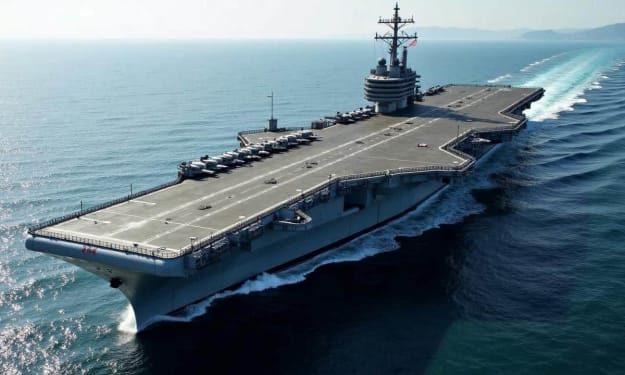
With Its 337 Meters and 100,000 Tons, the World’s Largest Aircraft Carrier Rules the Oceans. AI-Generated.
Stretching an astonishing 337 meters in length and weighing close to 100,000 tons, the world’s largest aircraft carrier is not just a ship—it is a floating symbol of modern military power, engineering excellence, and global influence. Often described as a mobile airbase at sea, this colossal vessel dominates the oceans, reshaping how naval warfare, diplomacy, and power projection are conducted in the 21st century. A Giant of the Seas To grasp the scale of this aircraft carrier, comparisons help. At 337 meters, it is longer than three football fields placed end to end. Its displacement of around 100,000 tons makes it heavier than many skyscrapers combined. Powered by advanced nuclear reactors, the carrier can operate for decades without refueling, allowing it to remain at sea for extended missions across the globe. This immense size is not for spectacle alone. The carrier is designed to support a full air wing of more than 70 aircraft, including fighter jets, early warning planes, helicopters, and unmanned aerial systems. Its flight deck is a carefully choreographed space where aircraft take off and land every few minutes, day and night, in all weather conditions. Engineering at Its Finest Building such a vessel is one of the most complex engineering challenges humanity has mastered. Thousands of engineers, technicians, and naval architects work for years to bring an aircraft carrier to life. From its reinforced steel hull to its advanced radar systems, every component is designed to withstand extreme conditions, including rough seas, combat damage, and long-term deployment. The nuclear propulsion system is a defining feature. Unlike conventional ships, this carrier does not rely on diesel or gas fuel. Its reactors generate enormous power, not only for propulsion but also for onboard systems such as radar, weapons, and aircraft launch mechanisms. This allows the ship to reach high speeds and maintain them over vast distances without logistical constraints. A Floating City Life aboard the world’s largest aircraft carrier resembles that of a small city. More than 5,000 sailors and aviators live and work on the ship during deployments. There are sleeping quarters, medical facilities, kitchens capable of serving thousands of meals a day, gyms, and even onboard shops. The crew operates around the clock, ensuring that the carrier remains combat-ready at all times. Pilots train continuously, engineers maintain critical systems, and command staff coordinate operations that may span multiple regions. Discipline, precision, and teamwork are essential, as a single mistake on such a complex platform can have serious consequences. Power Projection and Global Influence Beyond its technical marvels, the true significance of the world’s largest aircraft carrier lies in its strategic role. Wherever it sails, it sends a powerful message. An aircraft carrier strike group—typically consisting of destroyers, cruisers, submarines, and supply ships—represents one of the most formidable military forces on Earth. This capability allows its operator to respond rapidly to crises, whether through combat operations, humanitarian assistance, or deterrence. From disaster relief missions to enforcing no-fly zones, aircraft carriers offer unmatched flexibility. Their presence alone can influence diplomatic negotiations, reassure allies, or discourage potential adversaries. Changing the Nature of Warfare Modern aircraft carriers have evolved far beyond their World War II predecessors. Advanced sensors, stealth aircraft, electronic warfare systems, and missile defenses have transformed them into highly resilient platforms. The integration of unmanned systems is further expanding their reach, allowing surveillance and strike missions without putting pilots at risk. However, the rise of advanced anti-ship missiles and submarine technologies has also sparked debate. Critics argue that such massive vessels are vulnerable targets in high-intensity conflicts. Supporters counter that layered defenses, mobility, and escort fleets make aircraft carriers far more survivable than they appear. A Symbol of National Ambition Possessing the world’s largest aircraft carrier is also a matter of prestige. It reflects a nation’s industrial capacity, technological sophistication, and long-term strategic vision. Only a handful of countries have the resources and expertise to build and operate such ships, making them exclusive symbols of great-power status. For the public, these carriers often capture the imagination. Images of jets launching from their decks, crews working in synchronized precision, and the sheer scale of the vessel inspire awe and curiosity, reinforcing their status as icons of modern naval power. Conclusion At 337 meters long and weighing around 100,000 tons, the world’s largest aircraft carrier truly rules the oceans. It is a masterpiece of engineering, a floating city, and a central pillar of modern military strategy. While debates continue about the future of naval warfare, one thing remains clear: as long as nations seek to project power, protect interests, and influence global events, these colossal carriers will remain at the heart of maritime dominance.
By Fiaz Ahmed Brohi13 days ago in The Swamp
Trump Is Briefed on Options for Striking Iran as Protests Continue. AI-Generated.
As anti-government protests erupt across Iran and tensions escalate between Tehran and Washington, U.S. President Donald Trump has been officially briefed on a range of potential military options, including the possibility of striking Iranian targets if the situation worsens. The discussions reflect a dramatic moment in international relations, as unrest in Iran merges with long-standing disputes over its political system, nuclear ambitions and regional influence. �
By Fiaz Ahmed Brohi13 days ago in The Swamp
Russian Warship Escorts Sanctioned Ship Near NATO—Days After US Seized a Similar One. AI-Generated.
A Russian warship escorting a sanctioned cargo vessel through sensitive waters near NATO territory has reignited global tensions, coming just days after the United States seized a similar ship accused of violating international sanctions. The incident underscores the growing risks at sea as global powers increasingly enforce economic pressure through naval presence, turning commercial shipping lanes into geopolitical flashpoints. A Show of Force at Sea According to defense observers, the Russian Navy deployed a surface combat vessel to accompany a merchant ship flagged for alleged sanctions violations. The escorted vessel reportedly passed close to NATO-monitored waters, triggering heightened surveillance by alliance forces. While no direct confrontation occurred, the message was unmistakable: Moscow is willing to use military power to protect its economic lifelines. The timing is critical. Only days earlier, U.S. authorities seized a ship suspected of transporting sanctioned oil, an action Washington framed as lawful enforcement of international restrictions. Moscow, however, views such seizures as economic warfare. By sending a warship to escort a sanctioned vessel, Russia appears to be signaling that it will not allow similar actions against its interests without resistance. Sanctions and the Shadow Fleet Since the escalation of the Ukraine conflict, Western nations have imposed sweeping sanctions on Russian energy exports, targeting oil tankers, shipping companies, and financial networks. In response, Russia and its partners have relied increasingly on what analysts call a “shadow fleet” — aging tankers operating under opaque ownership structures and alternative insurance arrangements to bypass restrictions. These vessels often sail through strategically vital maritime corridors, including the Baltic Sea, Black Sea, and Mediterranean routes. NATO navies closely monitor such movements, creating a tense environment where miscalculation could quickly escalate. The Russian escort suggests a new phase in this maritime standoff: sanctions enforcement backed not just by law, but by naval power on both sides. NATO’s Delicate Balancing Act For NATO, the situation presents a serious challenge. Alliance forces are tasked with monitoring suspicious shipping while avoiding direct clashes with Russian military assets. Any aggressive move against a convoy protected by a Russian warship could spark an international crisis. NATO officials have emphasized restraint, noting that international waters remain open to lawful navigation. Still, surveillance aircraft, naval patrols, and intelligence assets were reportedly deployed to track the Russian escort mission closely. “This is about deterrence without provocation,” one defense analyst noted. “Both sides are testing boundaries, but neither wants to be the one blamed for igniting a wider conflict.” Echoes of Cold War Naval Tensions The incident has drawn comparisons to Cold War-era naval brinkmanship, when U.S. and Soviet warships routinely shadowed each other across the world’s oceans. Then, as now, maritime encounters carried enormous symbolic weight. However, today’s environment is arguably more complex. Unlike Cold War standoffs, modern confrontations involve commercial vessels, sanctions law, and economic warfare intertwined with military posturing. A misstep involving a civilian ship could have legal, humanitarian, and strategic consequences. Russia’s Strategic Message By escorting a sanctioned ship so visibly, Russia is sending several messages at once. Domestically, it signals strength and defiance against Western pressure. Internationally, it warns that enforcement actions against Russian-linked shipping may face armed resistance. The move also reassures partners and buyers that Moscow is committed to keeping its trade routes open, even under sanctions. For countries still purchasing Russian energy, naval escorts may offer a form of security—albeit one that raises the stakes considerably. A Dangerous Precedent? Western analysts worry that such escorts could normalize the militarization of sanctions evasion. If more sanctioned states begin using warships to shield commercial vessels, the world’s busiest shipping lanes could become zones of permanent tension. The United States and its allies have so far avoided intercepting vessels under direct military escort, preferring legal seizures when ships are isolated. But as escorts become more common, the room for enforcement narrows. What Comes Next? While the immediate incident ended without confrontation, it highlights a troubling trend: economic disputes increasingly playing out at sea, backed by naval power. As sanctions tighten and enforcement grows bolder, similar encounters are likely to become more frequent. The challenge for global powers will be preventing these encounters from spiraling into open conflict. For now, warships shadowing sanctioned tankers serve as a stark reminder that the world’s oceans are no longer just trade routes—they are front lines in a widening geopolitical struggle.
By Fiaz Ahmed Brohi13 days ago in The Swamp
Trump’s Actions May Be Illegal — But His Greed Might Be the Only Thing Holding Him Back. AI-Generated.
In American politics, few figures provoke as much controversy, outrage, and relentless fascination as Donald Trump. Years after entering the political arena, he remains a dominant force not only in elections and headlines, but also in courtrooms and public debate. Legal scholars, journalists, and watchdog groups have repeatedly argued that many of Trump’s actions — both during his presidency and after — crossed clear legal and ethical lines. From election interference claims to allegations of abusing executive power, mishandling classified information, and entangling public office with private business interests, the accusations against Trump are neither isolated nor trivial. They form a pattern that critics say reveals a leader willing to push, bend, or outright ignore the law when it suits him. And yet, paradoxically, Trump has not gone as far as many of his harshest critics once feared. The reason may not be respect for democratic norms or fear of legal accountability — but something far more personal: his own greed. This is not a defense of Trump’s conduct. Rather, it is an attempt to understand a reality that even some of his opponents quietly acknowledge. Trump’s obsession with personal wealth, brand image, and financial survival may sometimes limit how far he is willing to go, even when legality appears optional. A Pattern of Questionable Legality Trump’s political career has been accompanied by an almost constant cloud of legal scrutiny. Investigations have examined campaign finance violations, obstruction of justice, business fraud, election interference, and misuse of power. Unlike many politicians who rely on subtlety or plausible deniability, Trump often operates in full public view, openly testing the boundaries of what he can get away with. His response to legal challenges is also strikingly consistent. He rarely engages with the substance of allegations. Instead, he frames investigations as politically motivated “witch hunts” and portrays prosecutors, judges, and journalists as enemies of the people. This narrative has proven effective with his base, many of whom see legal accountability not as justice, but as persecution. The brazenness of this strategy has led critics to argue that Trump believes himself above the law. And yet, despite his rhetoric, he has repeatedly stopped short of actions that would create immediate, irreversible consequences. The question is why. The Central Role of Money and Brand To understand Trump’s restraint, one must understand how he sees himself. Trump has never primarily viewed himself as a public servant or ideological leader. His core identity is that of a businessman and brand. Trump’s wealth — or at least the perception of it — is central to his political power. His properties, licensing deals, fundraising apparatus, and media presence all depend on the image of success. Politics, for Trump, has never been separate from profit. It is another platform for monetization and self-promotion. Unlike leaders driven by ideology, nationalism, or historical legacy, Trump’s decisions often reflect a simple cost-benefit calculation. Actions that threaten his brand value, fundraising ability, or business empire are approached with caution. Actions that energize supporters without endangering his financial interests are embraced enthusiastically. This explains a recurring pattern: Trump escalates rhetorically, but hesitates operationally. He may use inflammatory language, encourage outrage, or flirt with extreme ideas, but often stops short of moves that would directly and permanently damage his wealth. Greed as a Limiting Force Greed is typically viewed as a corrupting influence, and in many ways, it is. But in Trump’s case, it also functions as a brake. Absolute power, while tempting, carries real risks — sanctions, asset seizures, international isolation, and loss of market confidence. Trump may dismiss institutions publicly, but he understands markets instinctively. He knows investors flee chaos, lenders demand predictability, and brands collapse under prolonged legal uncertainty. Even when he attacks courts or regulators in speeches, his actual behavior often reveals caution: delays, negotiations, settlements, and procedural maneuvering rather than outright defiance. This suggests that Trump’s greatest fear is not prison, but bankruptcy. Having faced financial collapse multiple times in the past, he appears determined never to experience it again. His greed does not eliminate risk-taking, but it shapes where he draws the line. Why This Is Not Reassuring It would be a profound mistake to find comfort in the idea that greed will protect democracy. Self-interest is not a moral safeguard; it is an unreliable and fragile one. Trump’s restraint is situational, not principled. When personal profit and political power align, the danger increases dramatically. Relying on greed rather than law also sets a dangerous precedent. Democracy should not depend on whether a powerful individual calculates that illegal actions are “bad for business.” That logic leaves institutions vulnerable to leaders with fewer assets to lose, greater tolerance for chaos, or ideological motivations stronger than personal wealth. In Trump’s case, the line is not legality — it is profitability. The Legal System Still Matters Despite its flaws and delays, the legal system has not been irrelevant in Trump’s story. Courts have imposed fines, restricted business practices, and upheld investigations despite intense political pressure. These outcomes matter, not just symbolically, but financially. Every legal loss chips away at Trump’s carefully constructed image as a “winner,” an image that underpins his fundraising and influence. Ironically, his obsession with money also makes him vulnerable. Legal accountability threatens the very thing he values most. A Calculated Balance Trump operates within a narrow corridor: push boundaries enough to energize supporters, but not so far that financial consequences become catastrophic. This balancing act explains why aggressive speeches are often followed by procedural stalling, appeals, and strategic retreats. It also explains why Trump attacks institutions rhetorically while continuing to rely on them practically. Banks, courts, and markets are not enemies he can afford to lose entirely. Conclusion Donald Trump’s legacy will likely be defined by how often he tested the limits of the law — and how inconsistently those limits restrained him. Yet one constant remains unmistakable: his devotion to personal profit. That devotion may sometimes hold him in check — not because he respects democracy, but because he values his wealth. Democracy deserves stronger guardians than greed. But for now, it remains an uncomfortable part of the equation in understanding Trump’s behavior and the risks he poses to American political life.
By Muhammad Hassan13 days ago in The Swamp
Iran Says Over 100 Officers Killed as Protesters Defy Government Crackdown. AI-Generated.
In a dramatic escalation of unrest, Iran is reporting that more than 100 security officers and personnel have been killed in clashes with demonstrators who have defied a violent government crackdown. The nationwide protests — some of the largest Iran has seen in years — have been met with intense force by state authorities, even as protesters continue to push for economic justice and political change. � Reuters +1 A Nation in Turmoil What began in late December 2025 as protests over mounting economic hardships — including soaring prices, inflation, and the collapse of the Iranian rial — quickly evolved into widespread opposition to the regime itself. Demonstrations have spread across all 31 provinces, uniting diverse segments of Iranian society in a shared display of discontent. � Le Monde.fr In response, the Iranian government has launched a harsh crackdown. Security forces, including the elite Islamic Revolutionary Guard Corps (IRGC) and police units, have deployed live ammunition, tear gas, and mass arrests to suppress dissent. A nationwide internet and communications blackout has been in effect for days, limiting independent verification of events but failing to halt the flow of information entirely. � Reuters +1 Conflicting Casualty Reports Iranian state media has highlighted fatalities among security personnel. Official reports suggest that dozens of police and security officers have been killed in clashes with protesters, describing them as casualties of violent “rioters” or coordinated attacks against state institutions. Some of these reported deaths occurred during confrontations in provinces such as Isfahan. � Al Jazeera However, independent sources paint a much broader picture of suffering. Human rights groups and activist networks estimate that the death toll — including civilian protesters — has risen significantly. According to some reports, at least 116 people have been killed overall, with thousands more arrested and hundreds wounded during the unrest. � AP News Discrepancies between state figures and those from international rights organizations make it difficult to verify the precise scale of violence. What is clear, however, is that the human cost is high — and growing. The combination of communications blackouts and state media control has made reliable reporting exceptionally challenging. � Le Monde.fr What Protesters Are Demanding The demonstrations initially centered on economic grievances, such as rising living costs and unemployment. Yet, a considerable number of protesters have shifted their focus toward political reform and even regime change. Many are calling for fundamental shifts in governance, greater freedoms, and accountability from leadership that they perceive as unresponsive and repressive. � Reddit In cities across Iran, crowds have formed in public squares, bazaars, and streets — often chanting slogans against state authorities and demanding improved living conditions. The breadth of participation demonstrates widespread frustration, cutting across age groups and social classes. � Reddit Government Response Iran’s leadership has framed the unrest as a security threat, insisting that what they term “rioters” are engaged in violent acts. Officials have issued stern warnings to foreign nations, particularly the United States and Israel, claiming external influences are at play. Some hard-line figures have even threatened retaliatory action in the event of foreign intervention. � People Daily Supreme Leader Ayatollah Ali Khamenei and other senior officials have portrayed the demonstrations as opportunistic uprisings fueled by foreign enemies intent on destabilizing Iran. Such rhetoric underscores a deepening divide between authorities and ordinary Iranians. � Financial Times The Role of Communication Blackouts One of the most significant facets of the current crisis is Iran’s near-total internet shutdown. Analysts argue this serves two purposes: obscuring the true extent of violence, and limiting the ability of protesters to organize. Groups like NetBlocks have confirmed widespread disruptions to connectivity, making independent reporting and documentation of abuses more difficult. � Reuters Despite these restrictions, videos and testimonials continue to leak online — often through VPNs, satellite connections, or foreign platforms — revealing scenes of intense street clashes, mass detentions, and military presence in urban centers. � Le Monde.fr Global Reaction International responses to the crisis have been mixed. Western nations, including the United States and members of the European Union, have condemned the violence and called for restraint. Former President Donald Trump publicly stated that the U.S. is “ready to help” Iranian protesters, a remark that was both welcomed by opposition activists and condemned by Tehran as interference. � Reuters Human rights organizations have also called for independent investigations into alleged abuses and urged Iran to lift its communication restrictions, emphasizing the need for transparency and accountability. � Le Monde.fr What Lies Ahead? With tensions continuing to escalate, Iran faces one of its most significant internal challenges in years. If protests persist and the government maintains its hard-line stance, the violence could deepen, risking a broader humanitarian crisis. Whether the state will soften its approach or double down on repression remains uncertain. As the world watches, the voices of both protesters and security personnel — their suffering, fears, and aspirations — illustrate the human toll of political unrest and the complex dynamics of power in one of the Middle East’s most influential nations.
By Fiaz Ahmed Brohi13 days ago in The Swamp
Trump’s Actions Are Illegal — But His Greed May Hold Him in Check. AI-Generated.
In American politics, few figures inspire as much debate, outrage, and fascination as Donald Trump. For years, legal scholars, journalists, and political opponents have argued that many of his actions — both in office and out — cross clear legal and ethical lines. From election interference claims to alleged misuse of power and financial conflicts of interest, the accusations are serious and persistent. Yet, paradoxically, there may be one force more powerful than law, norms, or even public pressure that restrains Trump: his own greed. This is not a defense of Trump’s conduct. Rather, it is an examination of a reality that many critics reluctantly acknowledge — Trump’s intense focus on personal wealth and brand preservation may sometimes limit how far he is willing to go, even when legality appears optional. A Pattern of Questionable Legality Trump’s political career has been marked by repeated legal challenges. Courts, prosecutors, and watchdog organizations have raised concerns about actions ranging from campaign finance violations to attempts to overturn election results. Unlike many politicians who seek plausible deniability, Trump often acts openly, publicly testing the boundaries of legality. This brazenness has led critics to argue that he believes himself above the law. His rhetoric frequently reinforces this perception, portraying investigations as “witch hunts” and prosecutors as politically motivated enemies. Such framing has proven effective with his core supporters, who often see legal accountability as persecution rather than prosecution. Still, even Trump has not been completely indifferent to consequences. The question is why. The Central Role of Money and Brand At the heart of Trump’s restraint lies his self-image — not as a public servant, but as a businessman. Trump’s wealth, properties, licensing deals, and media presence form the backbone of his identity. Politics, for him, has never been separate from profit. Unlike ideological leaders driven by belief systems or historical legacies, Trump’s decision-making often reflects a cost-benefit analysis rooted in personal gain. Actions that threaten his brand value, business empire, or fundraising potential are approached with caution. This explains why Trump frequently escalates rhetorically while hesitating operationally. He may encourage supporters with inflammatory language, but stops short of actions that would directly jeopardize his financial standing in irreversible ways. Greed as a Limiting Force Greed is typically seen as a corrupting influence, but in Trump’s case, it may also act as a brake. Total authoritarian power, while appealing in theory, comes with risks: sanctions, asset seizures, international isolation, and loss of market credibility. Trump understands markets better than institutions. He knows that investors flee instability, lenders demand predictability, and brands collapse under sustained legal uncertainty. Even if he dismisses court rulings publicly, he responds privately by delaying, negotiating, or reframing rather than outright defying them. This behavior suggests not fear of prison, but fear of bankruptcy — a fate Trump has narrowly avoided multiple times in the past and one he seems determined never to face again. Why This Is Not Reassuring It would be a mistake to take comfort in the idea that greed will save democracy. Personal financial interest is an unreliable safeguard against systemic damage. Trump’s restraint is situational, not principled. When profit and power align, the risks multiply. Moreover, relying on self-interest rather than rule of law sets a dangerous precedent. Democracy should not depend on whether a powerful individual calculates that illegal actions are “bad for business.” That logic leaves institutions vulnerable to leaders with fewer assets to lose or greater tolerance for chaos. In Trump’s case, the line is not legality — it is profitability. The Legal System Still Matters Trump’s ongoing legal battles demonstrate that institutions, while slow and imperfect, still function. Courts have imposed fines, restricted business operations, and upheld investigations despite political pressure. These outcomes matter not only symbolically but financially. Every legal loss chips away at Trump’s brand as a “winner,” a persona essential to his fundraising and political influence. Greed does not just restrain him; it also makes him vulnerable. Ironically, the same obsession with money that fuels his behavior also exposes him to accountability in ways that ideological leaders might evade. A Calculated Balance Trump operates within a narrow corridor: push boundaries enough to energize supporters, but not so far that the financial consequences become catastrophic. This balancing act explains his pattern of aggressive speech followed by procedural stalling and strategic retreats. It also explains why he often targets institutions rhetorically while continuing to rely on them practically. Banks, courts, and markets are not enemies he can afford to lose entirely. The Bigger Picture Trump’s actions may be illegal, and many argue they demand stronger consequences. But understanding what restrains him is crucial for anticipating future behavior. Greed is not a moral safeguard, but it is a practical one — and a fragile one at that. If future circumstances reduce the financial risks of illegal action, or if political power offers greater protection for wealth, that restraint could disappear. This is why strong institutions, independent courts, and clear enforcement matter more than ever. Conclusion Donald Trump’s legacy will likely be defined by how often he tested the limits of law and how rarely those limits stopped him outright. Yet, in a political landscape full of uncertainties, one constant remains: his devotion to personal profit. That devotion may hold him in check — not because he respects the law, but because he values his wealth. Democracy should demand better guardians than greed, but for now, it remains an uncomfortable part of the equation.
By Muhammad Hassan13 days ago in The Swamp