politics
Politics does not dictate our collective cultural mindset as much as it simply reflects it; We've got to look in the mirror sometimes, and we've got one.
Southern Separatists in Yemen Report Saudi Airstrikes Near Positions. AI-Generated.
Yemen’s long-running conflict has once again taken a volatile turn as southern separatist forces reported Saudi-led airstrikes near their positions, raising fresh concerns about shifting alliances and the fragile balance of power in the war-torn country. The development underscores the complexity of Yemen’s conflict, where allies can quickly become adversaries and regional powers continue to play decisive roles. A Fractured Battlefield in Southern Yemen The reported airstrikes occurred in southern Yemen, an area largely controlled by the Southern Transitional Council (STC), a separatist group that seeks independence for the south. The STC has long been backed by the United Arab Emirates and has, at times, cooperated with Saudi Arabia against the Iran-aligned Houthi movement. However, tensions between the separatists and Yemen’s internationally recognized government — itself supported by Riyadh — have persisted for years. Southern separatist officials claimed the airstrikes targeted areas close to their military deployments, sparking fears of a direct confrontation with Saudi-backed forces. While Saudi authorities have not publicly confirmed the strikes, the reports have fueled speculation that relations between Riyadh and the STC are deteriorating. Saudi Arabia’s Delicate Role Saudi Arabia entered the Yemen war in 2015 with the stated goal of restoring the internationally recognized government after Houthi forces seized the capital, Sanaa. Since then, the conflict has evolved into a multi-layered struggle involving regional rivalries, local militias, and competing visions for Yemen’s future. The kingdom has walked a diplomatic tightrope in the south. On one hand, it has sought to keep Yemen unified under a single government. On the other, it has tolerated — and at times cooperated with — southern separatists to maintain stability and counter the Houthis. Reports of Saudi airstrikes near STC positions suggest that Riyadh may now be sending a warning or attempting to reassert control over southern dynamics. Rising Tensions Within the Anti-Houthi Camp If confirmed, the airstrikes highlight deep fractures within the anti-Houthi coalition. The STC accuses Yemen’s central government of corruption and marginalizing southern interests, while the government views separatist ambitions as a threat to national unity. These tensions have previously erupted into armed clashes, particularly in the port city of Aden. Observers note that renewed fighting between nominal allies would weaken efforts to stabilize Yemen and could benefit the Houthis, who remain firmly entrenched in the north. The Houthis have capitalized on internal divisions before, strengthening their negotiating position and military posture. Civilian Concerns and Humanitarian Risks As with much of Yemen’s conflict, civilians stand to suffer the most. Southern Yemen hosts millions of displaced people who have fled fighting elsewhere in the country. Any escalation in airstrikes or ground clashes risks worsening an already dire humanitarian situation marked by food insecurity, damaged infrastructure, and limited access to healthcare. Local residents have expressed fear that renewed hostilities could disrupt aid deliveries and push communities deeper into crisis. International humanitarian organizations have repeatedly warned that Yemen cannot withstand another major escalation without catastrophic consequences. Regional and Diplomatic Implications The reported airstrikes come at a time when Saudi Arabia has been seeking to reduce its military footprint in Yemen and pursue diplomatic solutions, including indirect talks with the Houthis. Any clash with southern separatists could complicate those efforts and draw Riyadh back into active conflict on multiple fronts. The incident also highlights the divergent approaches of Saudi Arabia and the UAE, whose differing priorities in Yemen have occasionally strained their partnership. While both oppose Houthi control, their visions for Yemen’s political future are not fully aligned, particularly regarding southern autonomy. What Comes Next? Much depends on how Saudi Arabia and the STC manage the fallout. If the airstrikes were intended as a limited show of force, backchannel diplomacy could prevent further escalation. However, if mistrust deepens, southern Yemen could become another active battlefield in an already fragmented war. Analysts warn that lasting peace in Yemen will require addressing southern grievances alongside negotiations with the Houthis. Ignoring separatist aspirations risks prolonging instability even if a broader ceasefire is achieved. A Conflict Without Simple Answers The reports of Saudi airstrikes near southern separatist positions serve as a reminder that Yemen’s war is far from a binary conflict. It is a tangled web of local ambitions, regional rivalries, and international interests. Until these competing forces are reconciled through inclusive political dialogue, Yemen’s path to peace will remain uncertain — and fragile.
By Fiaz Ahmed Brohiabout a month ago in The Swamp
China Imposes Sanctions on U.S. Defense Firms Over Taiwan Arms Deal. AI-Generated.
China has imposed fresh sanctions on several United States defense companies in response to Washington’s latest arms sales to Taiwan, escalating tensions in an already fragile geopolitical relationship. The move underscores Beijing’s growing frustration with what it sees as repeated violations of its sovereignty and a challenge to its long-standing “One China” principle. As military cooperation between the U.S. and Taiwan deepens, China’s response signals that economic and diplomatic pressure will remain a central part of its strategy. The sanctions were announced shortly after the U.S. approved a new arms package for Taiwan, reportedly including advanced missile systems, radar technology, and military support services. For Beijing, such deals cross a red line. China considers Taiwan a breakaway province and has consistently opposed any form of foreign military assistance to the island. The Chinese government argues that U.S. arms sales embolden pro-independence forces in Taiwan and undermine regional stability. What the Sanctions Mean China’s sanctions target U.S. defense firms directly involved in producing or supplying weapons to Taiwan. These measures typically include bans on business operations within China, freezing of assets, and restrictions on travel for senior executives. While such penalties may not immediately cripple large U.S. defense contractors, they carry symbolic and strategic weight. Many American defense firms rely less on the Chinese market than companies in other sectors, limiting the immediate economic impact. However, analysts suggest the sanctions serve as a warning—to corporations, governments, and allies—that Beijing is prepared to respond forcefully when it perceives threats to its core interests. The move also reflects China’s broader effort to use economic leverage as a diplomatic tool. Over the past decade, Beijing has increasingly turned to sanctions, trade restrictions, and regulatory pressure to influence foreign policy behavior, especially in disputes involving sovereignty, technology, and national security. U.S. Position and Strategic Intent The United States maintains that its arms sales to Taiwan are consistent with the Taiwan Relations Act, which obliges Washington to help Taiwan maintain a sufficient self-defense capability. U.S. officials argue that these weapons are defensive in nature and are intended to deter aggression rather than provoke conflict. From Washington’s perspective, supporting Taiwan is not only about regional security but also about upholding democratic values. Taiwan is a self-governing democracy, and U.S. policymakers increasingly frame their support as part of a broader commitment to counter authoritarian influence in the Indo-Pacific region. This framing, however, further irritates Beijing, which views the issue strictly through the lens of territorial integrity rather than ideology. Rising Tensions Over Taiwan The sanctions come at a time of heightened military activity around Taiwan. China has increased air and naval patrols near the island, while Taiwan has stepped up its defense preparedness. Military exercises, diplomatic visits, and arms deals have collectively raised fears that miscalculation could trigger a wider conflict. Experts warn that sanctions and counter-sanctions, while short of military action, contribute to an atmosphere of distrust. Each side seeks to demonstrate resolve, but the risk lies in normalizing escalation. Economic and political measures may be safer than missiles, yet they can still entrench positions and reduce room for dialogue. Impact on Global Defense and Trade China’s action also has implications beyond U.S.-China relations. Defense firms worldwide are closely watching how geopolitical tensions affect supply chains, partnerships, and market access. As global defense spending rises, companies are increasingly navigating a fragmented world where political alignment matters as much as technology. The sanctions highlight a growing divide between major powers, with defense industries becoming instruments of diplomacy. Countries purchasing military equipment may also face pressure to choose sides, complicating international arms markets and alliances. What Comes Next? While China’s sanctions are unlikely to stop U.S. arms sales to Taiwan, they reinforce Beijing’s message that the issue is non-negotiable. Diplomatic channels between Washington and Beijing remain open, but trust is limited, and Taiwan remains one of the most sensitive flashpoints in global politics. For now, both sides appear determined to stand their ground. China continues to apply pressure through economic and diplomatic means, while the U.S. signals ongoing support for Taiwan’s defense. The challenge for the international community will be managing these tensions without allowing them to spiral into direct confrontation. Conclusion China’s sanctions on U.S. defense firms over Taiwan arms deals reflect a deeper struggle over power, sovereignty, and influence in the 21st century. While the immediate impact may be symbolic, the broader message is clear: Taiwan remains at the heart of U.S.-China rivalry. As sanctions replace diplomacy and deterrence replaces dialogue, the stakes continue to rise—not just for the region, but for global stability as well.
By Fiaz Ahmed Brohiabout a month ago in The Swamp
With More Than a Million Pages to Go, Justice Struggles With Epstein Files. AI-Generated.
The Jeffrey Epstein case continues to cast a long shadow over the American justice system. Years after Epstein’s arrest and death, the legal, political, and social ramifications are still unfolding. One of the most daunting challenges remains the sheer volume of documentation tied to the case. With more than a million pages to go, justice struggles with Epstein files, raising serious questions about transparency, accountability, and the capacity of institutions to deliver timely justice.
By Jhon smithabout a month ago in The Swamp
2 Killed in Vehicle Ramming and Stabbing in Israel, Officials Say. AI-Generated.
Israeli officials reported that two people were killed in a vehicle ramming followed by a stabbing attack on Friday, an incident that has once again heightened security concerns amid ongoing tensions between Israelis and Palestinians. The attack, which unfolded in multiple locations within a short span of time, is being investigated as a suspected politically motivated assault, according to police and emergency responders.
By Salaar Jamaliabout a month ago in The Swamp
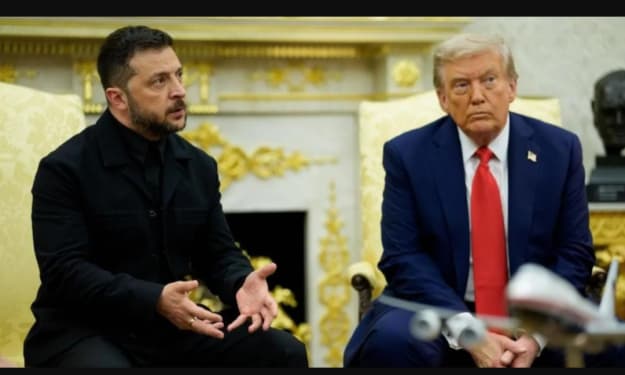
Trump Administration Live Updates: Zelensky Says He Will Meet President This Weekend. AI-Generated.
Fresh developments from Washington and Kyiv are drawing global attention as Ukrainian President Volodymyr Zelensky confirmed that he plans to meet with the U.S. President this weekend. The announcement comes amid heightened diplomatic activity, ongoing war concerns in Eastern Europe, and renewed debate over the Trump administration’s approach to Ukraine and Russia.
By Aadil shanawarabout a month ago in The Swamp
U.S. Strikes ISIS in Nigeria After Trump Warnings on Christian Killings. AI-Generated.
The United States has reportedly carried out targeted strikes against ISIS-linked militants in Nigeria, a move that follows renewed warnings from former President Donald Trump over the killing of Christians in the region. The development has reignited global attention on Nigeria’s long-running security crisis and the growing influence of extremist groups across West Africa.
By Aadil shanawarabout a month ago in The Swamp
‘All Brakes Are Off’: Russia’s Attempt to Rein In Illicit Market for Leaked Data Backfires. AI-Generated.
In an ironic twist, Russia’s efforts to curb the flourishing black market for leaked and stolen data appear to have backfired, according to cybersecurity analysts and investigative reports. Over the past year, Moscow has rolled out legislation aimed at regulating and restricting access to sensitive data, hoping to stem the flow of leaked information and control its spread online. Instead, the measures have unintentionally accelerated the growth of underground digital marketplaces, making illicit data trade more opaque and harder to track.
By Fiaz Ahmed Brohiabout a month ago in The Swamp