defense
Moving through the ranks of military activity including infrastructure, wars, our commander in chief and the nucleur arms race.
California's Redistricting Battle: A Response to Republican Gerrymandering
Introduction The lines that shape America’s political map are rarely neutral. Across the country, redistricting battles have become fierce, with accusations of gerrymandering dominating debates about fairness and representation. In California, Governor Gavin Newsom has endorsed a new Democratic-led redistricting package designed to push back against what Democrats describe as Republican attempts to secure long-term control through partisan maps in other states.
By Echoes of Life5 months ago in The Swamp
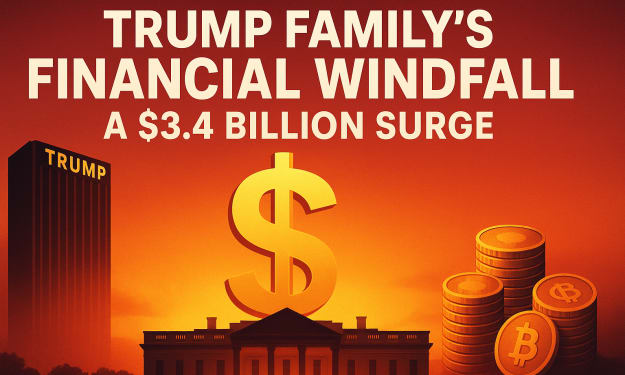
Trump Family's Financial Windfall: A $3.4 Billion Surge
When Donald Trump secured his second term as President, the world’s attention turned not only to his policies but also to his personal and family finances. A recent report reveals that the Trump family has amassed an extraordinary $3.4 billion in new wealth since the start of his second administration. This unprecedented financial growth has reignited debates about ethics, political influence, and the thin line between governance and personal profit.
By Echoes of Life5 months ago in The Swamp
Powerball Jackpot Rockets Past $600 Million Ahead of Monday Night Drawing
Before the Monday night drawing, the Powerball jackpot surges past $600 million. Before Monday night's drawing, the Powerball jackpot has increased to an eye-popping $655 million, making it the largest prize of the year thus far and one of the largest in recent history. Since the last grand prize win on May 31st, when a lucky ticket holder in California won the top prize, the jackpot has grown steadily. Since then, no player has been successful in matching all six numbers, and the jackpot has rolled over thirty times in a row. This long streak without a winner has fueled anticipation and ticket sales nationwide, as millions of hopefuls line up for their shot at fortune.
By GLOBAL NEWS5 months ago in The Swamp
Lounes Maatoub, the Rebel:. AI-Generated.
Introduction: In the rugged mountains of Kabylie, a voice once roared louder than any gunshot. That voice belonged to Lounès Matoub—a revolutionary, poet, and fierce defender of the Amazigh identity. Nicknamed "Le Rebelle" (The Rebel), Matoub’s legacy continues to echo across North Africa and the diaspora as a symbol of resistance, courage, and uncompromising truth.
By Youssef Khabchi5 months ago in The Swamp
"The Lion and the Lamb's Unlikely Pact"
The grasslands stretched endlessly under the warm glow of dawn. Dew clung to every blade of grass, catching the sunlight like tiny gems. Somewhere in that sea of green, a lamb named Liora grazed quietly, her soft wool damp from the morning mist. She was small, even for her age, and often strayed farther than the flock, not out of recklessness, but because she loved the silence of the open fields.
By Hakeem Khan 5 months ago in The Swamp
Pixel 9 Pro Fold Slashed by $600 Ahead of Pixel 10 Launch
Prior to the launch of the Pixel 10, the Pixel 9 Pro Fold received a price cut of around $600. The Pixel 9 Pro Fold has just received a significant price reduction of 600 dollars, amidst the growing anticipation for Google's next generation of foldable devices. The phone, which had a starting price of $1,799 for the 256 GB model, is now available at major retailers for just $1,199. This is the lowest price since the Pixel 10 was first released, and it comes just a few days before Google's upcoming event, where the Pixel 10 lineup, including the Pixel 10 Pro Fold, is expected to be unveiled. This timing is not random. This kind of price drop is a common tactic used by manufacturers to get rid of old models and make room for new ones. This presents buyers with a one-of-a-kind opportunity: a premium, cutting-edge foldable smartphone at a significantly reduced price. What distinguishes the Pixel 9 Pro Fold? Launched in August 2024, the device represented a bold evolution in Google’s foldable strategy. It improved both displays while building on the foundation laid by the first Pixel Fold. The Pixel 9 Pro Fold is one of the thinnest foldables available, measuring just 5.1 millimeters thick when opened. This makes it easier to carry and more comfortable to use. A 6.3-inch external screen and a larger 8-inch internal Super Actua Flex screen are the two high-quality displays on the phone. Both have refresh rates of 120 hertz, ensuring smooth scrolling and excellent gaming performance. The device has a high-end feel thanks to its polished and sleek design, which puts it in good company with foldables from Samsung and other brands. The phone is powered by Google's Tensor G4 processor and has 16 gigabytes of RAM. Fast multitasking, dependable performance, and strong integration with Google's AI features are all guaranteed by this. Users have access to storage capacities of 256 GB and 512 GB, providing ample space for media, apps, and productivity tools. The camera system is another highlight. It includes a 48 megapixel wide lens, a 10.5 megapixel ultrawide lens, and a 10.8 megapixel telephoto lens offering 5 times optical zoom and up to 20 times digital Super Res Zoom. While reviewers praised the setup overall, some noted that it still fell slightly short of the excellent imaging offered by the non-folding Pixel 9 Pro. In particular, low-light photography and telephoto shots left room for improvement.
By GLOBAL NEWS5 months ago in The Swamp
Spain at 'extreme risk' of new wildfires as 14 blazes spread
Authorities in Spain have issued a warning that large portions of the country are at “extreme risk” as a result of soaring temperatures, strong winds, and prolonged drought conditions combining to create a hazardous environment. As a result, Spain is once again facing the devastating threat of wildfires. Officials have confirmed that 14 separate fires are currently burning, putting a strain on resources and necessitating emergency services to fight fires in multiple locations. The fires, which have already destroyed thousands of hectares, emphasize Spain's increasing difficulty in dealing with climate-driven natural disasters. Numerous provinces have been issued red alerts by meteorological agencies, stressing that the perfect tinderbox of heatwaves and dry vegetation exists. Temperatures have frequently surpassed 40 degrees Celsius in parts of Andalusia, Extremadura, and Catalonia, well above seasonal averages. Because even a small spark can spread uncontrollably in a matter of minutes, these conditions make forests, farmland, and rural communities extremely vulnerable. The wind has been blowing at speeds that make it possible for fires to leap over roads, rivers, and other natural barriers in many places, making efforts to contain them more difficult. The most severe fires, according to authorities, are raging in Galicia, Valencia, and Aragón. A thick layer of smoke has engulfed entire towns in Galicia, necessitating the evacuation of hundreds of residents. In order to strengthen operations, additional firefighters from nearby provinces have been brought in to work night and day. Meanwhile, in Valencia, flames have already devoured extensive areas of pine forest, with local mayors calling the destruction unprecedented in recent years. Aragón has also seen rapid fire spread in rugged terrain, making it difficult for ground crews to reach the heart of the fires.
By GLOBAL NEWS5 months ago in The Swamp
Games of Tariffs & Power: Why Is Trump Hitting India Hard and Praising Pakistan?
Tariffs are never just about economics — they’re about leverage, influence, and sometimes, pure political theatre. Under Donald Trump, America’s trade policy became a chessboard where South Asia was a critical square. While India faces a crushing 50% tariff on key exports, Pakistan enjoys a much friendlier 19% rate — a move that has sparked debate from Washington to Islamabad. But is this short-term favor a blessing or a trap? In this article, we break down why Trump’s White House hit India hard, praised Pakistan, and what this means for the region’s future in an interconnected global economy. The Tariff Landscape: Numbers That Speak
By Leah Brooke5 months ago in The Swamp
A Last-Minute Truce: Putin’s Strategic Arms Offer Explained
Did you know that Russia and the U.S. together hold nearly 8,000 nuclear warheads, over 7,000 more than the limits set by current treaties? That staggering imbalance sets the stage for a story that grips us at our core.
By Soul Pages5 months ago in The Swamp
Crypto Firm Bullish Rockets 84% in Blockbuster IPO Debut
Crypto Firm Bullish Rockets 84% in Blockbuster IPO Debut On its first day of trading, cryptocurrency exchange Bullish raised a remarkable 1.1 billion dollars, a stunning display of investor enthusiasm as it surged 84% above its initial public offering price. One of the most successful public listings for a crypto-linked company in recent memory, this performance hints at investors' renewed interest in digital asset exposure. Bullish priced its debut at 37 dollars per share, exceeding earlier guidance of 28 to 33 dollars. The offering consisted of 30 million shares, raising approximately 1.11 billion dollars in proceeds and placing the company’s initial valuation around 5.4 billion dollars. On debut day, shares opened near 90 dollars, soared to an intraday high of 118 dollars, and settled at 68 dollars, still representing a robust 84% premium over the IPO price.
By GLOBAL NEWS5 months ago in The Swamp
US national debt surges to record breaking 37 trillion
US debt rises to a record-breaking 37 trillion dollars. The US Treasury Department confirmed on August 12, 2025, that the national debt has reached 37 trillion dollars. According to pre-pandemic forecasts, this level was not expected to be reached until after 2030. This milestone demonstrates the rapid pace of borrowing in recent years, driven by unprecedented spending responses to the COVID 19 pandemic and recent tax and spending legislation that has widened the federal deficit. The new tax cuts and spending programs that were enacted earlier this year will, according to the Congressional Budget Office, generate more than four trillion dollars in additional borrowing over the next ten years. While supporters of these measures argue that they stimulate growth and competitiveness, opponents warn that they deepen fiscal imbalances and make the nation more susceptible to economic shocks. The country has added trillions at a record pace in just over five years, which is particularly striking when compared to the previous quarter century, when the debt grew more gradually. In the past two years alone, the federal government has been adding roughly one trillion dollars to the debt every five months, more than double the historical average rate. This acceleration is particularly striking when compared to the previous quarter century, when the debt grew more gradually. Before 2020, debt projections showed a steady but slower rise, with the 37 trillion mark coming much The Peter G. Peterson Foundation's chief executive officer, Michael Peterson, has expressed concern about the consequences of such a rapid debt accumulation. He points out that large and growing federal borrowing puts upward pressure on interest rates, raises costs for consumers and businesses, reduces private sector investment, and creates a cycle that results in more borrowing, higher interest payments, and an ever-increasing debt load. The Government Accountability Office has also outlined the real-world effects of rising debt on Americans. Rising national debt can raise borrowing costs for consumers, making credit cards, mortgages, and car loans more expensive. Businesses may have less access to capital, which could limit hiring, wage growth, and investment. Rising debt also contributes to inflationary pressures, making everyday goods and services more expensive. Beyond the dollar figure, analysts point to the debt to GDP ratio as a crucial indicator of fiscal health. As of the middle of 2025, this ratio is still historically high, and if current trends continue, it is on track to surpass the peak reached during World War II by 2027. Mandatory programs like Social Security and Medicare consume a significant portion of the budget, and rapidly rising interest costs make it difficult for lawmakers to reduce deficits without deeply affecting politically sensitive areas. Despite these concerns, the United States still has advantages that a lot of other countries don't have. The US dollar is still the world's primary reserve currency, and there is still a strong demand for Treasury bonds all over the world. This demand has historically allowed the federal government to borrow at relatively low rates. However, some economists warn that if debt continues to grow unchecked, investor confidence could weaken over time, which could force the government to pay higher interest in order to attract buyers. Maya MacGuineas, president of the Committee for a Responsible Federal Budget, says that she hopes the milestone will awaken policymakers to the urgency of the problem. She argues that changes will need to be made quickly to prevent the debt from spiraling further out of control. Looking ahead, many fiscal experts hope that crossing the 37 trillion dollar threshold will spark serious discussions in Washington about long-term debt reduction. However, the path forward is uncertain due to political polarization and competing priorities. Both major parties have proposed fiscal reforms, but there are still deep disagreements about whether to focus on spending cuts, revenue increases, or a combination of the two. Without bipartisan agreement, a comprehensive debt reduction is unlikely to occur soon. The federal government is currently carrying the largest debt load in its history and growing at an unprecedented rate. In the coming years, it will be up to policymakers to decide whether they will take decisive steps to slow this growth or whether the country will continue along its current trajectory, which could result in higher costs and less flexibility to respond to future crises. The upcoming debates in Washington will determine whether the 37 trillion mark becomes a turning point toward fiscal discipline or simply another waypoint on the path to even higher levels of national debt. This latest milestone is not just a symbolic number on a balance sheet; rather, it represents a mounting fiscal challenge with real implications for interest rates, wages, inflation, and the overall economic resilience of the United States.
By GLOBAL NEWS5 months ago in The Swamp