
Games of Tariffs & Power: Why Is Trump Hitting India Hard and Praising Pakistan?
Inside the Political Chessboard Where Trade, Diplomacy, and Hidden Agendas Collide in South Asia

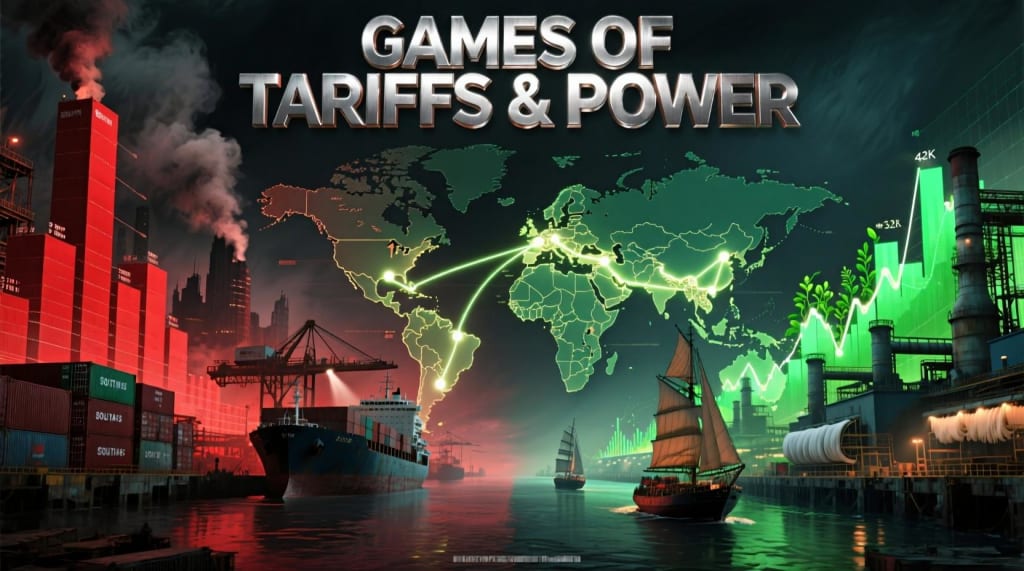
Tariffs are never just about economics — they’re about leverage, influence, and sometimes, pure political theatre. Under Donald Trump, America’s trade policy became a chessboard where South Asia was a critical square. While India faces a crushing 50% tariff on key exports, Pakistan enjoys a much friendlier 19% rate — a move that has sparked debate from Washington to Islamabad. But is this short-term favor a blessing or a trap? In this article, we break down why Trump’s White House hit India hard, praised Pakistan, and what this means for the region’s future in an interconnected global economy. The Tariff Landscape: Numbers That Speak
Currently, U.S. tariffs stand starkly different across South Asia:
India faces a hefty 50% tariff.
Pakistan enjoys a much lower rate of 19%.
Other South Asian countries average around 20%, with gradual increases over time.
On the surface, Pakistan’s position seems favorable—lower tariffs mean easier access to the American market. The government in Islamabad sees this as a positive diplomatic gesture. But this silver lining hides a cloud: in the long run, it could backfire.
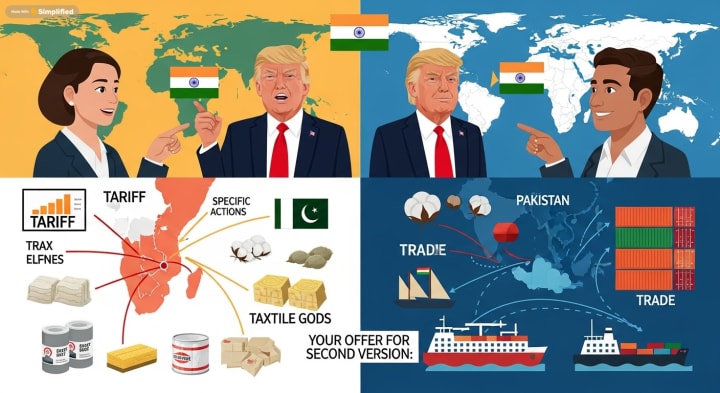
Here’s why: Pakistan’s exports are overwhelmingly dependent on textiles—about 92% of its total exports. Competing countries like Canada and Mexico enjoy GSP (Generalized System of Preferences) status in the same market, giving them better tariff-free access. Pakistan, however, only gets GSP benefits on a narrow range of goods—rice, plastics, and just about 5% of textiles. This limited scope keeps Pakistan vulnerable to sudden shifts in U.S. policy.
The Texas Connection
One interesting twist is the U.S. state of Texas, which exports around $2 billion worth of cotton (kappas) to Pakistan annually. In many textile-related imports, Pakistan actually has GSP status, unlike other South Asian competitors who face tariffs of 35–50%. This gives Pakistan a short-term advantage in that specific niche. The problem? It encourages over-reliance on one sector instead of broadening the export base.
Why Tariffs Hurt in a Connected World
In a tightly interlinked global economy, tariffs often harm more than they help. They trigger reciprocal tariffs—a tit-for-tat response where both sides lose. Take the example of U.S.–China tensions: each tariff hike invites retaliation, disrupting supply chains and consumer prices.
Even the U.S. itself is not immune. Vans and trucks made in Europe face a 25% U.S. tariff, which benefits American automakers. But in industries like textiles, the story flips—higher tariffs on imported clothing reduce demand, which in turn lowers the export of U.S. cotton. American farmers feel the pinch. This illustrates the reality of the “modern super-connected world”: no nation operates in a vacuum.
A striking illustration comes from the book The Travels of a T-Shirt in the Global Economy (2005), which traces how a simple German-made T-shirt might travel across three continents before reaching a store shelf. Tariffs disrupt this delicate dance.
Why Trump is Turning Up the Heat on India

The U.S.–India friction under Trump wasn’t just economic—it was deeply political. Trump openly warmed toward Pakistan while pressuring India, partly to gain leverage in broader geopolitical games.
One major flashpoint: Trump reportedly warned India to halt oil purchases from Russia, a move tied to broader U.S. sanctions strategy. At the same time, he pushed for mediation in the Kashmir dispute, a proposal India rejected outright. This refusal, alongside India’s reluctance to align fully with U.S. interests, annoyed the Trump administration.
Moreover, India walks a diplomatic tightrope—it’s a member of both the U.S.-led Quad alliance and the BRICS bloc with Russia and China. From Trump’s perspective, that looked like playing both sides.
India’s Image vs. Reality
Domestically, India promotes a narrative of economic greatness—its large population and growing GDP often feed a sense of national pride. But global weight is a different matter. Russia, with a smaller population and GDP, holds a permanent seat on the UN Security Council, wields energy influence through oil exports, and remains a major arms producer.
India, meanwhile, still struggles to produce advanced military hardware, such as fourth-generation fighter jets, without foreign assistance. The gap between perception and actual geopolitical clout remains wide.
Short-Term Favor, Long-Term Risk for Pakistan
Pakistan’s current tariff advantage is not a permanent win. It is, in many ways, a tactical move by Trump—meant to reward Pakistan’s cooperation while putting India under pressure. But relying too heavily on preferential treatment, without diversifying exports or securing broader GSP access, leaves Pakistan exposed. If U.S. policy shifts, the cushion could disappear overnight.

The lesson for both countries—and the rest of the world—is clear: in the era of interconnected economies, tariffs are less about protecting industries and more about political maneuvering. But in the end, they rarely deliver lasting prosperity.
About the Creator
Leah Brooke
Just a curious storyteller with a love for humor, emotion, and the everyday chaos of life. Writing one awkward moment at a time
Keep reading
More stories from Leah Brooke and writers in The Swamp and other communities.
Why America Has Its Eye on Pakistan: Oil, Jets, and a Shifting Alliance
In recent years, subtle yet striking signals from Washington have shown a surprising tilt in American interest toward Pakistan. While India has long been a U.S. strategic ally, recent developments suggest that America is looking at Pakistan not just with fresh eyes—but possibly with renewed ambition.
By Leah Brooke7 months ago in The Swamp
Why Black History Matters in America?
The United States of America is celebrating their 250th anniversary in 2026. I'm proud to be an American and as someone who was born here, I wouldn't imagine myself living anywhere else. This is a country where opportunities are possible. Where anyone can be successful in anything they desire to do. Equality, community, and togetherness are the backbones of what America is and should be about. However, we have an administration who wants to erase and disregard those who have made positive, meaningful impacts in our country, specifically Black figures, such as Martin Luther King, Jr., Rosa Parks, and Maya Angelou. President Trump and his administration have been constantly complaining and fighting against what they call the "Woke agenda". They use this excuse as a distraction from other issues they refuse to address, such as the high cost of living, climate change, and inflation. That equality is dividing America, when in reality, it's bringing us together. Being woke is not tied to a specific political party. No matter where you stand on the political spectrum, you can still care about other people and their plights. Compassion and empathy for others isn't tied to a political party, either. We were taught as children to treat others the way we want to be treated and not judge others because they're different from us. Caring about others isn't a personal attack on your beliefs. It doesn't make you any less of a person. People who are easily offended over African American figures, past or present, or anything related to it, are grasping at straws. Current and future generations need to know who people like Harriet Tubman and Shirley Chisholm were, especially in the classroom. Black History is part of American History. It should be recognized, not hidden or forgotten. Besides, you can't shield children from everything, just because your feelings are easily hurt.
By Mark Wesley Pritchard 27 days ago in The Swamp
It's 2026. Songs Turning 10 This Year
In 2016, we saw the rise of short form videos and what would lead to the birth of TikTok. We cannot forget the Snapchat filters no matter how cringe worthy some of them might have been. It was also the year in which the hit series Stranger Things debuted.
By Jasmine Aguilar6 days ago in Beat




Comments
There are no comments for this story
Be the first to respond and start the conversation.