
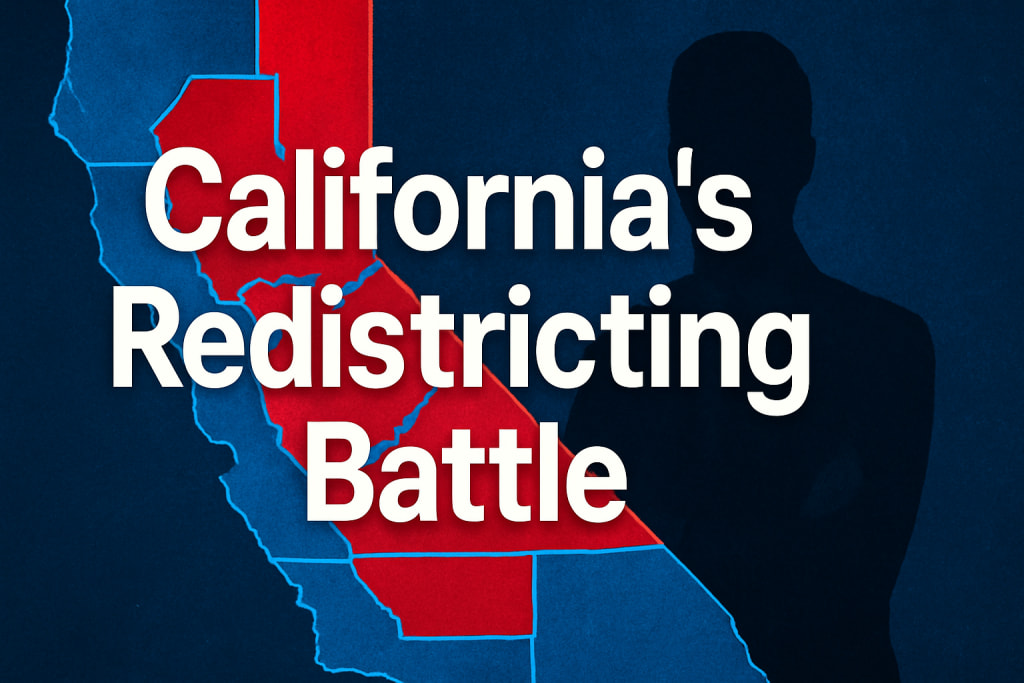
California's Redistricting Battle: A Response to Republican Gerrymandering
State-Level Pushback Against Partisan Map Drawing

Introduction
The lines that shape America’s political map are rarely neutral. Across the country, redistricting battles have become fierce, with accusations of gerrymandering dominating debates about fairness and representation. In California, Governor Gavin Newsom has endorsed a new Democratic-led redistricting package designed to push back against what Democrats describe as Republican attempts to secure long-term control through partisan maps in other states.
This move not only reflects California’s unique role in national politics but also signals how state-level fights over district boundaries could shape the future balance of power in Washington.
What Is at Stake
Redistricting happens every ten years after the census, and the process has enormous consequences. The way districts are drawn determines which communities are grouped together, which voices are amplified, and which political party gains an advantage in elections.
Republicans in states such as Texas, Florida, and North Carolina have been accused of drawing maps that maximize their chances of winning congressional seats, often by splitting urban areas or concentrating minority voters into fewer districts. Democrats argue this strategy undermines fair representation and weakens the voices of millions of voters.
California, the largest Democratic stronghold in the country, is now stepping forward with its own strategy.
Newsom’s Endorsement
Governor Gavin Newsom has thrown his support behind a sweeping redistricting package crafted by Democratic leaders in the state legislature. The proposal seeks to solidify Democratic advantages in California’s congressional delegation while also modeling what Democrats argue is a more transparent and fair process.
The plan is framed not just as a local issue but as a direct response to Republican gerrymandering elsewhere. By ensuring Democratic strength in California, party leaders believe they can help counterbalance GOP-drawn maps in other states and preserve national representation that better reflects the country’s political landscape.
A Political Chess Game
Redistricting has always been political, but in recent years it has become a high-stakes chess match with lasting consequences. Once lines are drawn, they can remain in place for a decade, shaping elections long after the politicians who drew them have left office.
Republicans, with control of several state legislatures, have been aggressive in redrawing boundaries to their advantage. Democrats, meanwhile, have been searching for ways to fight back. In this sense, California’s package is not just about local representation—it’s about setting an example of resistance and building a broader Democratic strategy.
Supporters’ Arguments
Supporters of California’s redistricting package argue that it is both fair and necessary. They believe the state has a responsibility to respond to partisan moves made elsewhere. If Republicans use their control of legislatures to secure long-term advantages, Democrats say they cannot afford to play by different rules.
Many also argue that California’s system is more open to public input and scrutiny, making it less prone to the secretive backroom deals that often define gerrymandering. By positioning itself as a defender of fairer processes, California hopes to show that redistricting can be done with more accountability.
Critics’ Concerns
Critics, however, see things differently. Some Republicans accuse California Democrats of hypocrisy, saying that in practice, the state is doing exactly what it condemns—drawing lines that favor one party. They argue that calling it a “response” does not change the fact that the maps are designed to entrench power.
Others worry that this escalating battle between red and blue states will only deepen national polarization. If both sides embrace aggressive map drawing, the result could be a Congress even more divided and less reflective of ordinary voters’ interests.
The Broader National Picture
The fight in California is part of a larger national struggle over democracy itself. In recent years, courts have been asked to intervene in redistricting disputes, with mixed results. Some state courts have struck down maps they viewed as unfair, while others have allowed partisan maps to stand.
The Supreme Court has largely stepped back from limiting gerrymandering, arguing that redistricting is a political question best left to states. This decision has fueled state-level fights, giving California’s move even greater importance. If the federal government will not step in, then states are left to shape their own destiny.
Implications for 2026 and Beyond
With congressional elections approaching in 2026, the maps being drawn now could decide control of the House of Representatives. California’s effort to lock in Democratic strength may prove crucial in maintaining balance as Republicans in other states push forward with maps that tilt in their favor.
Beyond the immediate election, the battle also highlights a deeper truth: American democracy is increasingly shaped not just by who votes, but by where district lines are drawn. For many, this undermines the principle of equal representation. For others, it is simply the reality of political competition.
Conclusion
California’s redistricting package is more than a local policy—it is a statement in a national conflict over fairness, representation, and political power. By endorsing the plan, Governor Newsom has positioned California as a defender of Democratic strength and a challenger to Republican gerrymandering across the country.
Whether seen as fair pushback or partisan maneuvering, the move reflects a larger truth: the battle over district lines is one of the most important fights in American politics today. The outcome will not only affect who represents California, but also who controls Congress, and perhaps the direction of the nation itself.
About the Creator
Echoes of Life
I’m a storyteller and lifelong learner who writes about history, human experiences, animals, and motivational lessons that spark change. Through true stories, thoughtful advice, and reflections on life.
Keep reading
More stories from Echoes of Life and writers in The Swamp and other communities.
Trump Family's Financial Windfall: A $3.4 Billion Surge
When Donald Trump secured his second term as President, the world’s attention turned not only to his policies but also to his personal and family finances. A recent report reveals that the Trump family has amassed an extraordinary $3.4 billion in new wealth since the start of his second administration. This unprecedented financial growth has reignited debates about ethics, political influence, and the thin line between governance and personal profit.
By Echoes of Life5 months ago in The Swamp
75% of Americans Oppose the U.S. Attempting to Take Control of Greenland
The idea of the United States attempting to take control of Greenland has once again entered public debate, but a new CNN poll makes one thing abundantly clear: most Americans are not on board. According to the survey, 75% of Americans oppose any effort by the U.S. to control the vast Arctic island, while only a small minority support such a move. This overwhelming opposition reflects more than just disagreement with a single policy proposal. It signals a deeper unease with expansionist foreign policy, concerns over international law, and fears that aggressive actions could undermine America’s global credibility and alliances. Why Greenland Is Back in the Spotlight Greenland, an autonomous territory within the Kingdom of Denmark, is the world’s largest island and one of the most strategically significant pieces of land in the Arctic. Its importance has grown as climate change accelerates ice melt, opening new shipping routes and increasing access to natural resources such as rare earth minerals, oil, and gas. From a military standpoint, Greenland occupies a critical position between North America and Europe. The United States already maintains a military presence there, and defense analysts often point to the island’s role in missile detection and Arctic security. As global competition intensifies, especially with Russia and China expanding their Arctic ambitions, Greenland has become a symbol of strategic advantage. However, while policymakers may view Greenland through a security lens, the American public appears far more cautious. What the CNN Poll Reveals The CNN poll paints a stark picture of public sentiment. A clear three-quarters of respondents oppose any U.S. attempt to take control of Greenland. This opposition spans political parties, age groups, and regions, making it one of the rare foreign policy issues where consensus leans strongly against intervention. Key insights from the poll include: Democrats show near-universal opposition, reflecting concerns about international norms and diplomacy. Independents largely reject the idea, signaling discomfort with aggressive foreign policy regardless of party leadership. Republicans are more divided, but even within the party, support does not reach a majority. This broad resistance suggests that Americans are drawing a firm line between defending national interests and pursuing territorial control. A Growing Skepticism Toward Expansionism The Greenland debate taps into a larger shift in how Americans view their country’s role in the world. After decades of military interventions and prolonged conflicts, public appetite for bold, unilateral actions has diminished. Many Americans are wary of policies that resemble imperial ambitions, fearing they could lead to conflict, economic strain, or diplomatic fallout. For younger generations especially, the concept of acquiring territory feels outdated. Instead, there is a growing emphasis on cooperation, multilateral agreements, and respect for sovereignty. The notion of “taking control” of another land — particularly one with its own people, culture, and government — clashes with these values. Concerns About Military Force and Global Stability One of the strongest reasons for opposition lies in fears about military escalation. While some proponents argue that Greenland could be acquired peacefully, critics worry that any serious attempt would inevitably involve pressure, coercion, or force. Americans are also concerned about the international consequences. Denmark is a NATO ally, and Greenland’s status is protected under international agreements. Any aggressive move could strain NATO unity at a time when cooperation among allies is already being tested by global crises. For many respondents, the potential damage to alliances outweighs any perceived strategic gain. The Voices of Greenland and Denmark Matter Another critical factor shaping public opinion is the perspective of those most directly affected. Leaders in Greenland and Denmark have repeatedly stated that Greenland is not for sale and not open to takeover. Greenland’s population, though small, has a strong sense of identity and self-governance, and polls conducted locally show overwhelming opposition to becoming part of the United States. Many Americans find this argument persuasive. In a democracy that prides itself on supporting self-determination, ignoring the wishes of Greenlanders would undermine core American values. What This Means for U.S. Foreign Policy The CNN poll sends a clear warning to policymakers: public support for aggressive foreign policy moves is limited. Americans want their country to remain influential, but not at the cost of international stability or moral authority. This does not mean Americans are indifferent to Arctic security or global competition. Instead, they appear to favor practical engagement — strengthening alliances, investing in diplomacy, and cooperating with partners — rather than pursuing control over foreign territory. Greenland’s strategic importance can be addressed through agreements, shared defense initiatives, and economic partnerships without crossing into controversial territory acquisition. A Defining Moment for Public Opinion Public opinion has always played a complex role in shaping U.S. foreign policy. While leaders often act based on strategic calculations, sustained public opposition can limit what is politically feasible. In this case, the message from Americans is unambiguous. The idea of taking control of Greenland may appeal to a narrow group focused on power projection, but for most Americans, it represents unnecessary risk, ethical concerns, and a step backward in global leadership. Conclusion: A Clear Message from Americans The CNN poll revealing that 75% of Americans oppose U.S. control of Greenland is more than just a snapshot of opinion. It reflects a broader desire for restraint, respect for sovereignty, and a foreign policy rooted in cooperation rather than domination. As debates over Arctic security and global influence continue, U.S. leaders may need to recalibrate their approach — not only to align with international norms but also to respect the clear preferences of the American public. In an interconnected world facing shared challenges, Americans appear to believe that partnership, not possession, is the smarter path forward.
By Muhammad Hassan3 days ago in The Swamp




Comments
There are no comments for this story
Be the first to respond and start the conversation.