Acrostic
Verses of a Mortal Soul
Elio was a quiet child, born in a small village nestled between golden hills and winding rivers. While others ran through fields or built forts from fallen branches, Elio would sit beneath a tall sycamore tree with a notebook in his lap, writing down everything he saw — the way the sun filtered through the leaves, the sound of the water tumbling over rocks, the stories he imagined the clouds were telling. His parents, farmers with hands always covered in earth, didn’t quite understand why their son chose words over wheat, but they smiled at his joy nonetheless. His mother would sometimes read his poems aloud by the fire in the evenings, her voice soft and curious, and Elio would listen with wonder — not just at the sound of his own words, but at the warmth they brought to those around him. As he grew, so did his verses. He wrote about friendship, the changing seasons, the mystery of stars. At school, his teachers noticed his talent and encouraged him to enter local competitions. He didn’t always win, but every poem he shared felt like a seed planted — not for praise, but for connection. One spring, when he was seventeen, Elio was invited to a youth poetry festival in the city. It was his first time leaving the village, and he felt like a small bird suddenly among the towering trees of unfamiliar skies. The city pulsed with voices, lights, and movement — but even here, poetry found him. He listened to spoken-word artists deliver lines with fire and rhythm, watched others paint stories with metaphors and emotion. He realized that poetry wasn’t only about quiet reflections — it could be a celebration, a dance, a song of resilience. He returned home with a heart full of new rhythms and a desire to help others discover what he had found. So Elio began teaching poetry workshops at the village school and organizing outdoor readings beneath the same sycamore tree that had once cradled his childhood musings. Soon, others started writing. Children scribbled verses about their dreams and games. Elders wrote about memories and old songs. The village, once quiet in the afternoons, buzzed with creativity. Poetry was no longer something hidden in notebooks — it was painted on walls, sung at festivals, even exchanged in love letters. Elio found joy not just in his own writing, but in the spark that poetry lit in others. His words had become part of a greater voice — a community of hearts speaking out loud. Years passed, and Elio’s poems were published in books and journals. He traveled to places he had only written about — standing at the edge of oceans, watching the Northern Lights from a quiet hill in Norway, sharing poems with strangers who soon felt like old friends. But no matter where he went, he always returned home to the sycamore, to the laughter of young poets, to the village that had taught him that the most beautiful verses come from living life fully. One summer evening, as the golden hour bathed the hills, Elio sat beneath the tree again, older now, silver in his hair but brightness still in his eyes. Around him sat a group of new poets — children, teenagers, even a few travelers who had heard of the village that loved words. "Why do you still write?" one young girl asked him, her voice curious. Elio smiled, tapping his pen gently against his notebook. "Because life keeps whispering stories," he said. "And every poem is a way of saying thank you." The group grew quiet, letting his words settle like sunlight on skin. Then someone began to read, and another followed, their voices weaving a tapestry of hope, wonder, and joy. Elio leaned back, closed his eyes, and listened — not just to the poems, but to the world itself. It was alive, singing in metaphors, blooming in rhyme, and echoing with laughter. And he, just one poet among many, had helped give it a voice.
By Muhammad Saad 6 months ago in Poets
The Poet's Voice: Shaping Souls and Societies
In a small village nestled between hills and rivers, there lived an old man named Elias, known not for wealth or power, but for his words. Every week, he stood in the town square and read aloud his poetry to those who would listen. Children sat cross-legged in front of him, elders leaned on their walking sticks, and farmers paused their carts just to catch a few lines. Elias was a poet—not by profession, but by calling. He had never left his village, yet his words traveled further than he ever could. His poems touched on sorrow and love, war and peace, injustice and beauty. Some villagers saw him as merely a dreamer. Others, especially in times of hardship, looked to his verses for comfort and guidance. Few realized that through his simple act of reciting poetry, Elias played a role as ancient and vital as the village itself. The role of a poet in society is often quiet but powerful. Poets do not wield authority like politicians or dictate policy like rulers, yet they hold a unique kind of influence: they shape how people see the world. Through rhythm and imagery, they offer reflections of our inner selves and the world around us. Elias knew this. He once said, “A poet doesn’t tell you what to think. He reminds you that you can.” Throughout history, poets have served as mirrors, voices of conscience, and keepers of collective memory. From Homer chronicling battles and gods, to Maya Angelou standing tall with dignity and defiance, poets have spoken when others could not. In times of oppression, they became protestors. In times of celebration, they sang praises. In silence, they became echoes of truth. Elias’s poetry, though humble, was no different. When a flood destroyed part of the village, he wrote a poem not about loss, but about rebuilding. When a child was born, he captured the miracle of life in three perfect lines. And when a nearby town faced injustice from corrupt leaders, Elias recited a poem so poignant that it spread beyond the village—copied by hand, passed from person to person, until even city officials took notice. Poets often live in the margins, but they write at the center of human experience. They help us make sense of chaos, reveal hidden truths, and inspire change—not through force, but through feeling. Elias once explained to a curious boy, “A poem is like a seed. You don’t know when it will grow in someone’s heart, but if planted with care, it always will.” In the modern world, the poet's role has evolved but not diminished. They may now share verses through screens instead of scrolls, speak on podcasts instead of street corners, yet their essence remains the same. Poets still awaken the sleeping parts of our consciousness. They still dare to ask questions that society avoids. In classrooms, their lines teach empathy. In courtrooms, their words are cited in defense of justice. In music and protest, their rhythm marches alongside the people. Even in grief, when no words seem enough, it is often a poem that finds a way to express the inexpressible. Elias continued his readings until the end of his days. His final poem, written with a trembling hand, was not about death but about legacy. “I am not the flame,” it read, “but I have carried the spark.” When he passed, villagers gathered in the same square, not to mourn, but to recite his poems aloud—passing on the spark. The poet’s voice, whether heard in quiet rooms or loud squares, remains a vital part of every society. It is the voice that remembers when others forget, that feels when others numb, that questions when others conform. Poets like Elias remind us that words, when spoken with honesty and heart, can move more than minds—they can move history. So next time you hear a poem—on a page, a wall, a stage, or a screen—listen closely. It may be more than just words. It may be a seed waiting to grow.
By Muhammad Saad 6 months ago in Poets
The Living Language of Verse
Long before the written word, before ink met paper or syllables were printed in textbooks, poetry lived in the breath and heartbeat of human expression. It echoed through chants around ancient fires, whispered in the rhythm of ritual, and danced in the memory of storytellers who passed tales from one generation to the next. In the cradle of civilization—Sumer, Egypt, and Mesopotamia—poetry was born not as decoration, but as necessity. The Epic of Gilgamesh, carved into stone tablets over 4,000 years ago, is one of the oldest known literary works. It told of gods and kings, friendship and loss, and the relentless quest for meaning. Even then, poetry was not just words; it was a mirror to the human soul. Centuries later, on the banks of the Nile and in the temples of ancient Greece, poetry took on form and structure. In Greece, it soared with the likes of Homer, whose Iliad and Odyssey stitched together myth, history, and heroism with a melodic, metered rhythm that was easy to remember and share aloud. These early bards were the original spoken word artists, performing epic tales with voice and gesture, captivating audiences much like modern poets do today. As writing systems evolved, so did poetic form. Across India, the Vedas were sung with spiritual reverence, their verses crafted to preserve sacred truths. In China, Li Bai and Du Fu blended nature, philosophy, and emotion into delicate, powerful brushstrokes of imagery. In Persia, the mystic Rumi wrote of love that transcended the physical, penning verses that still resonate centuries later in every corner of the world. During the Middle Ages, poetry became both an instrument of worship and a tool of courtship. In Europe, troubadours composed lyrical odes to unattainable loves, while monks transcribed psalms and hymns to glorify the divine. Meanwhile, on other continents, oral traditions flourished. African griots, for example, kept ancestral history alive through rhythmic storytelling and poetic song, each performance a living archive of culture and identity. The Renaissance ignited a poetic rebirth in Europe. It was an age of sonnets and soliloquies. Shakespeare elevated the English language, weaving iambic pentameter into dramas that exposed the full spectrum of human nature. His plays and poems proved that poetry was not just for the elite or scholarly—it belonged to the people. As literacy spread and printing presses roared to life, poetry became more accessible. The Romantic poets—Wordsworth, Keats, Shelley—embraced emotion and nature, pushing back against industrialism’s cold steel with tender stanzas about rivers, stars, and the aching heart. Their verses reminded people that to feel deeply was not a weakness, but a gift. The 20th century shattered boundaries once thought unbreakable. Poets like Langston Hughes infused jazz and racial identity into verse during the Harlem Renaissance. Sylvia Plath dared to write her inner world in raw, confessional tones. Allen Ginsberg howled against conformity, and Maya Angelou sang of freedom and resilience. The page was no longer the only home for poetry—it spilled into protests, concerts, and coffeehouses. Then came the digital age. At first, some feared poetry would fade, lost in a world of short attention spans and emojis. Instead, it transformed. Spoken word slams filled auditoriums. Instagram poets reached millions with just a few powerful lines. Videos, podcasts, and audio books breathed new life into old forms. A teenager in Nairobi could share verses with a teacher in Toronto. Poetry, once bound by borders and class, was now as free as thought itself. And still, it grows. Today, poetry appears in classrooms and subway walls, in text messages and at weddings, funerals, and protests. It comforts, challenges, and connects. It has evolved from oral tradition to digital expression, but its essence remains the same: to make sense of what it means to be human. Each era adds a verse to poetry’s ongoing story. The poet’s tools may change—stone, ink, screen—but their mission does not. To listen. To observe. To feel. To speak truths that others may only dare to whisper. Poetry, after all, is not just a relic of the past. It is a living, breathing language of the soul. And as long as there are hearts that ache, minds that question, and spirits that dream, poetry will continue to evolve—ever ancient, ever new.
By Muhammad Saad 6 months ago in Poets
Thriving Beyond Recovery: The New Era of Post-Health Empowerment
Just a few years ago, Maya Daniels was struggling to walk up a single flight of stairs. A former high school teacher in her early fifties, Maya had spent most of 2021 battling long-term complications from COVID-19. The fatigue, brain fog, and anxiety left her feeling like a stranger in her own body. But today, she’s training for her first 5K, managing a wellness blog, and mentoring others navigating life after serious illness. Maya’s story isn’t unique anymore. Across the world, people who once felt sidelined by health challenges are reclaiming their lives—not just surviving, but thriving. Thanks to a combination of modern medicine, digital tools, and a cultural shift toward holistic wellness, we are witnessing a new era: post-health empowerment. A Shift in the Narrative For decades, the healthcare journey often ended at "recovery." Patients were expected to return to normal life after treatment, with little guidance or support. But today’s health landscape looks different. Recovery is no longer the finish line—it’s the beginning of a new phase of personal growth. “We’ve seen a huge mindset shift,” says Dr. Lena Morales, a rehabilitation specialist in Austin, Texas. “People are redefining what it means to be healthy. It’s not just the absence of illness—it’s about thriving mentally, emotionally, and physically.” This evolving view is being driven by advances in healthcare and wellness technologies. Wearable devices now track everything from heart rate variability to sleep cycles, giving users real-time insights into their recovery progress. Telehealth platforms connect patients with specialists across the globe, making expert care accessible to more people. AI-powered health apps offer personalized exercise, nutrition, and mindfulness plans—all from a smartphone. The Rise of Community-Based Healing Technology may be leading the way, but community is the heart of the movement. Online and local support groups have become vital spaces for people to share experiences and resources. These communities are breaking the isolation that often accompanies recovery. One such example is “Reclaim & Rise,” a peer-led support network founded by stroke survivor Daniel Okafor in Chicago. The group meets weekly, both online and in-person, to practice gentle fitness routines, discuss mental health, and celebrate personal milestones. “Doctors helped save my life,” Daniel says, “but this community helped me build it back. We encourage each other to not only heal, but to grow stronger—together.” Wellness with a Purpose More people are also turning to integrative wellness approaches—blending traditional medicine with practices like yoga, meditation, nutrition, and nature therapy. Hospitals are increasingly including holistic programs in their post-care plans. Take the example of Sunfield Medical Center in Oregon. Their “Thrive Track” initiative offers post-illness patients six months of personalized lifestyle coaching, including dietary consultations, mindfulness training, and social outings like hiking and gardening. Early data shows participants experience faster physical recovery and improved mental health. “We’re seeing that when people are empowered to take charge of their health journey, they become more resilient and optimistic,” says Dr. Priya Natarajan, one of the program’s coordinators. A Healthier Tomorrow, Today Maya Daniels credits her post-health journey not just to technology or therapy, but to her renewed sense of purpose. “Getting sick changed my life,” she says. “But recovering helped me discover a version of myself I didn’t know existed—stronger, wiser, and more compassionate.” She now volunteers with local schools to teach mindfulness to children and runs workshops on managing chronic fatigue. Her blog, Maya Moves, has readers from over 40 countries who tune in for tips on navigating life after illness. “I still have off days,” Maya admits. “But I’ve learned that health isn’t a straight line—it’s a path. And I’m walking it, step by step.” --- As we continue to navigate a world shaped by global health challenges, stories like Maya’s are beacons of hope. The post-health era isn’t about going back to how things were—it’s about moving forward with intention, support, and empowerment. Whether it's through wearable tech, a community Zoom call, or a mindful walk in the park, people everywhere are finding ways to thrive beyond recovery. And in doing so, they’re redefining what it truly means to be well.
By Muhammad Saad 6 months ago in Poets
What Is Poetry?
Amara had never considered herself a poet. Numbers, charts, and logic were her language. As a data analyst in a bustling city firm, she spent her days decoding trends and drawing meaning from patterns. Yet, something always tugged at her—an unnamed longing in the quiet spaces between tasks, a yearning for something less structured, more… human. One rainy afternoon, she ducked into a small, unfamiliar bookstore to escape a sudden downpour. The scent of paper, ink, and rainwater wrapped around her like a warm shawl. As she wandered, her fingers brushed over the spine of a slim book titled The Sky Whispers in Verse. Intrigued, she opened it to a random page: "The wind speaks in sighs, Of love and loss and spring rains, But only hearts hear." She read it again. And again. Something stirred inside her—soft and electric. It wasn’t just the words. It was the space between them, the feeling that they held something bigger than themselves. For the first time in her life, Amara realized that poetry wasn’t about rhyme or strict form. It was about truth—raw, distilled, and dressed in metaphor. It was emotion made visible. That night, she wrote her first poem. Scribbled in the back of a grocery receipt, it was clumsy and awkward. But it was hers. And it said what her spreadsheets never could: I feel lonely sometimes, even in a crowd. Over the following weeks, Amara fell into poetry like one might fall in love—with awe and a little fear. She read Rumi, Angelou, Neruda, and Plath. She discovered that poetry had been the voice of revolution, the balm of grief, the celebration of joy, and the record of the soul across centuries. Each poet, whether ancient or modern, spoke with an urgency that echoed through time. She started carrying a small notebook, catching phrases mid-walk, mid-conversation, mid-sigh. The world began to look different. The sunrise wasn’t just “orange”—it was “a warm hush over tired rooftops.” Her neighbor’s laughter was “a skipping stone across silence.” Even numbers began to sing: “The statistics of heartbreak, 1 in 3, hide more than they reveal.” She joined a local poetry circle—a humble group that met every Thursday evening in the back of a café. People from all walks of life gathered there: a retired teacher, a young barista, a father who wrote poems to heal after losing his son. In that circle, Amara found something precious—permission to be vulnerable. There was no judgment, only curiosity and compassion. One night, she nervously read one of her poems aloud. Her voice trembled, but her words carried: "I build walls with data But poetry slips through cracks— A rebel of truth." When she finished, there was silence. Then a slow, genuine applause. A man with kind eyes said, “That hit me. I do the same. I hide in my logic. But poetry makes me feel again.” In that moment, Amara understood something profound: poetry isn’t just art—it’s connection. It bridges hearts that speak different languages. It transforms pain into healing and beauty. It tells us we are not alone. Years passed. Amara still worked with data by day, but she now taught a free weekend poetry class at the library. Children, teens, and elders came to write, read, and discover their voices. She often told them, “Poetry is not about being fancy or perfect. It’s about telling the truth beautifully. It’s about naming what lives inside you.” One student, a shy teenager named Niko, once whispered after class, “I didn’t know it was okay to say how I feel like that.” She smiled. “That’s the magic of poetry—it gives permission.” In the end, Amara’s life didn’t change in the way movies show—no best-selling books or global fame. But it changed in the most important way: it became more alive. More connected. More true. So, what is poetry? It’s the rain that pulls you into a bookstore. It’s the line that echoes in your heart for days. It’s the bridge between strangers and the mirror of your soul. It’s not just words—it’s meaning. It’s not just rhythm—it’s remembrance. Poetry is how we see—more deeply, more honestly, more humanly. And sometimes, all it takes is a single poem to remind us that we’re not alone in this vast, beautiful world.
By Muhammad Saad 6 months ago in Poets
The Poetic Mind: How Modern Poetry Shapes and Reflects Human Psychology
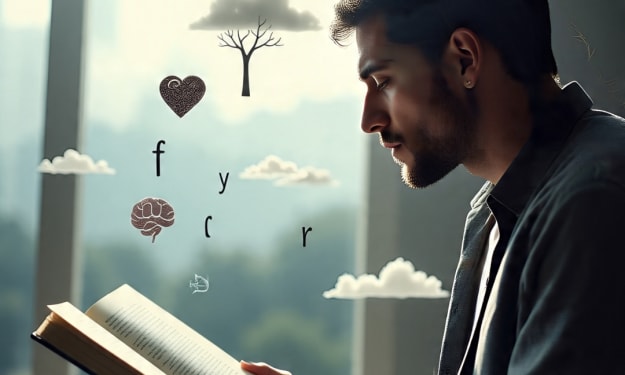
In a quiet café tucked away from the city noise, Maya sat by the window, flipping through the pages of a small, linen-covered poetry book. The words weren’t old-fashioned or hard to grasp. They spoke directly to her — raw, rhythmic, and real. A poem about anxiety hit her like a mirror; another, about hope, wrapped her like a soft scarf. For Maya, and millions like her, modern poetry has become more than literature — it's a psychological lifeline. In recent years, poetry has undergone a vibrant renaissance, not just in form, but in function. Short, impactful verses now flood social media feeds. From Instagram’s square images to TikTok’s spoken-word snippets, poetry has found a digital pulse. But why has it become so magnetic — especially now? Psychologists say it’s because poetry speaks directly to how the human brain processes emotion. Unlike long prose, poetry distills feeling into fragments — a format perfectly tailored to how we actually experience thoughts. According to Dr. Lena Hirsch, a cognitive psychologist and poetry researcher, "Our minds work in snapshots. We remember moments, not monologues. Poetry matches this memory style — it compresses insight into something instantly felt." Recent neuroscience backs this up. In a 2022 study from the University of Exeter, participants reading emotionally powerful poetry showed increased activity in brain regions linked to introspection, empathy, and self-awareness. Intriguingly, some of the strongest reactions came from reading modern, confessional poetry — the kind that speaks of mental health, identity, and everyday vulnerability. Poetry’s effect is also physical. Reading or listening to a resonant poem can trigger a physiological response: goosebumps, tears, even slowed heart rates. "It’s not magic, it’s resonance," says Dr. Hirsch. "When someone puts your emotion into words you couldn’t find yourself, it creates a psychological release — a form of emotional validation that’s deeply soothing." That’s part of why poetry has found new life among younger generations. The rise of poet-influencers like Rupi Kaur, Nikita Gill, and Atticus has shown that minimalist, emotionally direct poetry has power — not just on pages, but in pixels. These poets strip away the grandiose to make space for real feelings: heartbreak, anxiety, resilience. They're not trying to be mysterious; they’re trying to be human. Maya, a 24-year-old art student, explains: "I used to think poetry was something only academics understood. But reading a poem on Instagram about feeling lost — that hit home. It made me feel seen." Her experience isn’t unique. Mental health professionals are now integrating poetry into therapy, a growing field called poetry therapy. Clients are encouraged to write or reflect on poems as a way to process trauma, clarify emotion, and build self-compassion. Beyond therapy, poetry helps people connect. In a world that often moves too fast for reflection, poetry slows us down. It invites stillness, something psychology increasingly links to mental well-being. Reading a poem forces the mind to pause, focus, and interpret — gently engaging both the emotional and logical centers of the brain. It also boosts empathy. In 2023, a Yale study found that regular poetry readers scored significantly higher in empathic reasoning tests. Why? Because poetry, by design, places the reader in someone else’s shoes. It collapses distance — between writer and reader, emotion and understanding. "It makes the abstract personal," explains Dr. Hirsch. "And that, psychologically, is one of the fastest ways to build empathy." What’s most exciting, though, is poetry’s expanding accessibility. It’s not locked in ivory towers anymore. Workshops happen online. Open mic nights stream live on YouTube. AI-generated poetry even sparks discussion about what makes expression human. This democratization means more people are reading, writing, and sharing poetry than ever before — often without even labeling it as such. Poetry is no longer just an art form. It’s becoming a psychological tool — one that’s both ancient and newly vital. Whether in quiet cafés or scrolling before bed, people are turning to it for understanding, healing, and hope. Maya closes her poetry book and looks out the window. The city moves as it always has, fast and loud. But in her mind, there’s a new kind of quiet — the calm that comes when someone else’s words help you find your own.
By Muhammad Saad 6 months ago in Poets