Latest Stories
Most recently published stories on Vocal.
United States Alternative Protein Ingredients Market Trends & Summary (2025–2033). AI-Generated.
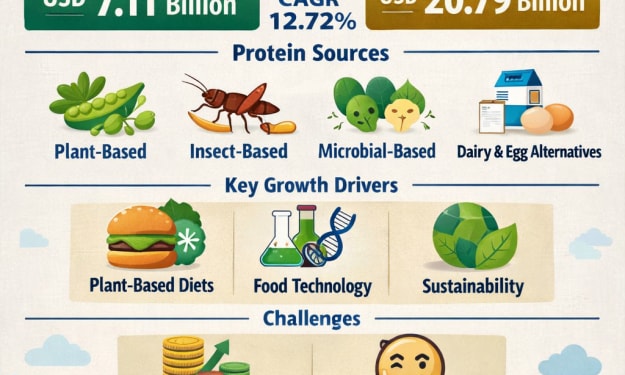
United States Alternative Protein Ingredients Market Overview The United States Alternative Protein Ingredients Market is entering a decisive growth phase as consumers, food manufacturers, and policymakers rethink the future of protein consumption. According to Renub Research, the market is expected to expand substantially from USD 7.11 billion in 2024 to USD 20.79 billion by 2033, registering a strong compound annual growth rate (CAGR) of 12.72% between 2025 and 2033.
By shibansh kumar7 days ago in Trader
The Art of the Silent Exit
The highest level of adult clarity is being selective with your social circle. 1. Releasing grudges is about cutting emotional losses. The human heart has limited capacity; do not fill it with useless garbage. Saving your energy for like-minded people and the things you love is the truest form of self-love.
By Emily Chan - Life and love sharing7 days ago in Poets
Food Service Market Growth Driven by Changing Consumer Dining Trends. AI-Generated.
Food Service Market Overview The Food Service Market includes establishments that prepare and serve food and beverages outside the home, such as restaurants, cafés, catering services, food trucks, institutional kitchens, and digital food delivery platforms. The industry plays a vital role in the global hospitality and retail ecosystem by providing convenient dining solutions to consumers with busy lifestyles. Rapid urbanization, rising disposable incomes, and shifting consumer preferences toward convenience and experiential dining are significantly transforming the market. Additionally, the expansion of digital infrastructure, including mobile ordering and online delivery platforms, has reshaped how consumers access food services, improving accessibility and operational efficiency across the industry.
By James Smith7 days ago in Futurism
Why Emotional Intelligence Matters More Than Obedience in Modern Parenting. AI-Generated.
For many parents, obedience has long been considered the ultimate goal of good parenting. A “well-behaved” child was seen as a successful outcome. I used to believe the same thing. If my child listened, followed rules, and stayed quiet in public, I felt I was doing my job correctly. Over time, however, I began to notice something troubling. While my child was obedient, they struggled to express emotions, handle frustration, and communicate needs in healthy ways. This realization led me to question an important assumption: Is obedience really more important than emotional intelligence? Understanding Emotional Intelligence in Children Emotional intelligence is the ability to recognize, understand, and manage emotions—both one’s own and those of others. For children, this skill is foundational. It influences how they handle conflict, build relationships, and cope with stress throughout life. Children with strong emotional intelligence are more likely to: express feelings clearly instead of acting out, regulate emotions during stressful situations, show empathy toward others, develop resilience and confidence. Unlike obedience, emotional intelligence does not come from control or fear. It grows through guidance, modeling, and emotional safety. The Limits of Obedience-Based Parenting Obedience-focused parenting often relies on authority and consequences. While this approach may produce short-term compliance, it can unintentionally suppress emotional development. When children are taught to obey without understanding, they may: follow rules out of fear rather than awareness, struggle to make decisions independently, feel disconnected from their emotions, hide feelings instead of processing them. I realized that my child was learning what to do, but not why they were doing it—or how to manage the emotions behind their behavior. Shifting the Focus: From Control to Guidance The turning point came when I began prioritizing emotional understanding over immediate compliance. Instead of asking, “Why won’t you listen?” I started asking, “What are you feeling right now?” This shift changed everything. When conflicts arose, I slowed down the interaction. I acknowledged emotions before addressing behavior. I made space for conversations instead of commands. The goal was no longer obedience—it was connection and learning. Teaching Skills That Last a Lifetime When parents focus on emotional intelligence, discipline becomes a teaching tool rather than a punishment. Here are some practical changes that helped: Naming emotions aloud to build emotional vocabulary Validating feelings without excusing harmful behavior Setting clear boundaries with calm consistency Encouraging problem-solving instead of blame Over time, my child began responding differently. Emotional outbursts decreased. Communication improved. Most importantly, my child started developing confidence in handling emotions independently. The Mental Health Connection Emotional intelligence plays a critical role in mental health. Children who are supported emotionally are better equipped to manage anxiety, stress, and social challenges. By fostering emotional awareness early, parents help reduce: chronic stress, emotional suppression, feelings of shame or inadequacy. I noticed that as emotional intelligence increased, our home environment became calmer. Conflicts no longer felt like battles. They became opportunities for growth. Respect Builds Cooperation One of the biggest surprises was that cooperation increased—not decreased—when obedience stopped being the primary focus. When children feel respected and understood, they are more willing to cooperate naturally. Respect does not eliminate boundaries. It strengthens them. Children learn that rules exist for safety and well-being, not control. This understanding builds internal motivation rather than external pressure. Rethinking Success in Parenting Parenting success should not be measured by silence or compliance. It should be measured by a child’s ability to: understand emotions, communicate needs, recover from mistakes, build healthy relationships. Emotional intelligence equips children for real life—long after childhood rules no longer apply. Final Thoughts Obedience may create order, but emotional intelligence creates strength. When parents invest in emotional development, they raise children who are not only well-behaved—but emotionally capable, resilient, and compassionate. In a world filled with challenges, emotional intelligence is not optional. It is essential.
By Zia Djamel7 days ago in Families
Why So Many Startups Fail in Their First Year; And the Real Steps That Save Them
Every year, millions of people decide to chase the same powerful idea. They want to build something of their own. A product that solves a problem. A service that makes life easier. A business that offers freedom, purpose, and independence.
By Zeenat Chauhan7 days ago in FYI
Russia Tequila Market Size and Forecast 2025–2033. AI-Generated.
Russia Tequila Market Overview The Russia tequila market is gradually transforming from a niche imported spirits segment into a recognizable and steadily growing category within the country’s broader alcoholic beverages industry. According to industry estimates, the Russia tequila market is expected to reach US$ 172.02 million by 2033, up from US$ 131 million in 2024, registering a compound annual growth rate (CAGR) of 3.08% during 2025–2033.
By Sakshi Sharma7 days ago in Trader
Mexico Compound Feed Market Trends & Summary: A Growing Pillar of Latin America’s Livestock Economy. AI-Generated.
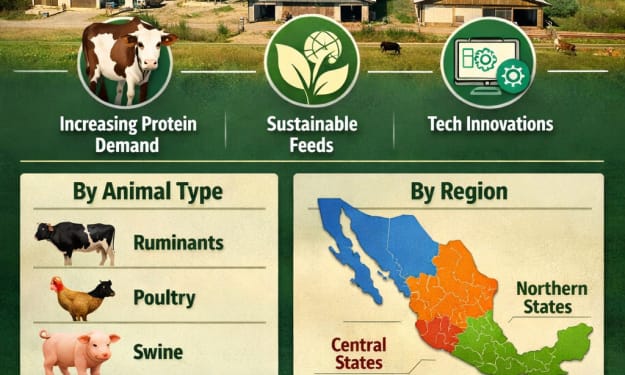
Introduction: Feeding a Nation’s Livestock Ambitions Mexico’s agricultural and livestock sectors are undergoing a profound transformation, and at the center of this evolution lies the compound feed industry. As one of Latin America’s most important producers of animal protein, Mexico relies heavily on a robust, innovative, and scalable feed ecosystem to support its poultry, swine, cattle, and aquaculture industries. From industrial-scale feed mills to regionally focused producers, the compound feed market has become a strategic pillar of food security, rural employment, and export-driven growth.
By Sakshi Sharma7 days ago in Trader
From Misconfigurations to Data Exposure: Web App Risks in Healthcare
Introduction Healthcare organizations increasingly rely on web applications to power patient portals, telemedicine platforms, electronic health record access, appointment scheduling, billing, and third-party integrations. These applications improve care delivery and operational efficiency, but they also introduce significant security risk.
By Sam Bishop7 days ago in 01