
Mexico Compound Feed Market Trends & Summary: A Growing Pillar of Latin America’s Livestock Economy
Rising protein demand, sustainable feed innovation, and digital transformation drive Mexico’s compound feed market toward US$ 11.48 billion by 2033

Introduction: Feeding a Nation’s Livestock Ambitions
Mexico’s agricultural and livestock sectors are undergoing a profound transformation, and at the center of this evolution lies the compound feed industry. As one of Latin America’s most important producers of animal protein, Mexico relies heavily on a robust, innovative, and scalable feed ecosystem to support its poultry, swine, cattle, and aquaculture industries. From industrial-scale feed mills to regionally focused producers, the compound feed market has become a strategic pillar of food security, rural employment, and export-driven growth.
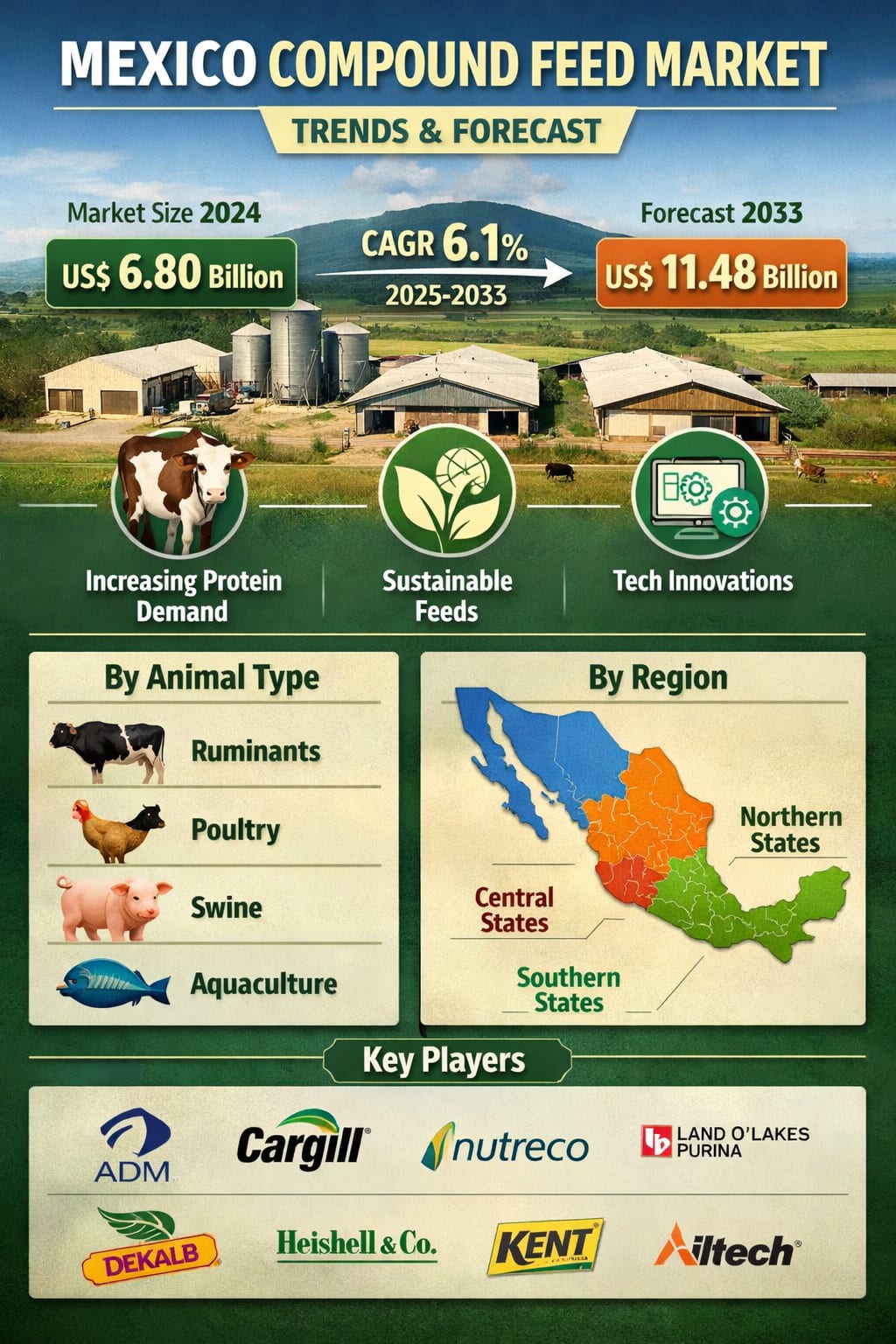
According to industry estimates, the Mexico Compound Feed Market was valued at US$ 6.80 billion in 2024 and is expected to reach US$ 11.48 billion by 2033, expanding at a compound annual growth rate (CAGR) of 6.10% from 2025 to 2033. This impressive growth trajectory reflects not only rising domestic consumption of meat, milk, and eggs, but also structural changes in how feed is formulated, produced, and distributed across the country.
Key forces shaping this market include the growing demand for animal-based protein, the shift toward sustainable and specialty feed products, and the increasing adoption of digital tools and advanced technologies in feed formulation and production. Together, these trends are redefining Mexico’s role in the regional and global livestock value chain.
Mexico Compound Feed Industry Overview
The compound feed industry is a vital component of Mexico’s broader agricultural economy. It supports one of the country’s most important productive activities: livestock farming. From poultry and swine to cattle and aquaculture, nearly every segment of animal production depends on a consistent supply of nutritionally balanced, cost-effective feed.
Mexico has established itself as one of Latin America’s largest producers of compound feed, driven by strong domestic demand and a growing export-oriented livestock sector. The industry supplies a wide range of feed products, including poultry feed, cattle feed, swine feed, and aquafeed, each tailored to specific nutritional requirements and production goals. As population growth and rising disposable incomes continue to shape consumption patterns, the demand for meat and dairy products has steadily increased, reinforcing the need for high-quality compound feed.
The structure of the Mexican compound feed sector is a mix of local and regional producers alongside large multinational agribusiness companies. This blend creates a competitive environment where scale, innovation, and supply chain efficiency play critical roles. In recent years, the industry has seen significant technological progress, particularly in feed formulation, ingredient optimization, and production efficiency. These innovations are not only improving animal performance and feed conversion ratios but also helping producers respond to growing concerns about sustainability and environmental impact.
At the same time, the industry faces persistent challenges. Price volatility in key raw materials such as corn and soybeans can significantly affect production costs and profitability. Despite these obstacles, the long-term outlook remains positive, supported by strong protein demand and continuous improvements in livestock production systems.
Mexico’s Position in the Global Livestock and Feed Landscape
Mexico is widely recognized as a major livestock-producing nation. Cattle, swine, sheep, goats, and poultry farming are deeply embedded in its agricultural landscape. The country is also one of the world’s leading producers and exporters of beef, and poultry and pork production continue to expand steadily.
In recent years, Mexico has produced tens of millions of metric tons of animal feed annually for poultry, swine, cattle, dairy, pet food, and aquaculture sectors, placing it among the world’s top feed-producing countries. Meat production figures further highlight the scale of the opportunity: millions of metric tons of poultry, beef, and pork are produced each year, serving both domestic consumers and international markets.
This strong livestock base naturally fuels demand for compound feed and feed additives. As producers seek to improve productivity, animal health, and product quality, the role of scientifically formulated feed becomes even more critical. High-quality and cost-effective feed solutions are no longer optional—they are essential for competitiveness in both domestic and export markets.
Government support also plays a role. Through targeted subsidies, rural development programs, and productivity-enhancing initiatives, Mexican authorities continue to promote agricultural and livestock efficiency. Financial support programs, especially during periods of climatic stress such as drought, help stabilize farm incomes and indirectly sustain demand for feed products. Over time, these policies are expected to further strengthen the compound feed market’s growth trajectory.
Key Growth Drivers Shaping the Market
Adoption of Specialty and Sustainable Feeds
One of the most important trends reshaping the Mexico compound feed market is the growing shift toward specialty and sustainable feed solutions. Environmental concerns, changing consumer preferences, and stricter regulatory frameworks are pushing producers to move away from conventional formulations that rely heavily on synthetic additives and antibiotics.
There is rising interest in feeds that incorporate locally sourced ingredients, alternative protein sources, and more environmentally friendly production methods. Precision fermentation, organic waste recycling, and circular economy approaches are gaining traction as companies look for ways to reduce costs and environmental impact simultaneously. Some players are even exploring the use of agricultural by-products and food waste streams to create nutritionally viable feed inputs.
This shift is not only about sustainability—it is also about market differentiation. As consumers increasingly demand traceability, animal welfare, and “cleaner” food products, livestock producers are responding by upgrading their feeding strategies. In turn, this is creating new growth opportunities for feed manufacturers that can offer innovative, high-performance, and sustainable solutions.
Developments in Feed Formulation and Production Technology
Technological advancement is another powerful growth engine for the Mexican compound feed market. Digital tools, automation, and data-driven formulation systems are transforming how feed is produced and optimized. Modern feed mills can now adjust formulations in real time, improving nutritional precision and reducing waste.
These innovations help manufacturers deliver more consistent quality, improve feed efficiency, and lower overall production costs. For livestock producers, this translates into better growth rates, improved animal health, and more predictable production outcomes. For feed companies, it means stronger competitiveness and the ability to respond quickly to changing market conditions.
Investments in new feed mills, hatcheries, and integrated production facilities reflect this technology-driven shift. The industry’s commitment to modernization underscores a broader strategy: using innovation to balance productivity, sustainability, and profitability in an increasingly demanding global food system.
Growing Production and Consumption of Livestock Products
Ultimately, the strongest driver of the compound feed market remains the growing demand for animal-based food products. As Mexico’s population grows and income levels rise, consumption of meat, milk, and eggs continues to increase. Long-term projections suggest that per capita meat consumption will keep climbing over the next decade, reinforcing the need for higher and more efficient livestock output.
To meet this demand, producers are scaling up operations and adopting more intensive, technology-driven farming models. These systems rely heavily on compound feed to ensure consistent nutrition, faster growth cycles, and better feed conversion ratios. Specialized feed formulations designed for different species and production stages are becoming standard practice, further boosting market demand.
In this way, compound feed is not just a supporting industry—it is a central enabler of Mexico’s expanding livestock economy.
Challenges Facing the Mexico Compound Feed Market
Raw Material Price Volatility
One of the most persistent challenges for the industry is the volatility of raw material prices. Key ingredients such as corn, soybeans, and wheat are subject to fluctuations driven by weather events, global supply chain disruptions, and changes in trade policies. Droughts, floods, or crop diseases in major producing regions can quickly tighten supply and push prices upward.
For feed manufacturers, these fluctuations directly impact production costs and profit margins. Higher input costs often translate into higher feed prices, which can strain livestock producers and, ultimately, affect food prices for consumers. Managing this volatility requires strong procurement strategies, diversified sourcing, and, in some cases, financial hedging mechanisms.
Disease Outbreaks and Biosecurity Risks
Livestock disease outbreaks, such as avian influenza or African swine fever, represent another major risk. When such diseases strike, they can lead to large-scale culling, reduced herd sizes, and a sudden drop in demand for animal feed. For feed producers, this can mean lower sales volumes, disrupted production planning, and financial losses.
Beyond demand shocks, disease outbreaks can also disrupt logistics and trade, delaying the movement of both raw materials and finished feed products. While biosecurity measures and improved veterinary controls can reduce these risks, they remain an inherent source of uncertainty for the market.
Regional Dynamics: Northern, Central, and Southern States
Northern States
The Northern States of Mexico, including regions such as Nuevo León, Coahuila, and Chihuahua, play a crucial role in the national livestock economy. With strong cattle, poultry, and swine production bases, these states generate significant demand for compound feed and feed additives.
Producers in the north increasingly focus on efficiency, growth optimization, and animal health, driving demand for vitamins, minerals, enzymes, and probiotics. At the same time, interest in natural and organic additives is rising as sustainability gains importance. Despite challenges related to input costs and logistics, the Northern States remain a key growth engine for the market.
Central States
The Central States, including Jalisco, Guanajuato, and Michoacán, represent the heart of Mexico’s livestock production. This region concentrates a large share of the country’s pig, cattle, and poultry output, making it a major hub for compound feed consumption.
Here, the emphasis is on maximizing feed efficiency and productivity through advanced formulations and performance-enhancing additives. As consumer awareness around sustainability and food quality increases, demand for cleaner and more natural feed solutions is also growing. While price volatility and supply chain disruptions pose challenges, the Central States continue to be a cornerstone of the national feed industry.
Southern States
In the Southern States, including Veracruz, Oaxaca, and Chiapas, agricultural activity—particularly in poultry and swine production—supports steady growth in the feed market. Demand for vitamins, minerals, probiotics, and enzymes is driven by the need to improve animal health, feed conversion, and overall productivity.
Sustainability trends are also influencing this region, with growing interest in organic and plant-based additives. However, climatic conditions, infrastructure constraints, and raw material price fluctuations can affect market stability. Even so, the Southern States remain an important and expanding segment of Mexico’s compound feed landscape.
Market Segmentation Overview
By Animal Type:
Ruminants
Poultry
Swine
Aquaculture
Others
By Ingredient:
Cereals
Cakes and Meals
By-products
Supplements
By Region:
Northern States
Central States
Southern States
Competitive Landscape and Key Players
The Mexican compound feed market is highly competitive, featuring a mix of global agribusiness giants and strong regional players. Companies compete on product quality, innovation, distribution reach, and technical support services.
Key players operating in the market include:
Archer Daniels Midland
DeKalb Feeds
Heiskell & Co.
Kent Feeds
Nutreco
Cargill Inc.
Land O’Lakes Purina
Alltech Inc.
These companies continue to invest in research and development, new production facilities, and strategic partnerships to strengthen their market positions and respond to evolving customer needs.
Final Thoughts: A Market Poised for Sustainable Growth
The Mexico compound feed market stands at the intersection of rising protein demand, technological innovation, and sustainability-driven transformation. With the market projected to grow from US$ 6.80 billion in 2024 to US$ 11.48 billion by 2033, the sector is set to play an even more critical role in shaping the future of Mexico’s livestock and food industries.
While challenges such as raw material price volatility and disease risks remain, the long-term fundamentals are strong. Growing livestock production, increasing consumer demand for animal protein, and continuous improvements in feed technology and sustainability practices all point toward a resilient and expanding market.
About the Creator
Sakshi Sharma
Content Writer with 7+ years of experience crafting SEO-driven blogs, web copy & research reports. Skilled in creating engaging, audience-focused content across diverse industries.
Keep reading
More stories from Sakshi Sharma and writers in Trader and other communities.
Saudi Arabia Wine Market Trends & Summary: A New Era of Alcohol-Free Luxury
Introduction: A Market Evolving Against Tradition Saudi Arabia’s relationship with wine is unlike that of any other major economy in the world. In a country where alcohol consumption is strictly prohibited by law due to religious and cultural principles, the very idea of a “wine market” might seem contradictory. Yet, the reality on the ground in 2025 and beyond tells a far more nuanced story—one driven by non-alcoholic innovation, changing consumer lifestyles, ambitious economic reforms, and a rapidly globalizing hospitality sector.
By Sakshi Sharmaabout 9 hours ago in Trader
Who Benefited From the Bitcoin Crash?
Who Benefited From the Bitcoin Crash? When Bitcoin crashes, headlines focus on losses: wiped-out traders, liquidated positions, and red charts flashing across screens. But in every major market drop, an uncomfortable truth remains—someone always benefits. The Bitcoin crash that followed heightened global uncertainty did not erase wealth; it redistributed it.
By Wings of Time about 13 hours ago in Trader
Philippines Ecotourism Market 2026: Sustainable Travel, Community Tourism & Nature-Led Growth
Philippines Ecotourism Market Overview The Philippines ecotourism market is emerging as a powerful force within the country’s broader tourism industry, driven by rising environmental awareness, community-based travel models, and a global shift toward responsible tourism. With its rich biodiversity, pristine coastlines, rainforests, and culturally diverse communities, the Philippines is uniquely positioned to benefit from ecotourism that prioritizes conservation while supporting local livelihoods. The Philippines ecotourism market size reached USD 4,898.7 Million in 2025. The market is projected to reach USD 12,388.0 Million by 2034, exhibiting a growth rate (CAGR) of 10.86% during 2026-2034.
By Manisha Dixit3 days ago in Trader
The Devil's Triangle
The sails ruffled in the breeze as we cruised along. The Sea Breeze was a mid-size catamaran that sailed out of Royal Naval Dockyard in Bermuda. We had booked this trip weeks in advance and were now looking at our Captain, Spike and two boat hands. Paddy and Wilson seemed like nice guys, joking around with the passengers and telling us some stories about Bermuda that only locals would know. Their island accents sounded almost British but they were pleasant to listen to.
By Barbara Gode Wiles6 days ago in Fiction



Comments
There are no comments for this story
Be the first to respond and start the conversation.