
Russia Tequila Market Size and Forecast 2025–2033
From Vodka Tradition to Agave Curiosity: How Tequila Is Carving a Premium Niche in Russia

Russia Tequila Market Overview
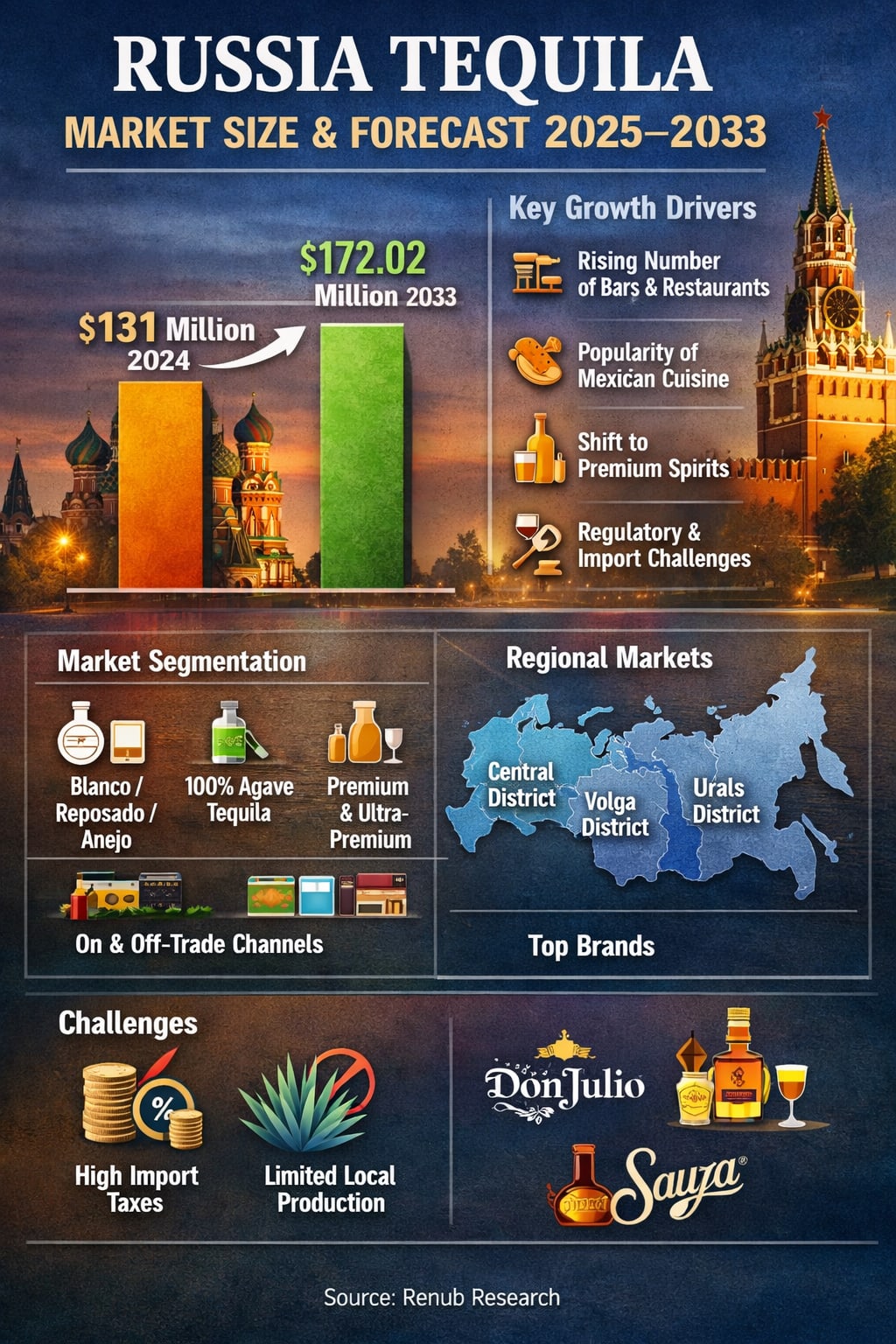
The Russia tequila market is gradually transforming from a niche imported spirits segment into a recognizable and steadily growing category within the country’s broader alcoholic beverages industry. According to industry estimates, the Russia tequila market is expected to reach US$ 172.02 million by 2033, up from US$ 131 million in 2024, registering a compound annual growth rate (CAGR) of 3.08% during 2025–2033.
While vodka continues to dominate Russia’s spirits landscape due to deep-rooted cultural and historical preferences, tequila has begun to establish a distinct identity, particularly among younger consumers and urban professionals seeking new and international drinking experiences. The increasing number of bars, pubs, and restaurants, the rising popularity of Mexican cuisine and themed festivals, and a visible shift toward premium and ultra-premium alcoholic beverages are all contributing to this steady growth trajectory.
Tequila in Russia is largely driven by imports from Mexico, the spirit’s country of origin. Global brands such as Don Julio, Jose Cuervo, and Sauza are among the most recognizable names shaping consumer awareness and category development. Their presence in high-end bars, restaurants, and specialty liquor stores has helped position tequila not merely as a party drink, but as a sophisticated spirit suitable for cocktails, tastings, and premium social occasions.
At the same time, Russian producers have shown interest in developing tequila-like spirits locally. However, this ambition faces a major structural limitation: tequila is protected by a Denomination of Origin (DO), which legally restricts authentic production to specific regions of Mexico. As a result, the Russian market remains heavily dependent on imports, making pricing, availability, and distribution closely tied to international trade conditions and regulatory frameworks.
Despite these constraints, tequila continues to gain traction, particularly in the premium segment. Russian consumers, especially in large metropolitan areas, are increasingly drawn to well-branded, high-quality international spirits that signal lifestyle, status, and global taste. This broader cultural shift toward “drinking better, not more” is becoming a central theme in the evolution of Russia’s spirits market—and tequila is benefiting directly from it.
Premiumization: A Key Driver of Market Growth
One of the most important trends shaping the Russia tequila market is the country’s ongoing move toward premium and ultra-premium alcoholic beverages. Rising disposable incomes and changing consumer aspirations are encouraging buyers to prioritize quality, brand heritage, and unique flavor profiles over sheer volume.
The average net-adjusted disposable income per capita in the Russian Federation stands at around USD 19,546 per year, and approximately 70% of the population aged 15 to 64 is employed. This growing base of working professionals, particularly in urban centers, is increasingly willing to spend more on high-quality lifestyle products, including imported spirits.
Tequila, once seen as a novelty or party shot, is now being repositioned as a refined spirit with craftsmanship, heritage, and complexity. Premium and super-premium tequila brands are emphasizing aspects such as 100% agave content, aging processes, and authentic Mexican origins to appeal to affluent consumers and spirits enthusiasts. For this audience, tequila is not just a drink—it is an experience, a conversation piece, and a symbol of global taste.
This premiumization trend is also closely linked to the broader evolution of Russia’s alcohol consumption patterns. Health awareness, lifestyle changes, and a growing appreciation for curated drinking experiences are all contributing to a market environment where fewer drinks of higher quality are increasingly preferred over mass consumption. Tequila fits well into this narrative, especially in cocktail culture and upscale social settings.
Tequila Consumption Growth in Russia
Rising Preference for Premium Spirits
Russia’s growing appetite for premium spirits is one of the strongest forces behind the expansion of the tequila market. As consumers become more exposed to international brands and global drinking trends, they are increasingly exploring categories beyond traditional choices like vodka and cognac.
Tequila’s appeal lies in its combination of authenticity, craftsmanship, and distinct flavor profile. Younger consumers and urban professionals, in particular, are drawn to products that offer a sense of exclusivity and global identity. For this group, tequila represents not only a beverage choice but also a lifestyle statement—one that aligns with travel, international cuisine, and modern social culture.
The willingness to pay more for quality and branding is helping premium and ultra-premium tequila segments outperform lower-priced alternatives. This shift is gradually reshaping shelf space in liquor stores and drink menus in bars, giving tequila more visibility and credibility as a serious spirits category in Russia.
Growing Cocktail Culture
Another major growth engine for the Russia tequila market is the rapid expansion of cocktail culture, especially in major cities such as Moscow and St. Petersburg. Bars, lounges, and restaurants are increasingly focusing on creative mixology, and tequila-based cocktails like Margaritas and Tequila Sunrises have become staples on many menus.
Tequila’s versatility makes it particularly attractive for this trend. It can be used in a wide range of cocktails, from refreshing citrus-based drinks to more complex, spirit-forward creations. This adaptability helps tequila reach a broader audience, including consumers who may not typically drink spirits neat but enjoy them in mixed drinks.
As Russian consumers become more adventurous and open to experimenting with new flavors, tequila’s role in social drinking continues to expand. What was once a niche import is now becoming a familiar and fashionable choice in urban nightlife and dining scenes.
Expansion of the Hospitality Industry
The growth of Russia’s hospitality industry is also playing a crucial role in increasing tequila consumption. The steady rise in the number of bars, restaurants, hotels, and entertainment venues—particularly in large cities—has created more opportunities for consumers to discover and try tequila in different formats.
Hospitality venues are increasingly curating diverse and premium spirits portfolios to attract customers seeking new experiences. Tequila fits naturally into this strategy, especially as part of cocktail menus and premium spirit selections. The expansion of international restaurant chains and themed dining concepts has further strengthened tequila’s presence, especially in Mexican and fusion cuisine settings.
This broader availability in on-trade channels is essential for building brand awareness, educating consumers, and normalizing tequila as a regular part of Russia’s spirits culture.
Challenges in the Russia Tequila Market
High Import Taxes and Regulations
Despite its growth potential, the Russia tequila market faces significant challenges, particularly in the form of high import duties and strict alcohol regulations. These factors increase the retail price of imported tequila, making it less accessible to a wider audience and limiting its appeal in the mid-range price segment.
Higher prices often push cost-sensitive consumers toward more affordable local spirits or traditional options like vodka, which benefits from established production, distribution, and regulatory advantages. This price gap makes it harder for tequila to compete on volume, even as it gains ground in the premium segment.
In addition, regulatory complexity around alcohol imports, labeling, and distribution adds operational challenges for brands and distributors, potentially slowing market expansion and limiting product variety.
Limited Local Production
Another structural limitation is the inability to produce authentic tequila locally due to Denomination of Origin rules. Since tequila must be produced in specific regions of Mexico, Russia remains entirely dependent on imports to supply its market.
This dependence exposes the market to supply chain risks, including shipping delays, currency fluctuations, customs procedures, and changes in trade policies. It also limits the flexibility of producers and distributors to quickly scale supply or adjust pricing strategies in response to market demand.
Compared to locally produced spirits, which benefit from lower costs and more stable supply chains, tequila faces inherent competitive disadvantages that continue to shape its market dynamics in Russia.
Russia Tequila Market by Product Type and Channel
The Russia tequila market spans a wide range of segments, including Blanco, Joven, Reposado, Añejo, and other varieties, as well as different purity levels such as 100% tequila and mixed tequila products.
In terms of pricing, the market is increasingly oriented toward premium, super-premium, and ultra-premium categories, reflecting the broader premiumization trend.
Distribution is split between off-trade channels (such as supermarkets, hypermarkets, discount stores, and online platforms) and on-trade channels (including restaurants, bars, and liquor-focused venues). While off-trade remains important for volume sales, on-trade plays a crucial role in brand building, consumer education, and driving trial through cocktails and curated menus.
Russia Tequila Market Overview by Regions
By region, the Russia tequila market is segmented into the Central District, Volga District, Urals District, Northwestern District, Siberian District, and others.
Central District Tequila Market
The Central District, anchored by Moscow and surrounding areas, represents the most important and developed tequila market in Russia. Moscow’s status as the country’s financial, cultural, and nightlife capital makes it a natural hub for premium and imported spirits.
The region’s dense concentration of bars, restaurants, and entertainment venues supports strong demand for tequila, particularly in cocktail culture. Younger, urban consumers are more open to experimenting with international spirits, helping tequila gain visibility and acceptance. Although competition from vodka and high import costs remain challenges, the Central District is expected to remain the main growth engine for tequila in Russia.
Volga District Tequila Market
The Volga District, including cities such as Kazan and Nizhny Novgorod, represents an emerging market for tequila. While vodka still dominates, changing consumer preferences and the gradual spread of cocktail culture are creating new opportunities for international spirits.
Growth in this region is more gradual, constrained by distribution limitations and price sensitivity. However, as the hospitality sector expands and consumer tastes evolve, tequila is slowly finding its place, particularly in larger urban centers.
Urals District Tequila Market
In the Urals District, cities like Yekaterinburg and Chelyabinsk are witnessing a slow but noticeable shift toward premium imported spirits. Tequila is benefiting from the rise of modern bars, international restaurants, and changing social habits among younger consumers.
Availability and pricing remain key challenges, especially outside major cities. Still, the region offers long-term potential as demand for diverse and premium spirits continues to grow alongside urban development and lifestyle changes.
Competitive Landscape and Company Analysis
The Russian tequila market is primarily shaped by well-known international brands, with Don Julio, Jose Cuervo, and Sauza among the most prominent names. These companies benefit from strong global brand recognition, established distribution networks, and a clear premium positioning strategy.
Their focus on authenticity, quality, and brand storytelling helps differentiate tequila from other spirits and supports its premium image in the Russian market. As competition intensifies, marketing, education, and on-trade partnerships are likely to play an even bigger role in shaping consumer preferences.
Final Thoughts
The Russia tequila market may still be small compared to traditional spirits categories, but its growth story is clear and compelling. With the market projected to rise from US$ 131 million in 2024 to US$ 172.02 million by 2033, tequila is steadily carving out a space in Russia’s evolving alcoholic beverages landscape.
Driven by premiumization, expanding cocktail culture, and the growth of the hospitality industry, tequila is increasingly seen as more than just an occasional novelty. It is becoming a symbol of modern taste, international influence, and refined social drinking.
While challenges such as high import taxes, regulatory complexity, and dependence on imports will continue to shape the market, the long-term outlook remains positive. As Russian consumers continue to embrace quality, authenticity, and global experiences, tequila is well-positioned to benefit from this cultural and economic shift—one carefully crafted cocktail at a time.
About the Creator
Sakshi Sharma
Content Writer with 7+ years of experience crafting SEO-driven blogs, web copy & research reports. Skilled in creating engaging, audience-focused content across diverse industries.
Keep reading
More stories from Sakshi Sharma and writers in Trader and other communities.
Mexico Compound Feed Market Trends & Summary: A Growing Pillar of Latin America’s Livestock Economy
Introduction: Feeding a Nation’s Livestock Ambitions Mexico’s agricultural and livestock sectors are undergoing a profound transformation, and at the center of this evolution lies the compound feed industry. As one of Latin America’s most important producers of animal protein, Mexico relies heavily on a robust, innovative, and scalable feed ecosystem to support its poultry, swine, cattle, and aquaculture industries. From industrial-scale feed mills to regionally focused producers, the compound feed market has become a strategic pillar of food security, rural employment, and export-driven growth.
By Sakshi Sharmaabout 6 hours ago in Trader
Buried for 33 Years: The Dream to Revive One of the Country’s Largest Gold Mines Suddenly Back on the Map
For more than three decades, one of the country’s most valuable natural resources lay dormant beneath layers of dust, disputes, and missed opportunities. Hidden deep in the rugged terrain of Balochistan, the legendary gold and copper mine remained silent — its potential buried along with the dreams of economic transformation it once inspired.
By Sajida Sikandar7 days ago in Trader




Comments
There are no comments for this story
Be the first to respond and start the conversation.