science
The Science Behind Relationships; Humans Media explores the basis of our attraction, contempt, why we do what we do and to whom we do it.
Who Owns You? Social Media Platforms or Yourself?
In the digital age, your online identity is arguably as important as your physical one. Social media platforms like Facebook, Instagram, TikTok, and X (formerly Twitter) have become the gatekeepers of our virtual selves. They store our data, influence what we see, shape our opinions, and monetize our presence—often without our informed consent. The question is no longer whether our data is being collected, but rather: Who owns it, and what rights do we have over it?
By Qismat ullah wazir 10 months ago in Humans
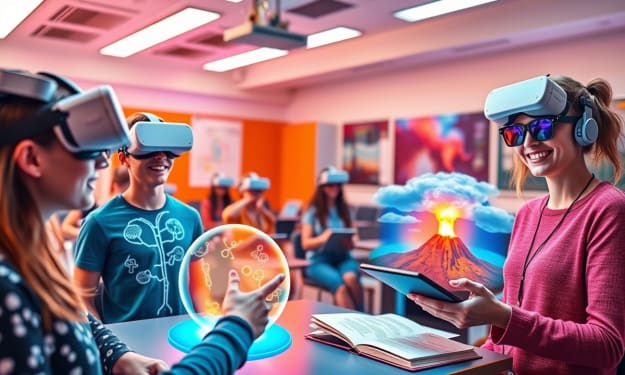
the Lesson: When AR and VR Come to the Rescue in Education
Can you still recall how you dozed off in history class, struggling to pull together an image of Julius Caesar crossing the Rubicon from an unattractive picture in a textbook? Or maybe staring at a plant cell diagram and wishing to figure out what all those squiggly lines did? That question is now irrelevant. With traditional learning, the emphasis is on memory through passive absorption—reading, listening, and memorizing. In other words, what if you could experience it firsthand? What if learning would feel like an adventure instead of an assignment?
By zobairuddin Zobair10 months ago in Humans
Title: Why Personal Narratives Matter: The Power of Human Stories
Title: Why Personal Narratives Matter: The Power of Human Stories Introduction: Humanity's Lifeblood We told stories before we could write, tweet, or even carve symbols into stone. Around ancient fires, under starlit skies, humans shared their lives through words—simple, raw, and powerful. These stories weren’t just entertainment; they were bridges—connecting generations, preserving culture, and giving meaning to life. Despite all the data and distractions of the digital age, one thing is still true: stories continue to move us. In ways that facts alone cannot, personal narratives—which are intimate, honest, and deeply human—can change minds, motivate action, and cultivate empathy. Why, then? What is it about personal storytelling that matters so much?
By Afia Sikder10 months ago in Humans
How Human Memory Works: The Fascinating Science of Forgetting and Remembering
Title: How Human Memory Works: The Fascinating Science of Forgetting and Remembering The Mysterious Power of Memory One of the most fascinating and intricate aspects of our existence is human memory. From remembering the scent of your grandmother’s kitchen to recalling a complicated mathematical formula, memory is intricately tied to every part of our lives. Imagine your brain as a living library, constantly cataloging, storing, and retrieving information that defines who you are. But this system isn’t flawless. Trauma or illness can cause us to misplace keys, forget names, or even completely lose our memories. So, exactly how does memory work? What makes us forget? Furthermore, how can we enhance our memory? The depths of human memory, their formation and decay, and the prospects for memory science are examined in this article. How Does Human Memory Work? The process of encoding, storing, and retrieving information is at the heart of memory. It is an essential brain function that enables us to navigate the present, make plans for the future, and learn from the past. Without memory, our experiences would be fleeting and meaningless.
By Afia Sikder10 months ago in Humans
The Power of Perseverance
In the heart of a bustling city, amidst the towering skyscrapers and the ceaseless hum of traffic, lived a young boy named Ethan. Ethan was a bright and curious child, always eager to learn and explore the world around him. However, there was one thing that made Ethan feel different from the other children in his neighborhood: his stutter.
By Dr. Ummay Musa10 months ago in Humans
What Makes Us Human: Examining Our Unique Qualities
What Makes Us Human: Examining Our Unique Qualities Identifying Human Nature in the Beginning The question "What makes us human?" is present in the ever-evolving world of science, philosophy, and culture. has captured the imaginations of thinkers for centuries. The quest to define what sets us apart from the rest of the animal kingdom has sparked extensive discussion and reflection from ancient philosophers like Aristotle to contemporary scientists. In this section, we’ll explore the historical perspective on what makes us human, starting with early philosophical views and advancing through modern scientific inquiries. The introduction will provide readers with a comprehensive understanding of the significance of this question to our quest for self-awareness and social progress.
By Afia Sikder10 months ago in Humans
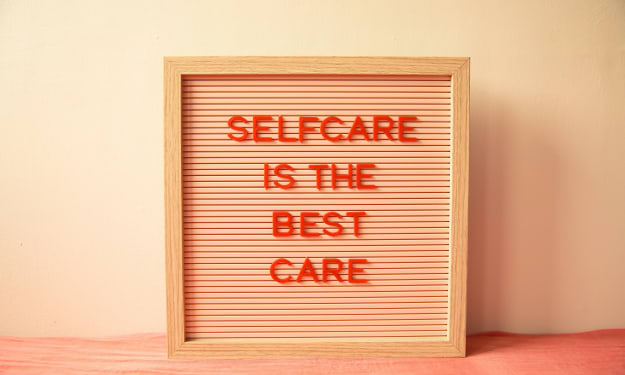
Why Self-Care Is Crucial for the Modern Human: A Guide to Taking Care of Yourself
The Modern Human Dilemma, Chapter 1 Digital overload, hustle culture's pressures, and the rise of burnout are just some of the unique challenges that modern humans face. In this chapter, we'll look at each of these issues. It will look at how, despite advances in technology, people are more stressed, anxious, and disconnected than ever before.
By Afia Sikder10 months ago in Humans
Understanding Thoughts, Feelings, and Actions: A Journey Into the Human Mind
Understanding Thoughts, Feelings, and Actions: A Journey Into the Human Mind Introduction: The Inside Mysteries There are times in life when everything seems to be falling apart inside rather than outside. Despite being in a crowded room, your thoughts are racing. A single memory can set off a storm of thoughts that spiral into feelings that make you feel tight in your chest and affect your every move. In those moments, have you ever wondered: Why did I feel that way? Why did I react like that? What is my mind doing to me?
By Afia Sikder10 months ago in Humans
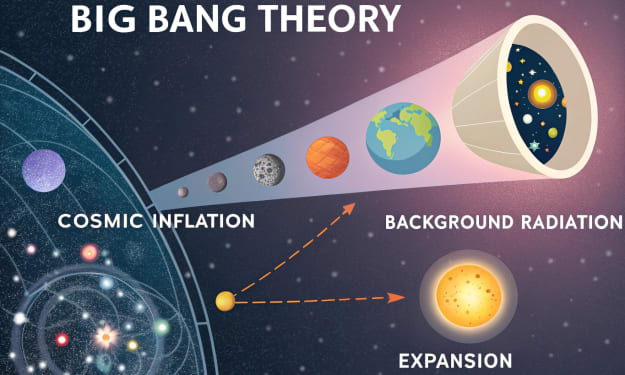
The Big Bang Theory: Revealing the Origins of the Universe
The universe we occupy is immense, enigmatic, and perpetually changing. But what initiated it all? The prevailing explanation in contemporary science regarding the universe's origin is the Big Bang Theory. This cosmological framework posits that the universe commenced approximately 13.8 billion years ago, emerging from an extremely hot and dense state and has been expanding ever since.
By G.M. Rayhan10 months ago in Humans