
the Lesson: When AR and VR Come to the Rescue in Education
AR and VR Transform Education into an Immersive Adventure

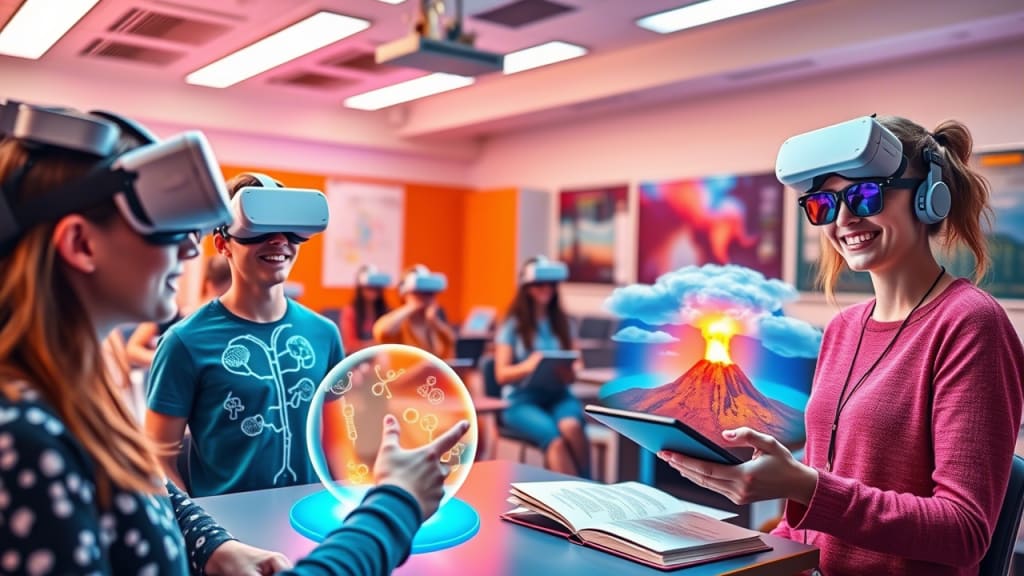
Can you still recall how you dozed off in history class, struggling to pull together an image of Julius Caesar crossing the Rubicon from an unattractive picture in a textbook? Or maybe staring at a plant cell diagram and wishing to figure out what all those squiggly lines did? That question is now irrelevant. With traditional learning, the emphasis is on memory through passive absorption—reading, listening, and memorizing. In other words, what if you could experience it firsthand? What if learning would feel like an adventure instead of an assignment?
Well, when the earth rotates, AR and VR, these words take an inside corridor in your mind because they are moving inside the classroom from the gaming zone, making education an interactive, engaging, and, frankly, much cooler experience.
But before getting your way, let us quickly hammer out our definition.
AR versus VR: In All Honesty, What's the Difference Here?
AR and VR are very commonly lumped together, but they provide pretty separate experiences. Consider it in this way:
• Virtual Reality (VR): This is the one that you strap onto your head, blocking your view of the real world entirely. In its place, you are taken into some other entirely different, digitally created environment. You could be swimming with dolphins, checking out the surface of Mars, or being trained on an operating table for surgery. It's a matter of transporting you to the other place. Almost remember VR arcade games? That's pretty much this one applied to the concept of learning.
• Augmented Reality (AR): AR operates under different principles. The real reality is not replaced by AR; it is merely augmented. With a smartphone or tablet or AR glasses special for this purpose, digital information in the form of images, videos, or even three-dimensional models is superimposed over the real world that you could see in front of you. In education, the idea would allow you to point your phone at a textbook page and see a 3D representation of the solar system pop right out at you or raise the tablet in a museum and see information about an artifact appear right next to it. It's enhancing the real world around us.
So, VR takes you away, and AR brings digital stuff to you. Both have tremendous educational potentials, just in different ways.
Why Now? A Shift Towards Immersive Learning
"And you think, Okay, some neat stuff out there; but is this really happening?" The answer, of course, is an absolute yes, and it's accelerating. There is a perfect storm of everything happening to bring AR and VR education into the forefront:
1. The Technology is Ready: The headsets are getting lighter, cheaper (somewhat!), and more powerful. The software is becoming sufficiently advanced as well as user-friendly. It has moved beyond being a mere collection of wobbly prototypes and is now truly usable.
2. The Need for Engagement: In the digital world, with millions of distractions, student engagement poses a tough challenge. AR and VR carry an aura of novelty and interactivity fully capable of grabbing and sustaining attention. Learning then becomes an experience and not just a chore.
3. Skill-Driven: Education today is more than a repository of factual information; it is a facilitation for critical thinking, problem-solving, and real-life skills. Just as VR can simulate a safe environment for students to learn the complex tasks of welding, surgery, or repairing a faulty machine over and over again.
4.
Accessibility: For students in rural schools and without a lot of budget for field trips, suddenly there's VR available to "transport" them to the Louvre in Paris or the Great Barrier Reef. Education can begin to be liberated from geographic and physical constraints in ways we've only begun to think about.
It feels like a transition moment: from "Wouldn't it be cool if..." to "Okay, how do we even begin to implement this?"
Virtual Reality: More than field trips to impress.
Indeed, VR field trips are a very fun use of VR (who would not like to see ancient Egypt from his/her desk?). However, we can take the educational possibilities of VR far deeper.
Making the Abstract Real:
Now, how about trying to grasp the idea of complex scientific concepts like molecular structures or astrophysics? It is one thing to simply read about them, but VR allows students to manipulate 3D models of molecules, fly through a representation of the solar system, or shrink down and journey through the insides of a human heart. It makes the abstract tangible. I do remember my struggles with chemistry—perhaps if I saw those atomic bindings forming in 3D, it would have clicked earlier!
Safe Spaces for Risky Business:
Some learning involves skills that are dangerous or costly to practice in real life.
• Medical Training: Medical students freely practice risky and complicated surgical procedures and diagnosing patients in realistic virtual simulations. They are allowed to repeat these procedures, learn from their mistakes, and build confidence before setting foot in an operating theater for real. Research suggests it helps develop skills and decreases errors.
• Technical Skills: You would never want to practice heavy machinery operation, complicated electrical work, or hazardous material handling with anything other than VR, which offers that safe sandbox to learn the ropes, mess up (without real consequence!), then figure it all out.
• Science Labs: Sometimes chemistry experiments can involve some rather volatile substances. Virtual labs also allow students to mix chemicals and observe reactions and even virtually explode stuff, all without safety goggles (but maybe keep them on hand just in case!).
Building Empathy and Understanding:
Powerful stuff. VR allows students to walk in the shoes of someone else, nurturing empathy rarely achieved with conventional methods. Imagine living a day in the life of a refugee, looking at the world through the eyes of a disabled person, or witnessing firsthand moments of history. These deeply immersive stories connect with emotion and engender a better understanding of diverse perspectives and societal issues: projects such as "Notes on Blindness" or simulations demonstrating climate change's impacts offer incredible learning experiences.
Case Study: Sarah's Biology Breakthrough:
Imagine Sarah, the high-school student who never quite understood biology diagrams. She just could not picture how all the different parts of a cell worked together. When her teacher introduced a VR module for students to shrink down and examine a virtual cell, things changed. Sarah floated around the mitochondria, watched proteins being synthesized on the ribosomes, and saw how the cell membrane controlled what came in and out. Suddenly there were no more lines on the page; there was a dynamic, interactive world. Not only did her grades improve, but most importantly, Sarah's interest in biology was kindled. This is the transformation VR can achieve.
Augmented Reality: Adding Layers to Learning
Whereas VR transports you, AR augments the already-there, augmenting a magical lens through which layers of otherwise hidden information and interactivity can be revealed.
Textbooks That Come Alive:
Remember those boring diagrams and pictures? Wouldn't it be fun if they came to life? Well, AR does just that! Hold your tablet to a picture of a volcano, and watch as a full eruption with labels and explanations fills your screen. Scan a diagram of an engine, and watch its parts move and interact. This makes textbooks less intimidating and a lot more fun! Companies are working on textbooks and worksheets enhanced with AR.
Interactive Museum and Field Experiences:
AR makes the museum or field experience much richer. Imagine pointing your phone at a dinosaur skeleton so you can see it come to life as it strolls around the museum floor. Or visiting a historical site, seeing digital reconstructions of buildings centuries ago overlaid onto the ruins. It provides context to the exploration and makes it far more fun. Once, I tried this AR app at a local historical house, and the ghostly figures reenacting scenes from the past right in the rooms were really impressive!
Step-by-Step Guidance and Skill Training:
AR provides real-time contextual instruction.
• Trainees in mechanics could wear AR glasses that put instruction overlays directly on the engine and highlight the parts to be worked on.
• Art students could be provided with digital feeds of instruction on their canvas to help with perspective or anatomy.
• Instructions for assembly can turn into interactive 3D manuals projected onto the parts themselves. This 'see-and-do' methodology has tremendous potential to accelerate the learning of practical skills.
Making the Invisible Visible in the Classroom:
AR can help teachers make invisible concepts visible in the class. Imagine projecting a 3D model of the human circulatory system suspended in the middle of the room while students walk around it and take a look from all angles. Or visualizing complex mathematical equations as interactive 3D shapes. It relieves the abstract theory of some pressure, bridging the gap toward concrete understanding.
Great Rewards: Why AR/VR in Education Makes Sense
So, what exactly are the main benefits that educators and students are seeing?
• Out-of-the-Sky Engagement: Let's face it! Going to Mars in VR beats reading about Mars for real in a Class VIII science book almost nine times out of ten. The power of immersion and interactivity motivates.
• Better Memory Retention: We tend to remember things we actually do far better than things we just hear or read. AR/VR facilitates experiential learning that locks concepts in. It is active learning vs. passive learning.
• Learning Through Doing (in a Safe Way): Nothing is perfect other than practice to acquire skills. AR/VR enables students to have endless practice scenarios for accomplishing the complex or dangerous without real-life risks or costs.
• Simplifying Difficult Subjects: Visualizing the abstract, manipulating 3D models, and seeing processes unfold—these things make tough subjects much easier to grasp.
• Breaking down Barriers: Real-time field trips and accessible simulations give students opportunities they might otherwise miss out on because of distance, costs, or physical constraints.
• Future Skills Development: The very exposure to these technologies becomes itself a skill in demand, preparing the student for a future in which AR/VR finds a footing in various industries.
Let's Be Real: Roadblocks on the Path Ahead
Okay, it all sounds lovely, right? But the road is not smooth. There sure are some barriers for mainstream adoption of AR and VR in education.
• Cost: This is a big one. Headsets, powerful computers to run them, software licenses—it all adds up. Costs, though decreasing, still pose a barrier for many institutions to equip entire classrooms or schools.
• Equity and Access: If this technology is only within reach for wealthy schools, it might actually be widening the digital divide, leaving some students further behind. Equitable access for all students is very important.
• Teacher Training: Clearly, it is not just enough to install fancy tech in classrooms. Teachers will need adequate training and continuous assistance to learn how to integrate AR/VR applications into their lesson materials. It requires a shift in pedagogy from teaching to facilitating experiences. This takes time and resources.
• Content Generation: There is already a budding library of educational AR/VR content, yet we need even more high-quality, curriculum-aligned experiences that span the entire spectrum of subjects and ages. It is very difficult and time-consuming to make those.
• Technical Issues and Logistics: In terms of hardware management (charging headsets, updating, troubleshooting), ensuring that the Wi-Fi is strong enough, and negotiating any possible technical hiccups, it could really be stressful for the teachers and the IT departments.
• Health and Comfort: Concerns like motion sickness, eye strain, or VR headset isolation may arise in the context of unsupervised use scenarios. These issues must be addressed in terms of guidelines and research. Finding the right balance is certainly important.
These are not reasons to drop the whole thing; they are, however, real challenges that must be tackled through various perspectives from the educators, the policymakers, the tech developers, and the communities.
Teacher's Role: Evolution, not Elimination
The archetypal fear is that technologies like AR and VR will replace teachers. Truly, the opposite is more plausible. If anything, the teacher's role grows in importance, albeit in a modified form.
View the teacher not merely as a deliverer of knowledge but also as a facilitator of experiences, a guide through virtual worlds, and a curator of learning journeys. They choose appropriate AR/VR tools for the learning objectives, design activities, stimulate critical thinking during and after the immersive experience, and assist students in making connections between the virtual world and the real world.
Technology is a great enabler, but it is the teacher who knows how to use it to spur debate, impart context, and, more importantly, see to it that real learning occurs. Machines can never take over the human aspect—being there to guide, provide encouragement, give a tap on the back, and individually assist.
Peering into the Horizon: What the Future Holds for Immersive Education?
The saga of AR and VR in education has only just begun. What may lie ahead?
• More Seamless Integration: Expect lighter and more comfortable glasses and headsets that eventually may look closer to regular eyewear. Next, integration with other innovative technologies such as AI could make the personalization of the learning experience even greater.
• AI-Powered Tutors: Now, think about AI tutors coexisting in VR environments, personalized according to the pace and learning style of the student, and offering assistance precisely when needed.
• Collaborative Virtual Spaces: Students from different schools or even from different countries can meet in shared virtual spaces to work together on projects, breaking geographical limits for collaboration.
• Haptic Feedback: Haptic technology, allowing the user to touch and feel virtual objects (like haptic gloves), could make simulations more realistic, especially for training in manual skills.
• Larger Content Libraries: With growing acceptance, AR and VR will see a proliferation of diverse, high-quality educational content across all subjects and grades.
• Cheaper Technologies: Continued innovation and economies of scale will hopefully help democratize hardware and software access across a broader range of schools and students.
Definitely an exciting time. It has the capacity to change learning and experiences as we know them.
The Bottom Line: It's About Deeper Learning
The future of augmented and virtual realities within educational paradigms is not about the glory of technology—or rather, about the glory of engendered learning contexts that are deep, meaningful, and engaging. It is all about learning experiences that supersede rote and memory work and are instead founded on real understanding and application. It is all about equipping students with relevant skills and experiences for a world on fast forward.
Yes, there are issues: costs, equity, and training. But the tide is turning. AR and VR promise to open up vistas where learning doesn't get confined within the four walls of a classroom or the pages of a book but instead gives vent to immersive, interactive worlds limited only by our imagination.
What can you do? Stay curious. If you're a teacher, experiment with some of the simpler AR applications or pilot programs. If you're a student, inquire about these technologies. If you're a parent, engage your school in a conversation about their technology plans. The sooner we talk about it and experiment with it now, the sooner we can unlock its immense potential for immersive learning. This next chapter of education is opening up; it's going to be quite an adventure.
Frequently Asked Questions (FAQs)
1. Aren't the AR/VR technologies just too expensive for most schools?
It can be a serious consideration when it comes to simplicity; consider the inevitable cost of the somewhat extravagant high-end VR setups. Cost is somewhat of the largest challenge right now. The costs for programming, etc., are gradually decreasing, while simpler AR experiences only need access to a smartphone or tablet, which most schools already have. There are more grants and pilot programs that are possible avenues being explored. It may be a challenge but probably not one that is going to be insurmountable for long.
2. Is AR/VR going to replace all the teachers?
Absolutely not! The AR/VR should be seen as new potent tools in the hands of teachers and not as tools for replacement. Teachers are essential to guide the experience, ask the right questions, facilitate discussions, and tie what has been learned virtually back to the real world. That shifts their role more toward that of a facilitator and guide, which may be an even more important role.
3. Are these tools really only for science and technology courses?
Far from it! Science and technical trainings are the obvious choices. But AR and VR offer huge possibilities in almost all fields! Think of virtual field trips for history or geography, immersive storytelling for literature, virtual practice partners for language, exploring architectural designs, or actually building a virtual art installation. The possibilities truly go very far.
4. What about health concerns like motion sickness or too much screen time?
These are valid considerations. Some VR will induce motion sickness, and some of the newer headsets are working hard to mitigate it. Just like any screen time, one must consider moderation. It is not about using the headset for one full day but rather to use AR/VR for focused, purposeful learning activities. Following best practices includes taking breaks, having a good fit, and balancing immersive experiences with other forms of learning.
5. How would the` average person or a school even begin to experiment with this?
You also don't need to begin with a whole bunch of expensive gear. A lot of educational AR works on regular smartphones or tablets (for example, those kinds of apps that animate textbook diagrams or superimpose information over an object's view in the real world). As for VR, simple headsets would provide an elementary taste of the experience, like Google Cardboard—one that has a smartphone as its display. Teachers should check out AR/VR online education resources and communities for accessible tools and lesson ideas. Start small and explore!
Meta Description Idea: Forget boring lectures! Discover how Augmented Reality (AR) and Virtual Reality (VR) are creating immersive, engaging learning experiences. Explore the future of education technology today.
About the Creator
zobairuddin Zobair
Hi, I’m Zobair Uddin 👋
I run a digital marketing agency endive spent 5 years turning ideas into stories that connect. When I’m not strategizing campaigns, I write about AI, tech, and the quirky future we’re all hurtling .
Keep reading
More stories from zobairuddin Zobair and writers in Humans and other communities.
Smart Home Technology Altering Modern Life: AI Rendering It All So Simple
Imagine waking up with your lights simulating those of the rising sun, coffee automatically brewing in the kitchen, and your thermostat adjusting the morning temperature—a perfect morning—all without raising any fingers. This isn't part of a sci-fi movie; it's possible in reality with smart home technology. From simple devices to life-enhancing tools came the profound and obvious effects on our day-to-day lives and progressed by leaps to what they are now. So time travel back to discover how smartphone technology grew up to what they are today.
By zobairuddin Zobair12 months ago in Humans
Empathy, Imagination, and the Soul’s Curriculum:
There is a long‑standing belief in spiritual traditions that the soul comes into this life with lessons to learn. Some call it a curriculum, some call it growth, some call it refinement, or the soul contract and some simply call it becoming more human. The idea is not that suffering is required, but that understanding is. Compassion, humility, forgiveness, courage, and clarity are not abstract virtues; they are lived experiences. Yet not every soul needs to endure every possible hardship firsthand. There are other routes to understanding, and one of the most powerful is empathy.
By Julie O'Hara - Author, Poet and Spiritual Warrior6 days ago in Humans
Hottest in the Office
Dear Rafi, You’re very distracting to work around. For the first second I saw you the other day, I thought you were some type of executive. It took a moment to realize no, you were just the new guy, dressed up for the job he wants. Be still, my heart.
By Gabriel Shames5 days ago in Pride




Comments (1)
Just wanted to drop in and say—you absolutely nailed it with this piece. 🎯 Your writing keeps getting better and better, and it's such a joy to read your work. 📚✨ Keep up the amazing work—you’ve got something truly special here. 💥 Super proud of your writing! 💖🙌 Can't wait to see what you create next! #KeepShining 🌟 #WriterOnTheRise 🚀