
The Big Bang Theory: Revealing the Origins of the Universe
Examine the universe's inception, recent advancements in cosmological research, and the unresolved questions that continue to challenge scientists.

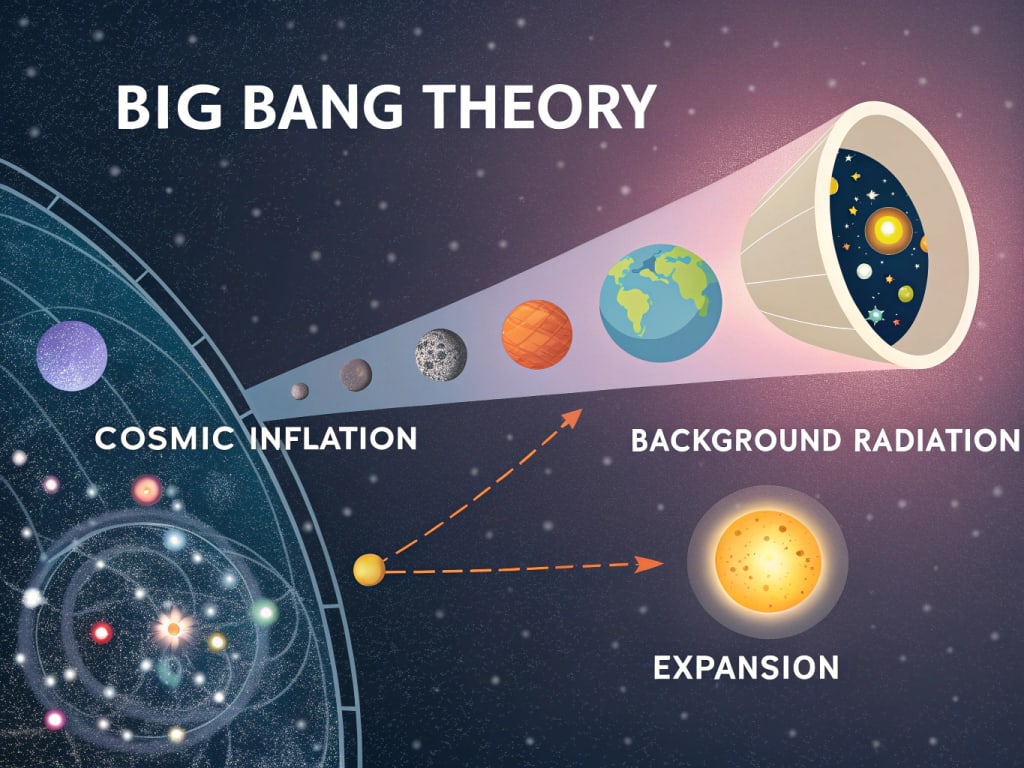
The universe we occupy is immense, enigmatic, and perpetually changing. But what initiated it all? The prevailing explanation in contemporary science regarding the universe's origin is the Big Bang Theory. This cosmological framework posits that the universe commenced approximately 13.8 billion years ago, emerging from an extremely hot and dense state and has been expanding ever since.
Investigating the Big Bang Theory encompasses more than merely examining the past; it necessitates sophisticated tools and theories to assess the present and forecast the future. This article explores the current scientific comprehension of the Big Bang, recent findings that have altered our perspectives, and the unresolved enigmas that persist.
What is the Big Bang Theory? The Big Bang Theory asserts that the universe originated from a singularity a point characterized by infinite density and temperature. This singularity underwent rapid expansion, signifying the inception of space, time, and matter as we recognize them. Contrary to common perceptions, the Big Bang was not an explosion occurring within space; instead, it represented the expansion of space itself.
In the aftermath of the Big Bang, the universe experienced a swift expansion termed cosmic inflation. During this fleeting period, space expanded at an astonishing rate. As the universe cooled, energy converted into subatomic particles, which eventually formed atoms. Over billions of years, these atoms merged to create stars, galaxies, and the extensive cosmic structures we observe today. Evidence Supporting the Big Bang The Big Bang Theory is bolstered by several significant observations, each providing essential support for the model: Cosmic Microwave Background (CMB): The CMB is the faint residual radiation from the early universe, identified in 1965 by Arno Penzias and Robert Wilson. It offers a glimpse of the universe when it was merely 380,000 years old. This ancient radiation has been meticulously mapped by satellites such as COBE, WMAP, and Planck, providing robust validation of the Big Bang.
Abundance of Light Elements: The observed ratios of hydrogen, helium, and lithium in the universe correspond with the predictions of the Big Bang Nucleon synthesis model, which explains the creation of light elements during the initial moments following the Big Bang. Large-Scale Structure: The arrangement of galaxies and galaxy clusters across the universe is consistent with models derived from the initial conditions established by the Big Bang. Recent Scientific Developments Our comprehension of the Big Bang has advanced considerably, particularly with the influx of new information from cutting-edge telescopes and experiments:
1. James Webb Space Telescope (JWST): Since its launch, the JWST has explored deeper into the cosmos and further back in time than any previous observatory. It has uncovered unexpectedly developed galaxies that existed merely a few hundred million years after the Big Bang, leading scientists to reevaluate the timeline of galaxy formation.
2. Hubble Tension: A notable discrepancy has emerged between the measurements of the universe’s expansion rate (Hubble Constant) derived from early universe observations (using CMB data) and those from the local universe (based on supernova studies). This inconsistency, referred to as "Hubble tension," may indicate the presence of new physics that extends beyond our existing models.
3. Dark Matter and Dark Energy: These enigmatic components constitute approximately 95% of the universe’s total mass-energy content. While dark matter aids in explaining the formation and rotation of galaxies, dark energy is thought to be responsible for the accelerating expansion of the universe. Gaining insight into these forces is essential for refining the Big Bang model.
4. Inflation Theory and Primordial Gravitational Waves: Inflation theory posits that the universe underwent a rapid expansion exceeding the speed of light for a brief period following the Big Bang. Researchers are currently on the lookout for primordial gravitational waves ripples in space-time originating from this inflationary phase. Future missions, such as Lite BIRD, are designed to detect these waves.
The Big Bang Theory stands as the most thorough and well-supported explanation for the universe's origin and development. Backed by extensive observational evidence and continually enhanced by new findings, it remains a fundamental aspect of contemporary cosmology. However, numerous enigmas persist. What is the nature of dark energy? What triggered inflation? Was there anything prior to the Big Bang? As we develop more sophisticated instruments and delve further into the realms of space and time, the solutions may soon be within reach. In the overarching tale of the cosmos, the Big Bang serves merely as the initial chapter. The narrative unfolds, and with each new revelation, we move closer to grasping the intricate essence of our universe.
About the Creator
G.M. Rayhan
I'm G.M. Rayhan, a Journalist and content writer covering trending news from around the world. I deliver timely, engaging, and reliable stories that inform and inspire readers to stay connected with global events and viral topics.
Keep reading
More stories from G.M. Rayhan and writers in Humans and other communities.
China stands firm in Trump’s tariff war what comes next?
The trade war between the world’s two largest economies China and the United States shows no signs of abating, with tensions reaching new heights and the economic consequences rippling across the globe. The dispute, which has been unfolding for years, escalated once again after U.S. President Donald Trump announced plans to nearly double existing tariffs on Chinese imports. In response, Beijing swiftly vowed to “fight to the end,” making it clear that it will not yield to American pressure. This hardline stance sets the stage for a potentially prolonged and damaging standoff that could reshape global trade dynamics for years to come.
By G.M. Rayhan10 months ago in Humans
Marc Guéhi
Marc Guéhi is a professional football player who is known for his calm defending, strong leadership, and smart decision-making on the field. He plays as a central defender and represents both club football and the England national team. Over the years, Marc Guéhi has become one of the most trusted young defenders in modern football.
By Farhan Sayed4 days ago in Humans
Silver Screen Magic with Mae West
American actress and singer Mae West became a popular film actress during the Great Depression. She started entertaining in vaudeville, then performed on Broadway, and finally went to Hollywood. She signed up with Paramount Pictures and made her debut in the 1932 film “Night After Night.” She also starred in musicals, comedies, and crime dramas. The American Film Institute named her one of the best classic Hollywood actresses.
By Rasma Raisters7 days ago in Geeks


Comments (1)
Nice work! 🌟 I really enjoyed reading your Vocal post. 😊📖 Keep it up! 💪✍️