science
The Science Behind Relationships; Humans Media explores the basis of our attraction, contempt, why we do what we do and to whom we do it.
The Room Without Doors
In a world where mystery often finds its way into the mundane, there are stories that capture the imagination and refuse to let go. One such haunting tale is that of The Room Without Doors, a chilling scenario that explores the edges of human consciousness, memory, and the terrifying question: what if you woke up trapped in a place with no way out?
By Fahad Khan10 months ago in Humans
Fast Food, Fast Life: How Junk Food Is Messing with Our Minds
Imagine this: You're rushing through your day, juggling work, family, and a never-ending to-do list. Suddenly, it's lunchtime, and you realize you haven't eaten. You dash to the nearest fast-food joint, order a burger and fries, and wolf it down in record time. Sound familiar? This scenario is all too common in our fast-paced world, but have you ever stopped to think about how this quick fix might be affecting not just your waistline, but your mind?
By Alain SUPPINI10 months ago in Humans
Why You’re Always Tired (Even After 8 Hours of Sleep)
Do you religiously get your eight hours of sleep each night, only to wake up feeling like you barely rested? You're not imagining things and you're certainly not alone. Millions of people experience chronic fatigue despite spending adequate time in bed. The truth is, that sleep duration is only part of the equation.
By Fahad Khan10 months ago in Humans
Aviation Accidents
In the span of just 24 hours, two devastating aviation accidents have shaken the United States. On April 10, 2025, a sightseeing helicopter plunged into the Hudson River, claiming six lives. The following day, a small plane crashed in Boca Raton, Florida, resulting in three fatalities. These incidents underscore the critical importance of understanding the multifaceted causes behind aviation accidents.
By sondos azhari10 months ago in Humans
From Discovery to Validation
Breaking ground in drug innovation calls for a joint effort that guides concepts through each stage. Starting from initial discovery all the way to validation, this procedure requires backing from diverse fields. Financiers, academic institutions, and research facility owners should form partnerships to enhance the development of meaningful therapies. Aiming resources at promising early ideas guarantees their advancement. Solid procedures guarantee effective testing and compliance with industry rules. Creative funds and support programs are key for assisting through the tough development period. All this together helps transform drug concepts into reality, showing a strong commitment to backing the discovery, development, and successful validation of new drugs.
By Samantha Higgins10 months ago in Humans
“Your Mind Matters: Easy Ways to Improve Mental Health”
Mental health is just as important as physical health, yet it’s often overlooked or misunderstood. Our minds have a powerful impact on how we think, feel, and act. While physical health is frequently prioritized, mental health often takes a back seat. The good news is that improving mental health doesn’t require complex solutions or dramatic changes. With small, consistent actions, you can significantly boost your mental well-being and lead a happier, healthier life.
By Niaz Ahmad 10 months ago in Humans
The Love Languages You’ve Never Heard Of: Beyond the Famous Five
Introduction For decades, Gary Chapman’s famous model of the five love languages—words of affirmation, acts of service, receiving gifts, quality time, and physical touch—has provided a framework for understanding how we give and receive love. While this model has served millions well, the complexities of modern relationships reveal that love is communicated through an even richer array of languages. Beyond the familiar five, there are subtle, unexpected, and deeply personal ways that individuals express and perceive love. These unique expressions not only deepen our connections with others but also allow us to better understand the many layers of our own hearts. This article explores these lesser-known love languages, offering new perspectives on how love can be felt, shared, and celebrated in today’s diverse world.
By Mysteries with Professor Jahani10 months ago in Humans
5 Top Providers for Liquid Face Lifts in Orange County
Are you considering a facial rejuvenation procedure but hesitant about going under the knife? A liquid face lift in Orange County might be the perfect solution for you. This non-surgical alternative to traditional facelifts has gained immense popularity for its minimal downtime and natural-looking results.
By Dr Valaie MD10 months ago in Humans
Destructive Addictions - Effects On Body & Mind
Alcohol and tobacco addictions. We live in a day and age when, unfortunately, too many people are attached to either smoking or drinking, or both of these harmful vices, one way or another. Both smoking and drinking are harmful enough on their own, but the combination of the two has grave physical and spiritual consequences for health.
By Mezei József Tibor10 months ago in Humans
The Human Brain . Content Warning. AI-Generated.
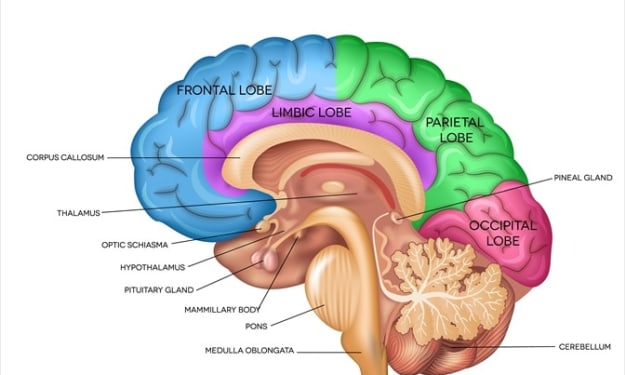
The human brain is one of the most complex and fascinating organs in the human body, serving as the control center for all bodily functions, thoughts, emotions, and behaviors. Weighing about three pounds and containing approximately 86 billion neurons, the brain is a marvel of biological engineering that scientists are still striving to fully understand. Each of these neurons can form thousands of connections with other neurons, creating trillions of synapses that enable the communication networks essential for every aspect of our lives, from breathing and digestion to memory, language, and abstract thinking. The brain is divided into several major parts, each with distinct functions. The cerebrum, the largest part of the brain, is responsible for higher cognitive functions such as thinking, decision-making, perception, and voluntary movement. It is divided into two hemispheres—left and right—which control opposite sides of the body and are further subdivided into four lobes: frontal, parietal, temporal, and occipital. The frontal lobe governs reasoning, planning, problem-solving, and emotions; the parietal lobe manages sensory input and spatial orientation; the temporal lobe processes auditory information and is essential for memory and language; and the occipital lobe is primarily responsible for vision. Below the cerebrum lies the cerebellum, which plays a key role in motor control, coordination, balance, and fine-tuning movements. The brainstem, which connects the brain to the spinal cord, is responsible for basic life-sustaining functions such as heart rate, breathing, and sleeping. The brain communicates with the rest of the body through the nervous system, which includes the central nervous system (brain and spinal cord) and the peripheral nervous system (nerves extending throughout the body). Electrical impulses travel between neurons across synapses via neurotransmitters, enabling the brain to process sensory information and issue motor commands almost instantaneously. Additionally, the brain regulates hormone production through the hypothalamus and pituitary gland, influencing growth, metabolism, and reproductive functions. One of the brain’s most extraordinary features is its plasticity—the ability to change and adapt throughout life in response to learning, experience, and injury. This neuroplasticity allows individuals to acquire new skills, recover from brain damage, and form new memories. Memory itself is a complex process involving encoding, storing, and retrieving information. Different types of memory—such as short-term, long-term, episodic, and procedural—are stored and processed in various regions of the brain, including the hippocampus and the prefrontal cortex. Language is another remarkable function of the brain, primarily managed by areas such as Broca’s area and Wernicke’s area, which are critical for speech production and comprehension. Emotions are processed in the limbic system, especially in the amygdala and the hypothalamus, which influence how we react to situations and form emotional memories. Despite its capabilities, the brain is also susceptible to disorders such as Alzheimer’s disease, Parkinson’s disease, depression, anxiety, and traumatic brain injuries, all of which can significantly affect cognition, behavior, and quality of life. Ongoing research in neuroscience and related fields seeks to unravel the brain’s many mysteries, leading to new treatments for mental and neurological conditions. Advances in technology, such as brain imaging (MRI, fMRI, PET scans), have allowed scientists to observe the brain in action and identify how different regions are activated during specific tasks. Understanding the brain also has implications beyond medicine, influencing fields like artificial intelligence, education, and psychology. The human brain is not only a biological organ but also the seat of consciousness, self-awareness, creativity, and the very essence of what it means to be human. It enables us to imagine, create art, solve problems, build societies, and experience the world in deeply personal and meaningful ways. As research continues to unlock its secrets, the brain remains a source of wonder and inspiration, a testament to the complexity of life and the potential of the human mind.
By Shohan Hossen10 months ago in Humans
The red blood cell. Content Warning. AI-Generated.
Red blood cells (RBCs), also known as erythrocytes, are one of the most vital components of the human body, playing a crucial role in the transport of oxygen from the lungs to the tissues and organs, and the removal of carbon dioxide from those tissues back to the lungs for exhalation. These specialized cells are uniquely structured to perform this task efficiently. Shaped like biconcave discs, they have a flexible membrane that allows them to squeeze through the tiniest of blood vessels—capillaries—without rupturing. This biconcave shape also increases the cell's surface area relative to its volume, facilitating faster and more efficient gas exchange. Mature red blood cells are remarkable in that they lack a nucleus and most organelles, maximizing internal space for hemoglobin, the iron-containing protein responsible for oxygen binding. Each red blood cell contains about 270 million hemoglobin molecules, enabling it to carry large amounts of oxygen. Hemoglobin has a high affinity for oxygen in the lungs, where oxygen concentration is high, and a lower affinity in the tissues, where oxygen concentration is lower, thus allowing efficient delivery. RBCs are produced in the bone marrow through a process called erythropoiesis, which is tightly regulated by the hormone erythropoietin, primarily secreted by the kidneys in response to low oxygen levels in the blood. Once produced, red blood cells circulate in the bloodstream for about 120 days before being broken down in the spleen, liver, or bone marrow. The components of aged RBCs are recycled—iron is salvaged and reused in new cells, and the heme portion of hemoglobin is broken down into bilirubin, which is processed by the liver and excreted in bile. Disorders affecting red blood cells can have serious consequences. Anemia, for instance, is a condition characterized by a deficiency in the number or quality of red blood cells, often resulting in fatigue, weakness, and shortness of breath due to reduced oxygen delivery to tissues. There are many types of anemia, including iron-deficiency anemia, sickle cell anemia, and pernicious anemia, each with distinct causes and treatments. Sickle cell anemia, a genetic disorder, results in the production of abnormally shaped hemoglobin, causing RBCs to assume a rigid, sickle-like shape, which can block blood flow and cause pain, organ damage, and an increased risk of infection. In contrast, polycythemia is a condition marked by an abnormally high concentration of red blood cells, leading to thickened blood and an increased risk of clotting, strokes, and heart attacks. The health of red blood cells is influenced by a person's diet, particularly the intake of nutrients such as iron, vitamin B12, and folic acid, all of which are essential for red blood cell production and function. Iron is necessary for hemoglobin synthesis, while vitamin B12 and folate are required for DNA synthesis during cell division. Deficiencies in these nutrients can impair red blood cell formation, leading to various forms of anemia. In medical diagnostics, red blood cell count, hemoglobin concentration, and hematocrit (the percentage of blood volume occupied by red cells) are routinely measured as part of a complete blood count (CBC) test to assess a person’s overall health and detect disorders. Advances in science and medicine have led to improved understanding and treatment of red blood cell-related diseases, including blood transfusions, bone marrow transplants, and gene therapies. Research continues to explore innovative ways to produce artificial red blood cells and improve treatments for conditions like sickle cell disease and thalassemia. In summary, red blood cells are indispensable to human life due to their role in oxygen transport, and their proper function is essential for maintaining health and energy. Maintaining healthy red blood cell levels through proper nutrition, regular check-ups, and timely treatment of disorders ensures that the body’s cells receive the oxygen they need to perform their vital functions.
By Shohan Hossen10 months ago in Humans