
Why America still uses Fahrenheit?
Fahrenheit vs. Celsius: The Historical, Cultural, and Practical Factors Behind America's Enduring Temperature Scale Preference


"Alexa, what's the weather today?" If you're in the US, you're likely to receive a response in Fahrenheit. While virtually every country on Earth has embraced Celsius for temperature measurements, the US still holds onto Fahrenheit. This peculiar choice often prompts raised eyebrows and bemused comments. But it's not just a matter of meteorological semantics. The Fahrenheit system has deep historical roots that have both shaped and hindered progress. Let's delve into the tale of Fahrenheit, its origins, its global impact, and the ongoing debate over adopting the metric system.
The Birth of Fahrenheit:
In the early 18th century, measuring temperature was a disorganized affair. It was a German scientist, Gabriel Fahrenheit, who brought order to this chaos by inventing the mercury thermometer in 1714. Fahrenheit devised a scale that assigned freezing and boiling points to water at specific numbers, with the freezing point at 32 degrees and the boiling point at 212 degrees. He even added the average human body temperature at 96 degrees. This scale gained popularity, particularly after Fahrenheit's formal induction into the British Royal Society, where it found its place as a standard within the British Empire's extensive territories.
Metric System's Rise:
As the British Empire expanded, it carried the Fahrenheit system along with other Imperial measurements across the globe. Meanwhile, the metric system gained traction during the French Revolution, driven by the need for national unification. By the mid-20th century, Celsius, a unit of the metric system, gained favor in many English-speaking countries. In 1975, the US attempted to make the switch, enacting the Metric Conversion Act. This led to initiatives like the Interstate 19 metric highway sign, connecting Arizona to Mexico. However, resistance and a lack of enforcement eventually led to the disbandment of the United States Metric Board in 1982.
The Struggle to Change:
Despite attempts to promote metrication, the US clung to its familiar Fahrenheit system. This resistance persists, even as the global community increasingly embraces the metric system. The US's dual-system approach poses challenges for education, where students must learn two sets of measurements, and for businesses that must manufacture products for both domestic and metric markets. The consequences are more serious than mere inconvenience—medical dosage errors caused by conversion mistakes lead to thousands of unintentional medication overdoses every year.
The Economic Conundrum:
The argument for adopting the metric system is compelling—streamlined education, simplified commerce, and enhanced public health. Yet, the US hesitates due to the perceived financial burden of change. The cost of converting infrastructure, education materials, and public understanding is substantial. Without concrete evidence of economic benefits, the reluctance to transition remains strong. The question lingers: Is the expense of conversion justified by the potential gains?
As the US continues to straddle two measurement systems, the debate over Fahrenheit versus Celsius persists. The historical legacy of Fahrenheit's invention and its integration into the British Empire has cemented its place in American culture. However, the global momentum towards the metric system raises questions about the costs and benefits of holding onto the Fahrenheit scale. While Celsius may seem more intuitive and widespread, the financial implications of change require careful consideration. So, for now, 77°F remains 25°C only in the eyes of those who choose to convert. Whether the US will eventually join the rest of the world in adopting the metric system remains a decision yet to be made.
Like what you read? Consider liking and subscribing for more! :)
About the Creator
Keep reading
More stories from Shubham Bajaj and writers in History and other communities.
From spy to President: Rise of Mr. Putin
To truly grasp the extent of Putin's influence, we must rewind to a tumultuous era in Russian history – the aftermath of the Soviet Union's collapse. As the Berlin Wall crumbled, a young Putin found himself serving as an undercover spy in East Germany for the Soviet security agency, the KGB. The disintegration of the Soviet Union birthed 15 new nations, including the Russian Federation, which Putin viewed as a staggering loss of two million square miles of territory. He lamented the displacement of countless compatriots beyond Russian borders, labeling it a profound geopolitical calamity.
By Shubham Bajaj3 years ago in History
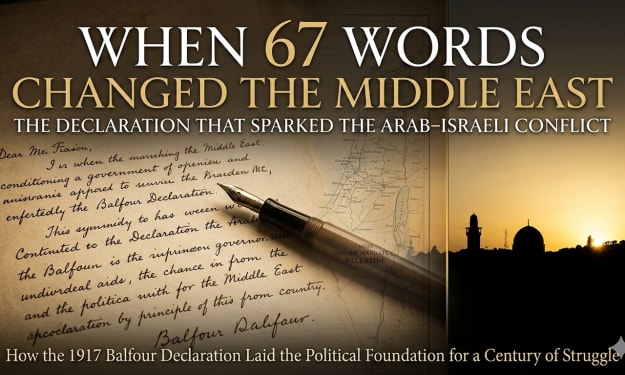
When 67 Words Changed the Middle East: The Declaration That Sparked the Arab–Israeli Conflict
In the long and turbulent history of the Middle East, few political documents have had as profound and lasting an impact as the Balfour Declaration. Written in just 67 words in 1917, this brief letter from British Foreign Secretary Arthur Balfour to Lord Rothschild would go on to shape the destiny of Palestine and lay the foundation for what became the Arab–Israeli conflict. A century later, the consequences of those carefully crafted words continue to influence geopolitics, identity, and regional stability.
By Irshad Abbasi 7 days ago in History



Comments
There are no comments for this story
Be the first to respond and start the conversation.