
🪖Top 7 Submachine Guns of World War II
🔫The Titans of Close Combat

🪖Top 7 Submachine Guns of World War II
MP40 — The Backbone of German Firepower
The **MP40**, known as the Maschinenpistole 40, became one of the most iconic and widely used submachine guns of Nazi Germany during World War II. It was developed as a successor to the MP38, streamlining the design for mass production using stamped steel and bakelite, which made it cheaper and faster to manufacture. The MP40 was chambered in 9x19mm Parabellum and had a relatively low rate of fire at approximately 500–550 rounds per minute, allowing for better control in full-auto fire. It featured an open-bolt blowback action and a 32-round magazine, though the magazine was prone to jamming if not handled carefully.
Used predominantly by paratroopers, platoon leaders, and squad commanders, the MP40 was never issued to every soldier but was respected for its ergonomics and reliability. Its folding metal stock allowed for easier transport and maneuverability, particularly in urban warfare and confined spaces like bunkers or trenches. In the hands of experienced German infantry, the MP40 offered a deadly edge in close-quarters battle. However, the gun had some limitations: it was not well-suited for muddy or sandy environments, and its magazine design made it sensitive to dirt. Yet despite these flaws, the MP40 remains a symbol of German infantry power and was highly sought after by Allied troops who occasionally captured and reused them.
The MP40 influenced post-war designs significantly. Many Cold War-era submachine guns, such as the Israeli Uzi, drew inspiration from its engineering simplicity. Its impact on combat tactics and its cultural legacy, having appeared in countless war films and documentaries, make the MP40 a defining weapon of WWII’s European theatre.

PPSh-41 — Stalin's Steel Storm
The **PPSh-41** was the Soviet Union’s answer to the submachine gun needs of the Red Army, and it became one of the most mass-produced weapons of World War II. Designed by Georgi Shpagin as a simpler and cheaper alternative to the PPD-40, the PPSh-41 was engineered for rapid production and durability under extreme combat conditions. Chambered in 7.62x25mm Tokarev, it fired at a blistering rate of 900 rounds per minute, which allowed Soviet soldiers to unleash intense volumes of fire during infantry assaults.
The gun could use either a 35-round box magazine or a 71-round drum magazine, the latter being more common early in the war. While the drum offered tremendous firepower, it was heavy and occasionally unreliable in harsh winter conditions. Later in the war, soldiers often preferred the more dependable box magazine. The PPSh-41’s blowback-operated mechanism and robust construction meant it could function in the mud, snow, and freezing temperatures of the Eastern Front, where many other weapons failed.
Tactically, the PPSh-41 allowed Soviet infantry to perform highly aggressive and mobile maneuvers. Entire units of Red Army troops were equipped with these SMGs, essentially turning them into stormtroopers. In urban combat, particularly in battles like Stalingrad, its high rate of fire gave Soviet soldiers a significant advantage in brutal, room-to-room fighting. The PPSh-41 was also relatively easy to train soldiers on, which was crucial given the massive numbers of conscripts being funneled into combat.
After the war, the PPSh-41 remained in service with Soviet-aligned states and appeared in conflicts like the Korean War and the Vietnam War. Its design was influential worldwide, and the weapon became a symbol of Soviet resilience and industrial might during WWII. By war's end, over 6 million units had been produced, solidifying its place as one of the most effective and iconic weapons of the 20th century.

Sten Gun — The British Budget Blaster
The **Sten gun** was Britain’s pragmatic response to a dire need for small arms following the Dunkirk evacuation, where vast quantities of equipment had been lost. The official designation "Sten" comes from the names of its creators: Major Reginald Shepherd and Harold Turpin, and the Enfield factory where it was produced. The Sten was revolutionary in its simplicity and cost-effectiveness. It could be manufactured using minimal materials and unskilled labor, which allowed Britain to quickly arm its soldiers and resistance fighters across Europe.
Chambered in 9x19mm Parabellum, the Sten gun had a side-mounted 32-round magazine and used simple blowback operation. The early Mk I and Mk II variants were rough in construction and not without flaws, such as a tendency to misfire or discharge if dropped. Nevertheless, they were lightweight, compact, and effective in close-quarters engagements. Some elite units, like British commandos and SOE agents, favored the Sten for its compact profile and ease of suppression, allowing it to be used in clandestine operations.
Perhaps the most fascinating aspect of the Sten was its use in guerrilla warfare. Resistance fighters in occupied countries such as France, Poland, and Yugoslavia relied heavily on Stens, which were airdropped by the thousands. Its simple design even allowed some underground workshops to manufacture local imitations. Despite its reputation as a crude weapon, the Sten gave the Allies a critical advantage in both open combat and behind enemy lines. It demonstrated how mass production and design simplicity could overcome even the most daunting logistical challenges during wartime.
After the war, the Sten remained in service in various conflicts well into the 1960s. Its legacy lies not in refinement or firepower but in accessibility, proving that effective weapons need not be complicated or expensive. The Sten embodied British ingenuity during one of the most desperate periods of the war.

Thompson Submachine Gun — The American Gangster Turned G.I.
The **Thompson Submachine Gun**, or "Tommy Gun," originated in the aftermath of World War I but found its lasting fame during WWII. Originally designed by General John T. Thompson, the weapon was intended for trench warfare but became widely known during the 1920s and 30s as a favorite of gangsters and law enforcement. By the time of World War II, the U.S. military had adopted the Thompson, with early models like the M1928 and later the simplified M1 and M1A1 variants seeing extensive service.
Chambered in .45 ACP, the Thompson packed a punch, though its rate of fire—between 600 to 700 rounds per minute—was moderate compared to Soviet or German designs. Its weight and complexity made it expensive to produce, but it was beloved by American soldiers and Marines for its reliability and stopping power. The Thompson could use both a 20- or 30-round box magazine and the iconic 50-round drum, though the latter was mostly phased out due to reliability concerns in the field.
The weapon excelled in jungle warfare, such as in the Pacific Theater, where its heavy-caliber rounds were effective against enemy troops at close range. U.S. paratroopers and Rangers also favored it for assaults and clearing bunkers. While the M1 variant eliminated some of the aesthetic features like the vertical foregrip and finned barrel to streamline production, the core performance remained excellent. American troops affectionately called it the "Trench Broom" for its devastating impact in close combat.
The Thompson’s legacy was further cemented by its continued use in the Korean War and even early stages of Vietnam. It also remained a staple in police arsenals for decades. Its association with both military heroism and organized crime makes it one of the most culturally recognizable firearms ever produced. Despite being overshadowed in numbers by other SMGs, the Thompson stands as a symbol of American firepower and resilience.

Suomi KP/-31 — Finland's Precision Submachine Gun
Often overlooked in broader discussions of WWII weaponry, the **Suomi KP/-31** submachine gun from Finland was among the most accurate and reliable of the war. Designed by Aimo Lahti and introduced in the early 1930s, the Suomi KP/-31 was a robust and precise weapon chambered in 9x19mm Parabellum. It featured a high rate of fire—around 750–900 rounds per minute—and had excellent balance, which made it highly effective in combat, particularly in the hands of skilled Finnish marksmen.
The Suomi gained widespread recognition during the Winter War of 1939–40, when Finnish soldiers used it with devastating effectiveness against Soviet forces. The gun could utilize a 20- or 36-round box magazine, but more famously, it featured a 71-round drum magazine that was both more reliable and sturdier than the Soviet version later used in the PPSh-41. The weapon’s heavy construction allowed it to maintain accuracy even during prolonged firing, which contributed to its stellar reputation.
Tactically, Finnish troops employed the Suomi in ambushes and guerrilla-style engagements in snowy forests, where quick, close-range firepower proved critical. Its effectiveness was so apparent that the Soviet Union took direct inspiration from it when designing the PPSh-41. The Suomi’s superior craftsmanship and finish did make it expensive and time-consuming to produce, which limited its widespread adoption despite its battlefield success.
After WWII, the Suomi continued in use well into the 1960s and saw action in several post-war conflicts. Though it never achieved the production scale of other SMGs, it is remembered as one of the finest submachine guns ever created, particularly in terms of accuracy and reliability. Its influence extended beyond its numbers, proving that quality could indeed trump quantity in the right hands.

Beretta Model 38 — The Italian Underdog with Elite Engineering
The **Beretta Model 38**, also known as the MAB 38 (Moschetto Automatico Beretta), was Italy’s premier submachine gun during World War II and is often considered one of the most finely engineered SMGs of the conflict. Developed by Tullio Marengoni in the late 1930s, the weapon was a showcase of precision craftsmanship. Chambered in 9x19mm Parabellum, the Beretta 38 featured a high rate of fire around 600–800 rounds per minute and was known for its accuracy, reliability, and rugged build.
Unlike many submachine guns of the war that were designed for mass production, the Beretta 38 was machined with a focus on quality. It used a delayed blowback system and had two triggers—one for semi-automatic fire and the other for full-auto. This made the weapon extremely versatile in a range of combat situations. The fixed wooden stock, robust metal components, and good balance contributed to its effectiveness in both urban and open terrain.
Italian troops used the Beretta 38 extensively on various fronts, from North Africa to the Balkans. Its reliability in sand, mud, and rough weather was praised even by German soldiers who were later issued the gun after Italy's armistice in 1943. Some versions of the weapon were adapted for use with German 9mm ammo and magazines, further extending its utility across Axis forces.
After the war, the Beretta 38 continued to see service in post-war Italy and even in conflicts like the Algerian War and Indo-China War. Despite not being produced in the same numbers as the PPSh or MP40, the Beretta 38’s legacy is one of quality and elite design, showcasing how Italy contributed to the evolution of small arms during the 20th century.

ZK-383 — The Czechoslovakian Hybrid
The **ZK-383** was one of the more unique and underappreciated submachine guns of World War II. Developed by the Koucký brothers in Czechoslovakia and produced by the famous Zbrojovka Brno arms factory, the ZK-383 stood out for its high build quality and unusual features that blended characteristics of both light machine guns and submachine guns. Chambered in 9x19mm Parabellum, the ZK-383 had a relatively low rate of fire around 450–500 rounds per minute, emphasizing accuracy over volume.
One of its most distinguishing features was its integral folding bipod, an uncommon addition for an SMG. The ZK-383 was intended as a squad automatic weapon in addition to its role as a submachine gun, allowing for more stable, sustained fire from supported positions. It could be fitted with either a 30-round or 40-round detachable box magazine and had a quick-change barrel feature—another trait borrowed from light machine guns.
German and Slovak forces made use of the ZK-383 after Czechoslovakia was occupied by Nazi Germany in 1939. Its precision and mechanical sophistication earned respect, though its complexity and production cost prevented it from achieving wide deployment. Nevertheless, it served effectively in roles where a more accurate and sturdy SMG was required, such as defending fixed positions or providing supporting fire in mobile units.
After the war, the ZK-383 saw limited use, mostly phased out in favor of more mass-producible models. However, it remains a fascinating example of hybrid design philosophy and Czechoslovak engineering excellence. As a rare and refined weapon, the ZK-383 holds a special place among WWII submachine guns.

Together, these seven submachine guns not only shaped the tactics and outcomes of World War II firefights but also left enduring marks on firearm design and military doctrine. From the snowy forests of Finland to the deserts of North Africa, the roar of these weapons told the tale of a world at war—and the innovative human spirit under fire.
About the Creator
Kek Viktor
I like the metal music I like the good food and the history...
Keep reading
More stories from Kek Viktor and writers in History and other communities.
🏹🔥When the Zulu warriors overpowered the British army
🏹🔥 The Battle of Isandlwana (1879): The Zulu Triumph Over Empire 🌍 The British Invasion of Zululand In the late 19th century, the British Empire stood at the zenith of its global power. With colonies stretching across every inhabited continent, it pursued a relentless policy of expansionism underpinned by economic interest, racial ideology, and the belief in a “civilizing mission.” Southern Africa, rich in minerals and strategically located, became a key target in Britain’s imperial vision, particularly the drive to unite its various colonies—like the Cape Colony and Natal—into a single political confederation under British rule.
By Kek Viktor9 months ago in History
Pakistani Man Accused of Plotting to Kill Donald Trump Appears in Court
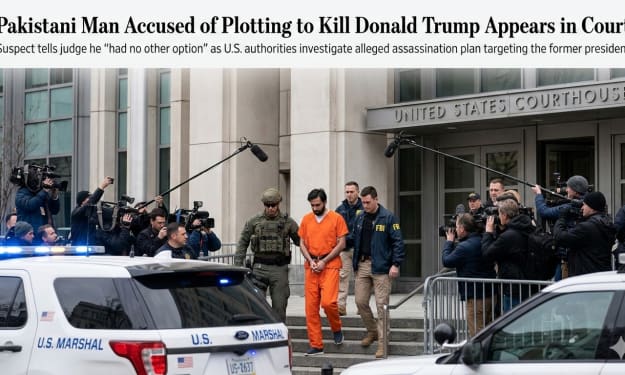
A Pakistani citizen accused of plotting to assassinate former United States President Donald Trump appeared in a U.S. federal court this week, where prosecutors outlined details of what they described as a serious and potentially dangerous plan. During the hearing, the suspect reportedly told the court that he believed he “had no other option,” a statement that immediately drew attention as authorities continue to investigate the motives and possible connections behind the alleged plot.
By Irshad Abbasi 7 days ago in History


Comments
There are no comments for this story
Be the first to respond and start the conversation.