
The Woman Who Lived 10 Years Alone in the Amazon
A Tale of Survival, Silence, and Self-Discovery

The Woman Who Lived 10 Years Alone in the Amazon
A Tale of Survival, Silence, and Self-Discovery
When most people imagine the Amazon rainforest, they think of endless greenery, exotic birds, venomous snakes, and rivers that wind like serpents through a living world of mystery. Few, however, would imagine making it their permanent home without a village, without modern tools, and without another human voice for a decade. Yet, that is exactly what happened to Elena Marquez, a woman who chose solitude deep in the Amazon and lived alone there for ten years.
The Decision to Disappear
Elena had once been a schoolteacher in Manaus, a city that sits at the meeting of the Negro and Solimões rivers. Her life was ordinary, predictable, and filled with the sounds of traffic, chatter, and deadlines. But after a personal tragedy the sudden loss of her husband in a river accident she felt suffocated by the weight of human noise. The city seemed to press in on her, offering sympathy but no true comfort.
So, at the age of 32, she made a decision few would dare: she packed a canoe with basic tools, some seeds, a machete, and a worn hammock, and headed deeper into the rainforest. She did not tell many people where she was going. To her, the Amazon was not a hostile wilderness, but a living, breathing world that could offer peace.
Building a Life from Nature
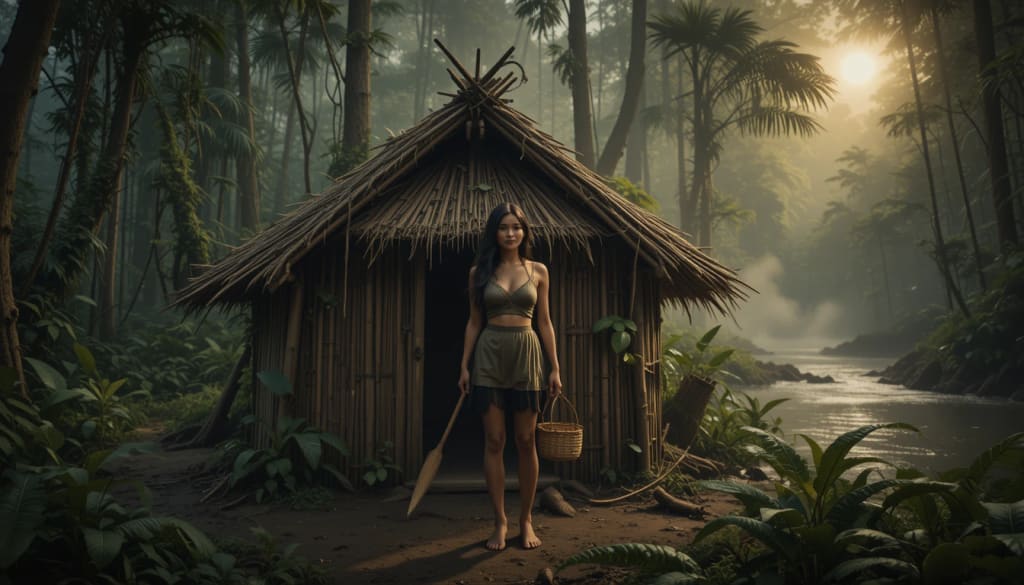
At first, survival was difficult. Elena knew a little about farming from her grandparents, but the Amazon demanded a sharper skill. She built a small hut from palm leaves and branches, raised on stilts to avoid flooding, and learned to weave strong baskets for gathering food.
Hunting and fishing became her lifeline. She learned to catch fish with traps made of bamboo and sharpened sticks, and she grew manioc and maize on a small cleared patch of land. She gathered Brazil nuts, fruits, and medicinal plants, slowly developing an understanding of which ones healed and which ones harmed.
The greatest challenge was not food, but safety. Jaguars prowled at night, anacondas slithered silently in the water, and clouds of mosquitoes tested her patience daily. Once, she was bitten by a venomous spider and nearly lost her life, surviving only because she remembered a traditional remedy her grandmother had once taught her.
The Silence of Loneliness
Elena’s greatest struggle was not the wild, but the absence of people. For months at a time, she heard no human voice but her own. She spoke to the trees, whispered to the river, and even sang songs to the night sky just to remind herself that her voice still existed.
There were moments when she considered returning to the city. Once, after falling ill with fever for several days, she believed she would die alone. But she also felt a strange freedom there were no rules, no expectations, no judgments. Life had become stripped down to its rawest form: survival, observation, and quiet wonder.
Over time, her fear faded. The rainforest, once alien, became familiar. She learned the rhythm of bird calls, the warning signs of approaching storms, and the patterns of the stars above the canopy. Slowly, she began to see herself not as a visitor, but as part of the forest itself.
A Decade in the Wild

Years passed without notice. Her clothes wore thin, replaced by handmade garments woven from bark and plant fibers. Her hut was rebuilt three times after floods, each time stronger than before. Her hair grew long, her skin darkened under the sun, and her hands grew calloused and strong.
On rare occasions, she glimpsed indigenous tribes passing through the forest, but she always stayed hidden, not wishing to disturb them or be disturbed. The forest had given her solitude, and she respected it.
Finally, after ten years, a team of researchers traveling by canoe spotted her hut along the riverbank. At first, they thought it abandoned, until they saw Elena thin, strong, and smiling faintly standing with a spear in her hand. When they asked her name, she spoke slowly, as if unused to conversation.
She chose to return with them, though part of her heart remained in the forest. The decade she had spent alone had transformed her. She was no longer just a woman; she was a story, a reminder of human resilience and the delicate bond between people and the natural world.
Legacy of Silence
Today, Elena’s tale is spoken of in whispers in Manaus, sometimes exaggerated, sometimes doubted. But for her, it was not about legend or recognition. It was about healing, about finding a place where grief and noise could be washed away by the rhythm of rain, the hum of insects, and the eternal heartbeat of the Amazon.
Her ten years in the rainforest were not an escape they were a transformation. And though she returned to the city, she often dreamt of the nights under the canopy, when the only sound in the world was the forest breathing around her.
About the Creator
Farooq Hashmi
Thanks for reading! Subscribe to my newsletters.
- Storyteller, Love/Romance, Dark, Surrealism, Psychological, Nature, Mythical, Whimsical
Keep reading
More stories from Farooq Hashmi and writers in History and other communities.
Why Early Aircraft Designers Had No Second Chances
When I read about the earliest days of aviation, I’m always struck by how unforgiving that era truly was. Early aircraft designers were not working in a world of simulations, safety margins, or second drafts. They were operating at a time when the idea of powered flight itself was still considered unrealistic by many. Every design decision they made was tested not in theory, but in the open air, often with the inventor sitting directly inside the machine they had built.
By Beckett Dowhan4 days ago in History
Dr. Martin Luther King, Jr.
Dr. Martin Luther King, Jr. was born on January 15, 1929. Martin Luther King, Jr. Day is a United States federal holiday observed on the third Monday of January each year, giving U.S. residents a three-day weekend. It is the first federal holiday of 2026.
By Margaret Minnicks2 days ago in History


Comments
There are no comments for this story
Be the first to respond and start the conversation.