
A secret staircase found beneath a 1,500-year-old French church
Why holy places continue to exist

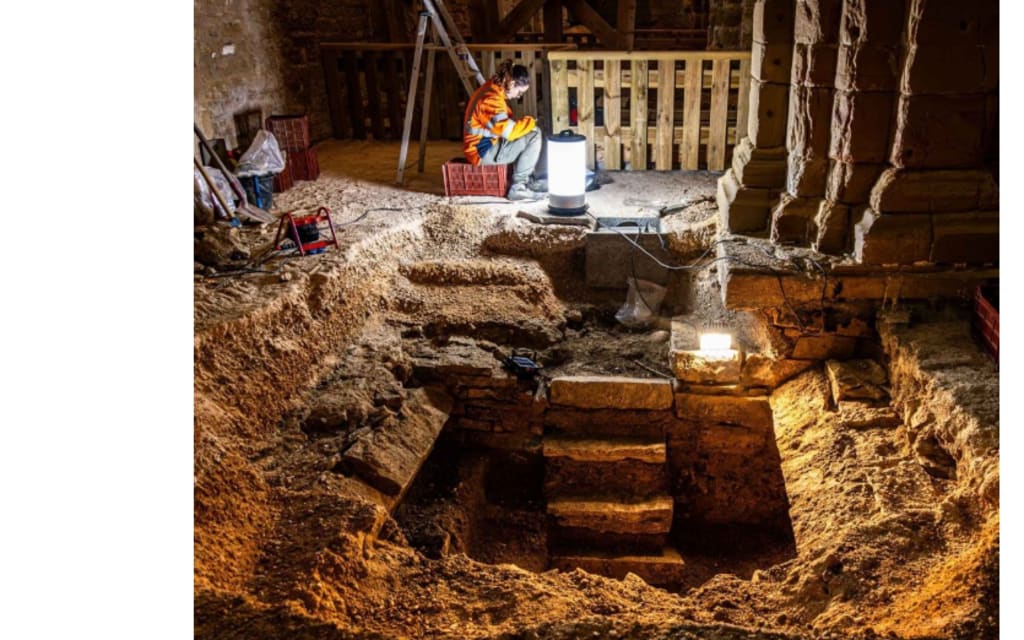
A subterranean staircase and burial strata dating back approximately 1,500 years were discovered during a project inside the Church of Saint Philibert in Dijon, France. The stairs were discovered by restoration workers inside the church when repairs were being made, and the excavation soon ensued.
Workers discovered a stairway inside the church that was not noted on the repair plans when they raised a part of the stone flooring. Clarisse Couderc of the French National Institute for Preventive Archaeological Research (Inrap) oversaw the project.
Her study looks at how neighbourhoods were changed by politics and devotion, and how mediaeval towns repurposed graves and holy structures.
Scars from salt
Salt trapped beneath the floor caused damage beneath the church long before excavation began. The structure was used as a salt storage facility in the 18th and 19th centuries, leaving salts buried in mortar and earth.
That salt was trapped in a heated concrete slab during the 1970s, and heat forced it upward into the pillars. A sluggish chemical process operating inside damp stone was identified by modern restorations as the cause of the church's degradation.
Water seeps upward through microscopic pores, dissolved salts move with the water, and moisture rises due to capillary action. As the water dries, salt crystals form, and spalling—stone flakes that break off in sheets—occurs after several cycles.
excavating the church's staircase
Because crews worked between pillars that could not move without running the risk of collapsing, work proceeded cautiously. Couderc stated, "We dug down to a depth of three meters." Because tools might shake foundations and cause walls and pillars to crack, a 10-foot depth altered the pace.
Beneath the church crossing, an excavation uncovered a late mediaeval vaulted burial chamber. Children's and adults' remains were discovered inside, and older bones were moved to make room for new interment.
Archaeologists were able to locate secure access sites for meticulous work thanks to a tiny stairway that connected the floor to deeper strata.
Coffins arranged
Beneath the nave, rows of wooden coffins emerged, carefully arranged from east to west. The majority of the burials, which took place between the 1300s and the 1700s, involved adults who were shrouded.
With the exception of a few coins and two rosaries put next to bodies, graves contained very few items. Slab-covered burials that predate the present church building were located beneath the coffins.
In order to recreate events and arrange tombs according to depth and construction style, archaeologists employed stratigraphy, which involves reading soil layers. A number of layers indicate that prior churches were located nearby or on the site in the 1000s and 1100s.
Six coffins made of stone
Later walls revealed six stone sarcophagi, two of which were perched on four older ones. A significant period in French history, the Merovingian dynasty, the first Frankish dynasty of the sixth to eighth centuries, is represented by two upper coffins.
One lid has carving, while four lower coffins have the appearance of Late Antiquity, a transitional era following Roman authority.
The church's front walls
Remains of a church constructed circa 1000 were among the earlier wall lines that were discovered. Opus spicatum, a zigzag pattern of herringbone stonework that frequently characterises early mediaeval building, was utilised in one corner.
These newly uncovered walls establish a clearer sequence that now includes an apse described in 1923.
Why holy places continue to exist
The results are consistent with a larger European trend of churches repurposing land that has long been considered sacred. Because ownership was established, tombs were close by, and foundations saved effort, builders frequently went back to the same sites.
In order to maintain continuity and establish new authority, some Christian churches took the place of Roman temples or shrines.
What bones may reveal
Human remains from many centuries ago today provide information about local communities that came before them. Shrouds, coffin wood, and vault reuse are examples of burial decisions that allude to social standing, health, and familial relationships.
While radiocarbon dating refines time frames, laboratories may examine bone chemistry for dietary and migration patterns.
The cathedral staircase teaches us
Deep soil opening requires caution since disturbance could exacerbate already-existing salt damage. When bones or stones need to be reburied, details are preserved through drawings, photos, and three-dimensional scans.
Additionally, conservators regulate salts, which continue to crystallise whenever moisture reappears. The site's evolution as Dijon grew is now depicted in a hidden arrangement of chapels, walls, and cemeteries.
The main structure of Saint Philibert Church, which is designated as a historic monument, was built in the 1100s, according to official lists.
Since later construction typically destroys older layers rather than sealing them away, such stacking preservation is uncommon. The findings will direct future repairs by assisting engineers in identifying unstable soils, voids, and graves.
While the church structure eventually dries, future research may compare these burials with those at other Dijon locations to tighten dates.
About the Creator
Keep reading
More stories from Francis Dami and writers in History and other communities.
A massive underwater stone wall that is almost 7,000 years old is found by divers.
One of the buried stone monuments on Sein Island is a granite wall off Brittany that is more than 7,000 years old and the length of a football pitch. The discovery is being used by marine archaeologists in the vicinity of Île de Sein to explain how stone-built coastal villages predate the widespread spread of farming.
By Francis Dami6 days ago in History
The Titanic Mystery: Secrets Beneath the Frozen Sea
On the night of April 14, 1912, the RMS Titanic sailed calmly through the dark waters of the North Atlantic, carrying more than 2,200 souls and the dreams of a modern world that believed it had conquered nature. Labeled “unsinkable,” the Titanic was the pride of human engineering. Yet before dawn broke, the great ship lay shattered beneath miles of icy ocean. More than a century later, the Titanic remains not just a tragedy—but a mystery filled with unanswered questions.
By The best writer 5 days ago in History
3 True Stories That Sound Like Urban Legends but Aren’t
Urban legends usually follow a familiar pattern. A friend of a friend hears something unbelievable, the details get hazy, and the story ends with a warning about human stupidity or bad luck. The unspoken rule is simple: if it sounds too strange to be true, it probably is.
By Enoch Sagini3 days ago in History
How to Succeed at the Benson Directory®
Congratulations and welcome to the Benson Directory® employee #22391! As our newest call handler, you will have the privilege of speaking with dozens of unique and interesting people on a daily basis as well as the opportunity to earn bonuses for high performance. Contained within this handbook you will find a set of ease to follow instructions designed to help you settle in to your new role and begin paving the way to success.
By S. A. Crawforda day ago in Fiction




Comments
There are no comments for this story
Be the first to respond and start the conversation.