
The USA’s “Next Targets”?
Why claims about Greenland, Cuba, Colombia, and Iran reveal more about global anxiety than confirmed war plans

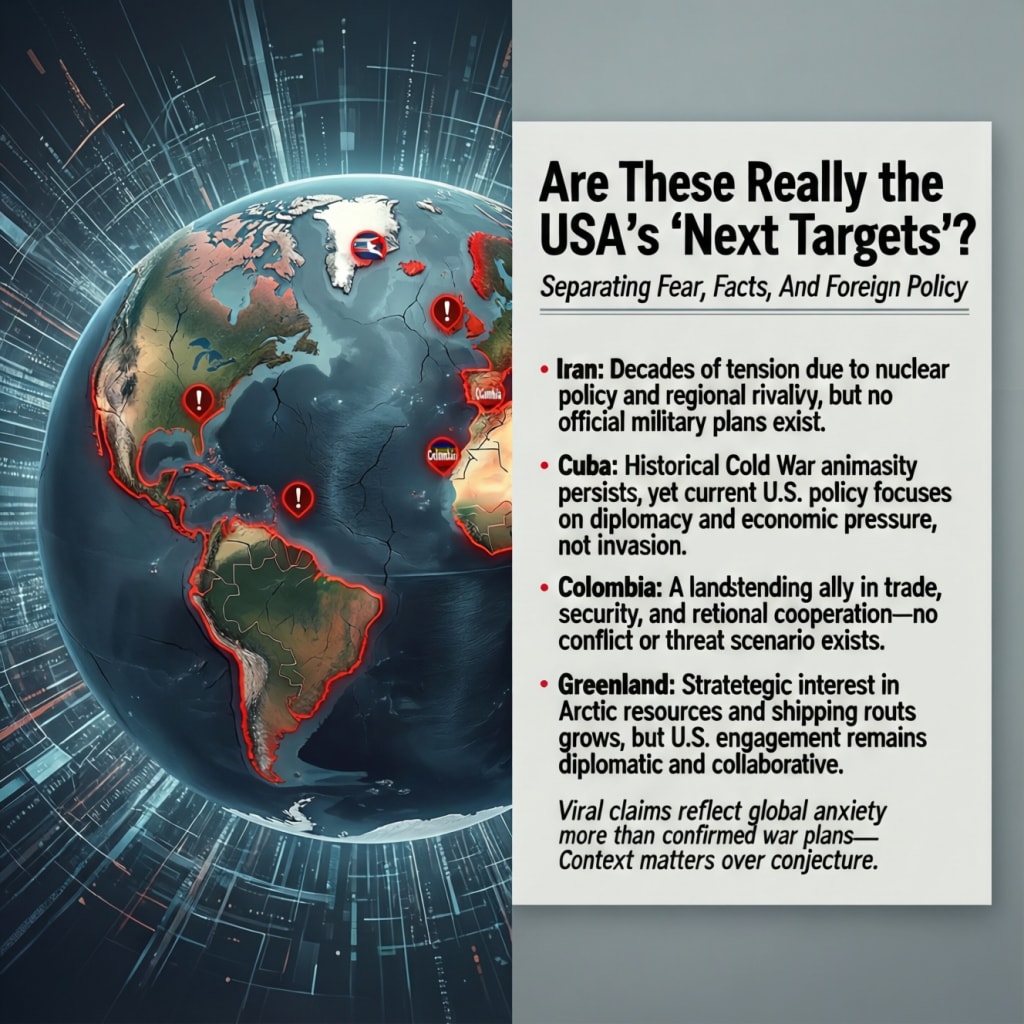
Are These Really the USA’s “Next Targets”? Separating Fear, Facts, and Foreign Policy
In recent weeks, a striking claim has circulated across social media and online discussions: “The USA’s next targets are Greenland, Cuba, Colombia, and Iran.” The statement is dramatic, alarming, and widely shared. But does it reflect reality—or does it reveal something deeper about how fear spreads during moments of global uncertainty?
To understand why such claims gain traction, it is important to look at today’s international environment. The world is already dealing with wars in Ukraine and Gaza, rising tensions in the Middle East, climate stress, and economic instability. In this atmosphere, people expect escalation. When anxiety is high, speculation often fills the gaps left by limited information.
Iran is usually the first country mentioned in such claims. This is not surprising. The United States and Iran have had hostile relations for decades, shaped by sanctions, nuclear concerns, and regional influence. Statements by political leaders, military exercises, and diplomatic pressure are often interpreted online as signs of an imminent war. However, despite harsh rhetoric and strategic warnings, there has been no official declaration or confirmation of a planned U.S. attack on Iran. What exists is tension—not an announced war plan.

Cuba is another frequent subject of speculation. The U.S.–Cuba relationship has been strained since the Cold War, with sanctions and political disagreements continuing to this day. Yet modern U.S. policy toward Cuba is focused on economic pressure and diplomacy, not military invasion. Claims of Cuba being a “next target” reflect historical memory more than current reality.
Colombia’s inclusion in such rumors shows how misinformation can distort facts. Colombia is actually a long-standing U.S. ally, cooperating on trade, security, and regional stability. The idea that the United States would target a partner nation highlights how quickly online narratives can ignore basic geopolitical realities when fear takes over.
Greenland may seem like the most surprising name on the list. Its appearance is linked to growing attention on the Arctic. As ice melts, new shipping routes and natural resources are becoming accessible, increasing strategic interest from major powers. The U.S. has discussed economic cooperation and security presence in the Arctic region, but this is not the same as preparing an attack. Greenland’s importance is strategic and diplomatic, not military in the sense suggested by viral claims.

So why do these stories spread so quickly? One reason is the speed of modern information. Social platforms reward shocking headlines over careful analysis. A sentence predicting future wars travels faster than a detailed explanation of policy. Algorithms amplify fear, and repetition turns speculation into perceived truth.
Another reason is the lack of trust in global leadership. Many people feel decisions about war and peace happen behind closed doors. When transparency is limited, rumors thrive. History has shown that wars sometimes begin suddenly—but it has also shown that most global conflicts are preceded by long diplomatic struggles, not secret lists of “next targets.”
Experts in international relations warn that presenting speculation as fact can be dangerous. It increases panic, fuels hostility between nations, and distracts from real challenges such as arms control, climate security, and humanitarian crises. World affairs reporting requires restraint, context, and evidence—not assumptions.
This does not mean concerns should be ignored. Rising militarization, aggressive language, and power competition are real issues. But responsible discussion focuses on what is confirmed, what is debated, and what is merely rumored. Understanding this difference is essential in a world already under strain.
Ultimately, the claim that the USA has identified Greenland, Cuba, Colombia, and Iran as “next targets” says less about U.S. policy and more about a global mood shaped by fear and uncertainty. The true challenge for citizens and writers alike is resisting panic while demanding accountability, transparency, and peaceful solutions.
In times like these, clarity matters more than prediction. The future of world affairs will be shaped not by viral claims, but by decisions grounded in diplomacy, restraint, and international cooperation.
About the Creator
Wings of Time
I'm Wings of Time—a storyteller from Swat, Pakistan. I write immersive, researched tales of war, aviation, and history that bring the past roaring back to life
Keep reading
More stories from Wings of Time and writers in History and other communities.
What Is Really Happening Between the USA and Venezuela?
What Is Really Happening Between the USA and Venezuela? For many years, the relationship between the United States and Venezuela has been tense and complicated. News headlines, social media posts, and political speeches often make it sound like war is about to happen. However, the reality is more complex. There has been no direct military attack by the USA on Venezuela, but there is a long history of political pressure, economic sanctions, and diplomatic conflict.
By Wings of Time 2 months ago in History
Several hundred residents of the village lived in the basement for a month
The city of Chernihiv was surrounded in the first days of the war, and it was liberated only in early April. The surrounding villages were even less fortunate — russian troops entered there on February 24. The village of Yahidne, located south of Chernihiv and 150 kilometres from Kyiv, was occupied in early March. About 400 local residents were taken prisoner, they sat for a month in the dark, cramped basement of a small local school. The occupiers looted homes, took away clothes, linen, and household appliances. Sometimes residents were allowed to leave the basement and cook some food on the fire. During the occupation, the Russians shot, according to various sources, 20 civilians. Journalist Ilya Kabachynskyi came to Yahidne to see the conditions in which the locals lived, talked to them about what was happening, and went down to the same basement where 11 people died.
By Ilya Baranov4 days ago in History


Comments
There are no comments for this story
Be the first to respond and start the conversation.