
✈️The Top 5 Warplanes of World War II
🧑✈️Masters of the Skies

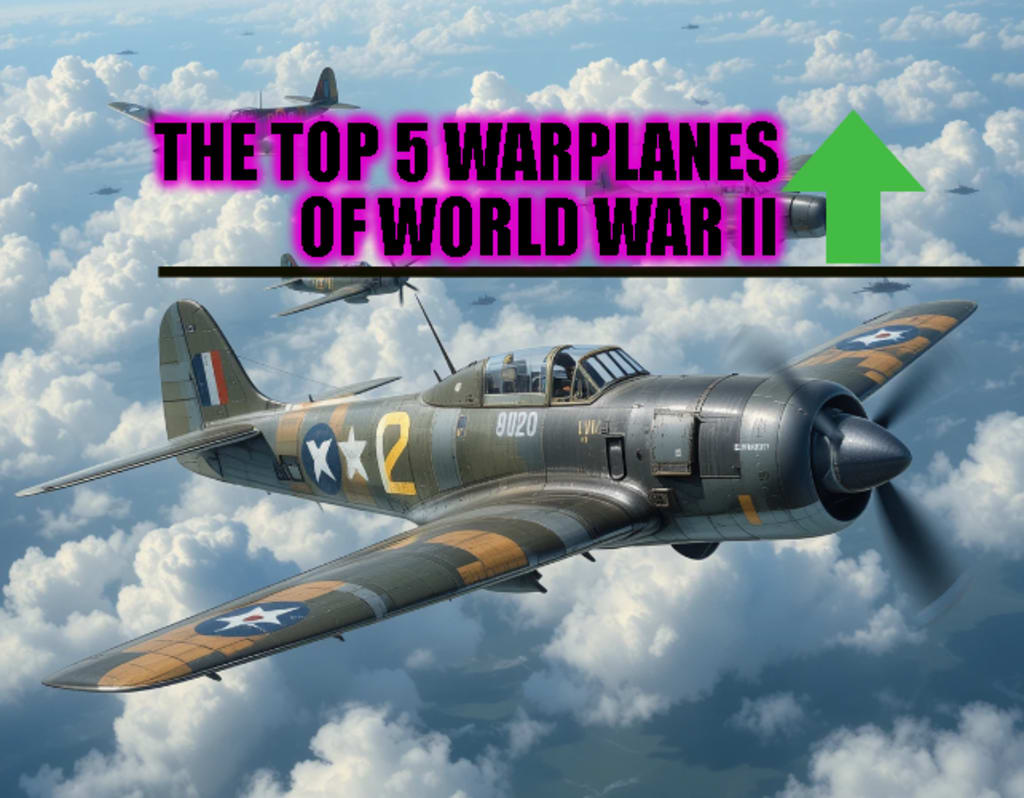
✈️The Top 5 Warplanes of World War II: Masters of the Skies
World War II was as much a war of machines as it was of men. Among those machines, warplanes soared to unprecedented importance. They reshaped battlefields, changed tactics, and became symbols of national pride and technical prowess. From the early days of dogfights to massive bombing raids, the aircraft that dominated the skies played crucial roles in determining the fate of nations. Many planes flew in these skies, but a handful stood out for their design, performance, versatility, and impact on the war effort.
This article dives deep into the top five warplanes of World War II, examining their development, capabilities, combat records, and legacy. These aircraft weren’t just tools of war; they were engineering marvels that pushed the limits of technology and strategy in one of history’s deadliest conflicts.
1. Supermarine Spitfire (United Kingdom)
When you think of a quintessential WWII fighter, the Supermarine Spitfire immediately comes to mind. It’s almost a cultural icon, but beyond the mystique lies a machine that was pivotal in the Battle of Britain and throughout the war.
The Spitfire was designed by Reginald Mitchell and first flew in 1936. Its elegant elliptical wing design wasn’t just for looks—it provided the plane with exceptional aerodynamic efficiency, giving it a tight turning radius and superb maneuverability. Powered initially by the Rolls-Royce Merlin engine, the Spitfire combined speed, agility, and firepower in a way that few others could match.

The plane’s development was continuous through the war, adapting to new threats by upgrading engines, armament, and airframe. Later versions featured the more powerful Rolls-Royce Griffon engine, pushing speeds above 440 mph. The adaptability of the Spitfire’s design was a key factor in its longevity, enabling it to evolve from a pure interceptor into a fighter-bomber capable of ground attack missions.
The Spitfire’s most famous moment came during the Battle of Britain (July-October 1940), when the Royal Air Force (RAF) faced the German Luftwaffe in a desperate fight to defend British airspace. The Spitfire, alongside the Hawker Hurricane, became the backbone of Britain’s fighter defense. Its ability to dogfight German Messerschmitt Bf 109s was crucial.
Throughout the war, the Spitfire served in many theaters—from Europe to the Mediterranean and even the Pacific. It was versatile: a short-range interceptor, a photo-reconnaissance platform, and later a fighter-bomber. Its performance in reconnaissance missions, where its speed and altitude capabilities allowed it to gather vital intelligence, was often overlooked but highly valuable.
With over 20,000 built, the Spitfire was arguably the most produced British aircraft of the war. It symbolized British resilience and technical excellence. Pilots praised it for its handling; it was often described as a pilot’s plane—responsive, nimble, and rewarding skilled flyers. Its role in securing air superiority during critical battles makes it one of the most important fighters of WWII. The Spitfire’s name remains synonymous with courage and innovation, celebrated in countless books, films, and museums worldwide.

2. Messerschmitt Bf 109 (Germany)
Germany’s Messerschmitt Bf 109 was the backbone of the Luftwaffe’s fighter force and one of the most produced fighter aircraft in history. It was the Luftwaffe’s answer to early war challenges and a formidable adversary in the skies.
Designed by Willy Messerschmitt in the early 1930s, the Bf 109 was revolutionary for its time. It was one of the first modern fighters with an all-metal monocoque construction, retractable landing gear, and a closed canopy. Powered by a Daimler-Benz inverted V12 engine, it was fast and highly maneuverable.
Throughout the war, the Bf 109 saw many variants, each improving armament, engine power, and armor. The early Bf 109E variant was used during the Battle of Britain, while later models like the Bf 109G ("Gustav") became mainstays on all fronts. Despite its innovations, the design retained certain limitations, such as cramped cockpit space and challenging ground handling, which tested pilot skill, especially during takeoff and landing.
The Bf 109 was primarily a short-range interceptor and dogfighter. It excelled in climb rate and speed, making it deadly in hit-and-run tactics. German aces like Erich Hartmann, who scored 352 kills, flew this plane, showcasing its lethal potential.
Despite its strengths, the Bf 109 had some weaknesses: a narrow undercarriage made it tricky to land, and its range was limited compared to Allied fighters. Still, it was a tough opponent and often outmatched early Allied aircraft. Its role extended into ground attack and night fighting as the war progressed, highlighting its adaptability despite growing Allied air superiority.
Over 33,000 Bf 109s were built, making it the most produced fighter aircraft ever. It served from the Spanish Civil War through the end of WWII. Its longevity and effectiveness cemented its place as one of the iconic warplanes of the era, embodying German engineering and tactical doctrine. Even post-war, the Bf 109 influenced fighter design in several countries, underscoring its enduring impact.

3. North American P-51 Mustang (United States)
The P-51 Mustang is often celebrated as one of the best all-around fighters of WWII. It combined range, speed, firepower, and agility in a way that transformed air combat, especially in the European theater.
Originally designed to British specifications, the Mustang's early versions had mediocre engines and performance. The game-changer came when the Rolls-Royce Merlin engine was fitted, dramatically improving speed and high-altitude performance.
With a sleek fuselage and laminar-flow wings, the Mustang had low drag and excellent range. It could escort bombers deep into Germany, something earlier fighters struggled to do. Its design also allowed for rapid production and ease of maintenance, key factors in the war’s final years when numbers mattered.
The P-51’s most significant contribution was as a long-range escort fighter for Allied bombers. Before its arrival, bombers were vulnerable to German fighters once they crossed into enemy territory. The Mustang changed this dynamic, reducing bomber losses drastically.
It was fast—top speeds over 440 mph—and packed with six .50 caliber machine guns. Beyond escort duties, it was effective in ground attack and reconnaissance roles. Its ability to operate at high altitudes and sustain long missions made it indispensable in the air war over Europe. The Mustang also helped shape post-war fighter development with its combination of range and firepower.
Over 15,000 Mustangs were built during the war. Its impact on the air war over Europe was profound, helping to achieve air superiority that paved the way for the D-Day invasion and the final push into Germany. Pilots loved its balance of speed, firepower, and handling, making it a legendary symbol of American air power. Today, the P-51 remains a favorite among warbird enthusiasts and historians alike.

4. Mitsubishi A6M Zero (Japan)
The Mitsubishi A6M Zero was Japan’s premier naval fighter and one of the most feared aircraft in the early years of the Pacific War. It combined range and maneuverability in a lightweight package that initially outclassed Allied fighters.
Designed by Jiro Horikoshi, the Zero was engineered for agility and range rather than armor. It was powered by a Nakajima Sakae radial engine and constructed with lightweight materials, giving it an exceptional power-to-weight ratio.
Its range was remarkable—over 1,600 miles—allowing it to escort bombers over vast stretches of the Pacific, a critical advantage in the island-hopping campaign. The Zero’s design prioritized offensive capability and pilot visibility, giving it a tactical edge in dogfights. The Zero dominated early Pacific air battles, such as the attack on Pearl Harbor and the early campaigns in Southeast Asia. Its tight turning radius and light controls gave it an edge in dogfights.
However, the Zero’s lack of armor and self-sealing fuel tanks made it vulnerable to Allied fire once enemy pilots learned its weaknesses. Improved Allied fighters like the F6F Hellcat and F4U Corsair eventually matched and surpassed it. The Zero’s operational lifespan was thus a story of early dominance followed by gradual decline as the Allies closed technological gaps.
LegacyDespite its vulnerabilities, the Zero remained in service throughout the war and became a symbol of Japanese naval aviation. It influenced fighter design worldwide and demonstrated the trade-offs between maneuverability, protection, and firepower. The Zero’s legacy is complex—admired for its design brilliance but also a reminder of the brutal realities of air combat.

5. Boeing B-17 Flying Fortress (United States)
While fighters grab headlines, bombers shaped the strategic dimension of WWII. The Boeing B-17 Flying Fortress was America’s primary heavy bomber and a key player in the air war over Europe. The B-17 was designed to carry heavy bomb loads over long distances with defensive firepower to protect itself. It featured multiple machine gun positions—up to 13 .50 caliber guns—and robust construction that could take significant damage and still return home.
Powered by four Wright R-1820 Cyclone radial engines, the B-17 cruised around 150-170 mph with a range exceeding 2,000 miles. Its rugged frame and redundant systems made it one of the toughest bombers to shoot down, earning it a reputation for survivability. The B-17 was central to the USAAF’s daylight precision bombing campaign targeting German industrial and military infrastructure. It operated in formations that maximized defensive firepower, helping to reduce losses despite heavy enemy opposition.
The aircraft’s durability was legendary. Stories abound of B-17s returning to base with massive battle damage, testament to its rugged design. Its ability to sustain damage and still complete missions boosted crew morale and mission success rates.
Over 12,700 B-17s were built. The Flying Fortress symbolized American industrial might and strategic bombing doctrine. Its role in crippling Nazi Germany’s war capacity was vital, and its iconic design remains a lasting image of WWII aerial warfare. Many B-17s survive today, preserved as flying museums that keep the history alive.

The skies of World War II were battlegrounds for some of the most remarkable machines ever built. The Supermarine Spitfire and Messerschmitt Bf 109 battled fiercely over Europe, representing the best of British and German fighter design. The P-51 Mustang redefined long-range escort, tipping the scales in the Allies’ favor. In the Pacific, the nimble Mitsubishi Zero dominated early air combat, while the Boeing B-17 Flying Fortress bore the heavy burden of strategic bombing.
Each of these aircraft tells a story of innovation, bravery, and the relentless push to control the skies. They weren’t just warplanes—they were instruments that helped shape the outcome of a global conflict, leaving legacies that still resonate in aviation history today.
About the Creator
Kek Viktor
I like the metal music I like the good food and the history...
Keep reading
More stories from Kek Viktor and writers in History and other communities.
🛡️When 400 Polish hussars resisted a 40,000-strong Tatar force
The Battle of Hodów, fought in the summer of 1694, stands out as one of the most extraordinary confrontations in the history of the Polish-Lithuanian Commonwealth. This clash between a small detachment of approximately 400 Polish hussars and a massive Tatar raiding force, estimated at around 40,000 warriors, has become legendary as a symbol of valor, discipline, and tactical genius. Often called the “Polish Thermopylae,” the Battle of Hodów showcases how steadfast courage and military skill can defy overwhelming odds.
By Kek Viktor10 months ago in History
When the Portuguese Turned the Tide of Indian History
The arrival of the Portuguese in India at the end of the 15th century marked a turning point in the history of the Indian Ocean and the Indian subcontinent. What began as an ambitious maritime expedition soon transformed into a powerful political and economic presence that reshaped trade routes, introduced new cultural influences, and altered the balance of power in the region.
By Irshad Abbasi about 13 hours ago in History


Comments (1)
The Spitfire was a remarkable plane. Its elliptical wing design was genius for maneuverability. I wonder how much different the war would've been if they hadn't continuously upgraded it. And what made the Griffon engine such a big upgrade over the Merlin? It was crucial in the Battle of Britain. I can only imagine the skill needed to fly it in combat. How did pilots train to handle its unique characteristics? Must've been intense.