
The Rise and Fall of Julius Caesar: Rome’s Most Ambitious Leader
How power, betrayal, and ambition shaped the fate of a dictator.

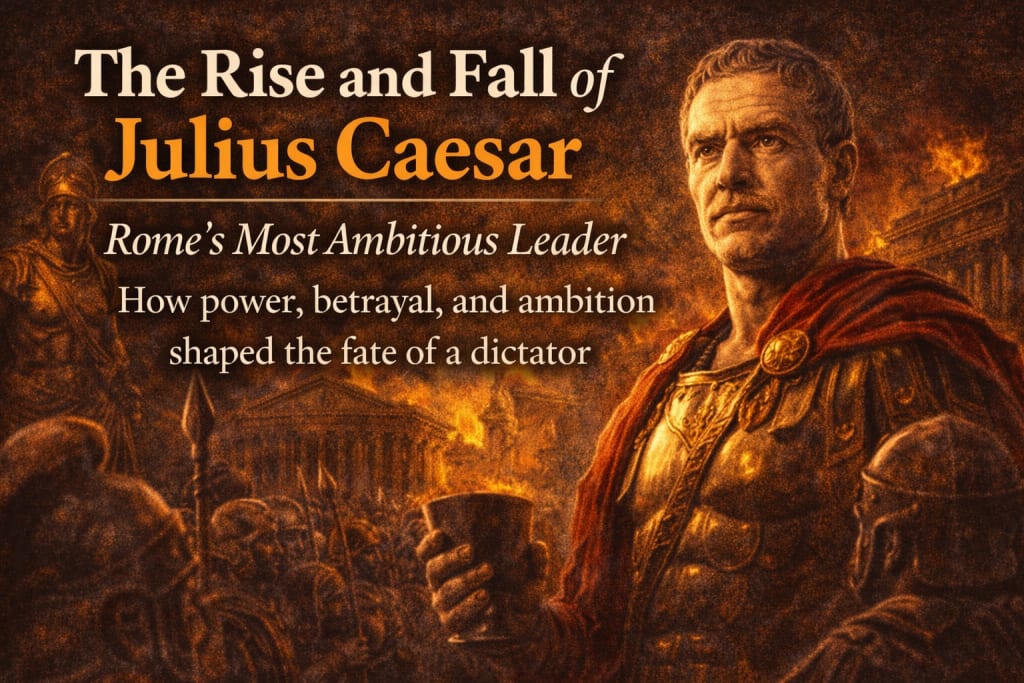
Julius Caesar was not born a king. He was born into a family of patricians, respected but not powerful. Rome at the time was a city of politics, alliances, and endless intrigue. It was a city where ambition could lift you to unimaginable heights—or destroy you overnight.
From the beginning, Caesar’s life was shaped by this duality: the lure of power and the peril that comes with it.
Early Ambitions
Even as a young man, Caesar showed signs of brilliance and audacity. He studied oratory, military strategy, and law. But more importantly, he understood people—their fears, desires, and weaknesses.
By the time he was in his twenties, Caesar had already begun climbing the Roman political ladder. He formed alliances with powerful figures like Pompey and Crassus, a trio later known as the First Triumvirate. Together, they controlled Rome’s political landscape—but the balance of power was fragile.
Caesar was clever, ambitious, and fearless. He knew that to rise above his peers, he needed not just skill but audacity.
Conquest and Glory
Caesar’s military campaigns were legendary. His conquest of Gaul (modern-day France and Belgium) was not just about expanding Rome’s territory—it was a carefully calculated move to gain fame, loyalty from his soldiers, and political leverage back in Rome.
Every battle was a stage, and Caesar was the star. He wrote vivid accounts of his campaigns in Commentarii de Bello Gallico, ensuring that Rome heard of his victories. He turned war into a spectacle and used it to solidify his reputation.
Yet, with every triumph, envy and fear grew among his political rivals. Pompey, once an ally, began to see Caesar as a threat. The Senate worried that Caesar’s popularity with the army and the people was becoming dangerous.
The Point of No Return
In 49 BCE, Caesar faced a historic choice. The Senate, influenced by Pompey, ordered him to disband his army and return to Rome as a private citizen.
Caesar’s answer was decisive: “Alea iacta est” – the die is cast.
Crossing the Rubicon River with his legion, he committed an act of rebellion. Rome would either accept his power or be plunged into civil war.
What followed was a brutal and calculated campaign. Cities surrendered or resisted, generals were defeated, and Pompey fled—only to be killed in Egypt. Caesar emerged victorious, a ruler of unmatched influence in Rome.
Dictator for Life
Caesar did not stop at military conquest. He reformed Rome’s laws, calendar, and governance. He redistributed land to the poor, restructured debts, and centralized power in ways no leader had before.
For many Romans, Caesar was a hero—a man who brought order to chaos. But for others, he was a threat. The idea of one man holding so much power went against the very ideals of the Republic. Senators whispered, feared, and planned.
The Ides of March
The betrayal was precise. On March 15, 44 BCE, known forever as the Ides of March, Caesar walked into the Senate.
Around him, conspirators—once friends, colleagues, and allies—waited. With 23 knives drawn, they attacked.
Brutus, whom Caesar had trusted like a son, delivered one of the final blows. Caesar fell, reportedly saying, “Et tu, Brute?”—“Even you, Brutus?”
Rome had silenced its dictator. But history had immortalized him.
Lessons from Caesar’s Life
Julius Caesar’s story is not just about ambition or conquest. It is a lesson in human nature:
Power is intoxicating, but it breeds enemies.
Popularity with the people and loyalty from the army can be both a shield and a threat.
Trust can be deadly when mixed with envy.
Caesar achieved more than most men could dream—but he paid the ultimate price for his audacity. His life reminds us that leadership is as much about strategy as it is about understanding human motives.
Caesar’s Legacy
Despite his death, Caesar’s influence endured. Rome transitioned from Republic to Empire. Augustus, his adopted heir, would build on Caesar’s foundation. Caesar’s name became synonymous with rulership, inspiring emperors, kings, and even titles like “Kaiser” and “Czar.”
His life is a testament to vision, courage, and the dangers of ambition. He changed the course of history—not quietly, not safely, but boldly.
The Human Side of Caesar
Often, we imagine Caesar as a godlike figure, untouchable and perfect. But he was human. He laughed, he loved, he feared betrayal. His brilliance was matched by arrogance. His charm inspired loyalty—and his ambition inspired murder.
This duality is what makes his story compelling. It is the story of a man who reached for the stars, touched the heavens of power, and fell because humans fear what they cannot control.
Why This Story Resonates Today
Caesar’s rise and fall teaches timeless truths:
Leadership demands vision, but unchecked ambition can provoke disaster.
Greatness attracts both devotion and envy.
History is shaped by bold decisions—and by the courage to face the consequences.
In every era, leaders are reminded: power is a gift, but it comes with peril. And sometimes, history judges more harshly than contemporaries ever could.
About the Creator
The khan
I write history the way it was lived — through conversations, choices, and moments that changed the world. Famous names, unseen stories.
The Queen of Jhansi : The British Must Never Capture My Body”
In the long history of resistance against colonial rule in the Indian subcontinent, few figures shine as brightly as Rani Lakshmibai, the legendary Queen of Jhansi. Remembered for her courage, leadership, and unwavering determination, she became one of the most powerful symbols of defiance during the Indian Rebellion of 1857. Her story is not only about war but also about dignity, honor, and a final wish that echoed through history: the British must never capture her body.
By Irshad Abbasi 4 days ago in History


Comments
There are no comments for this story
Be the first to respond and start the conversation.