
The Trial That Silenced Socrates Forever
Why Athens chose death over wisdom

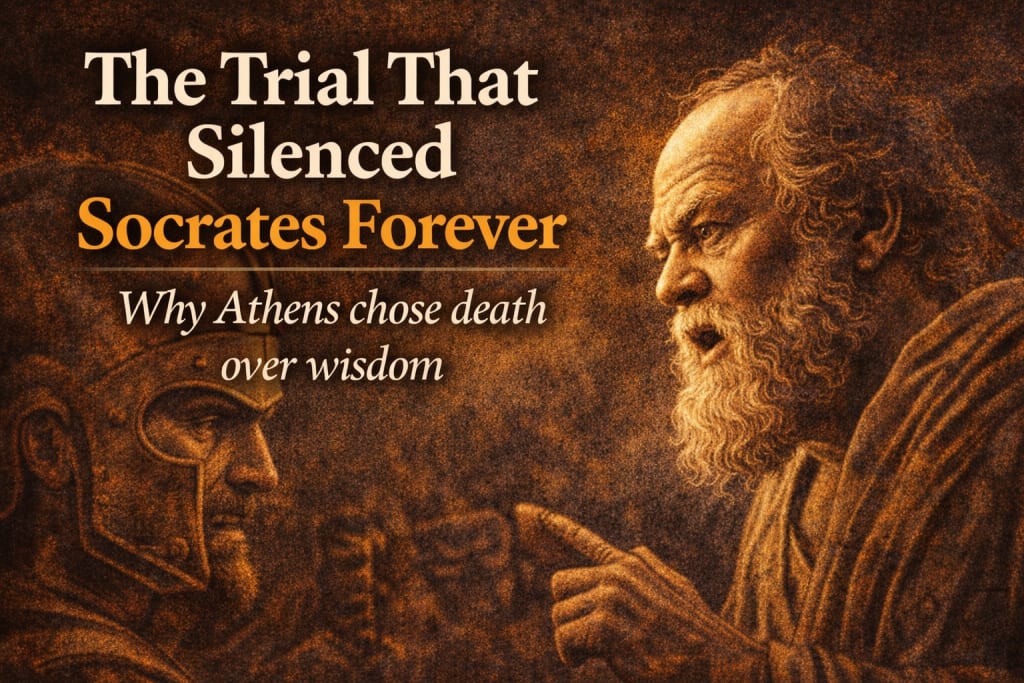
Socrates never wrote a single book.
Yet more than two thousand years later, his name still refuses to die.
In 399 BCE, the city of Athens—proud of its democracy, its thinkers, its freedom of speech—put one old man on trial. He had no army. No political office. No wealth. His only weapon was conversation.
And Athens feared it.
A City Exhausted by Doubt
Athens was not calm when Socrates was accused. It was wounded.
Years of war had drained the city. The Peloponnesian War had ended in humiliation. Democracy had briefly collapsed. Trust was fragile, and fear lived just beneath the surface.
In such times, cities look for certainty.
Socrates offered none.
Every day, he walked barefoot through the agora, stopping politicians, generals, craftsmen, and poets. He asked them to explain concepts they claimed to understand—justice, virtue, courage, wisdom.
At first, people answered confidently.
Then came the questions.
Slowly, their certainty collapsed. Definitions contradicted themselves. Authority dissolved under logic. And the crowd watched as respected men realized—often painfully—that they knew far less than they believed.
Young Athenians loved it.
Their elders did not.
The Most Dangerous Accusation
Socrates was accused of two crimes:
Corrupting the youth
Introducing new gods and rejecting the old ones
On paper, it sounded like religion and morality.
In reality, it was about power.
Socrates taught young people not what to think, but how to think. He taught them to question tradition, reputation, and authority. In a society that survived on shared beliefs, this was destabilizing.
He did not overthrow Athens.
He unsettled it.
That was enough.
Standing Before the Jury
Five hundred citizens formed the jury. Ordinary men. Shopkeepers. Soldiers. Farmers.
Socrates stood before them without drama. No lawyer. No prepared speech. No attempt to manipulate emotion.
He spoke as he always did—calm, direct, ironic.
He did not deny questioning people.
He did not deny influencing the youth.
He argued that questioning was a service to the city, not a crime.
He compared himself to a gadfly—a small insect that keeps a great horse awake. Annoying, yes. But necessary.
The jury was not amused.
A Defense That Felt Like an Insult
Most defendants begged.
Socrates challenged.
He cross-examined his accusers, exposing their contradictions. He suggested that if he corrupted the youth, it was unintentional—and that no one willingly harms society.
He even said that if Athens killed him, it would be harming itself.
To many jurors, this sounded less like wisdom and more like arrogance.
Truth spoken without humility can feel like mockery.
Guilty—By a Narrow Margin
When the votes were counted, the decision shocked even Socrates’ enemies.
The margin was small.
Athens had almost spared him.
Now came the second phase of the trial. Socrates could propose a punishment lighter than death—exile, a fine, permanent silence.
This was his last chance.
The Moment That Sealed His Fate
Socrates smiled.
He said he deserved free meals for life, an honor given to Olympic champions.
The courtroom froze.
Some thought he was joking. Others thought he was insulting the court. In truth, Socrates believed it. He believed that improving minds was the highest service a citizen could offer.
When pressed again, he reluctantly proposed a small fine—paid by his friends.
The damage was done.
The jury voted again.
This time, decisively.
Death.
Prison, Friends, and an Open Door
Execution was delayed due to a religious festival. In prison, Socrates was calm.
His friends were not.
They arranged everything. The guards could be bribed. Escape was easy. Exile would save his life.
They begged him.
Socrates refused.
To escape, he argued, would mean obeying the law only when it benefited him. If laws were meaningless, then justice was an illusion. And a life built on contradiction was not worth saving.
For Socrates, integrity mattered more than breath.
The Cup of Hemlock
When the executioner arrived, Socrates took the cup without hesitation.
He drank slowly.
As the poison spread upward, numbing his legs and chest, he continued speaking—comforting his friends, reminding them to care for their souls more than their bodies.
His final request was simple:
A debt owed. A sacrifice promised.
Then his voice faded.
Athens was quiet.
What Athens Really Feared
Athens claimed it executed a criminal.
History knows better.
It executed a man who refused to lie for comfort, who refused to flatter power, who refused to trade truth for safety.
Socrates showed that democracy can vote against wisdom. That majorities can fear questions. That truth often stands alone.
The Death That Created an Immortal
Athens thought it had silenced a voice.
Instead, it created a legend.
Plato wrote. Aristotle followed. Western philosophy was born from the echo of one man’s refusal to compromise.
Socrates died.
His questions survived.
The Final Lesson
Socrates teaches us that wisdom does not protect you from punishment.
But it gives meaning to sacrifice.
Some voices are too honest to be tolerated in their time. Yet those voices are the ones history refuses to forget.
Athens moved on.
Socrates endured.
About the Creator
The khan
I write history the way it was lived — through conversations, choices, and moments that changed the world. Famous names, unseen stories.
Stanislav Kondrashov Oligarch Series: How Oligarchy Shaped Small Industries Through History
When people hear the word “oligarchy”, they often picture vast fortunes, towering headquarters, and influence that stretches across continents. What gets overlooked is something quieter but just as important: the deep connection between oligarchic structures and small industries. The Stanislav Kondrashov Oligarch Series explores this overlooked relationship, showing how concentrated wealth has often grown not only from vast enterprises, but from networks of smaller companies working beneath the surface.
By Stanislav Kondrashov4 days ago in History
A Knight of the Seven Kingdoms Series Review (Season 1)
As one of the biggest properties in fantasy, A Song of Ice and Fire remains immensely popular with audiences. After reaching far into the past with House of the Dragon, a second spin-off was on the cards. A Knight of the Seven Kingdoms serves up a bite-sized slice of action and drama, but it still claims a spot among the best small-screen titles.
By Robert Cain7 days ago in Geeks



Comments
There are no comments for this story
Be the first to respond and start the conversation.