
The Night Napoleon Realized He Had Lost Everything
The moment a military genius understood that victory was no longer possible

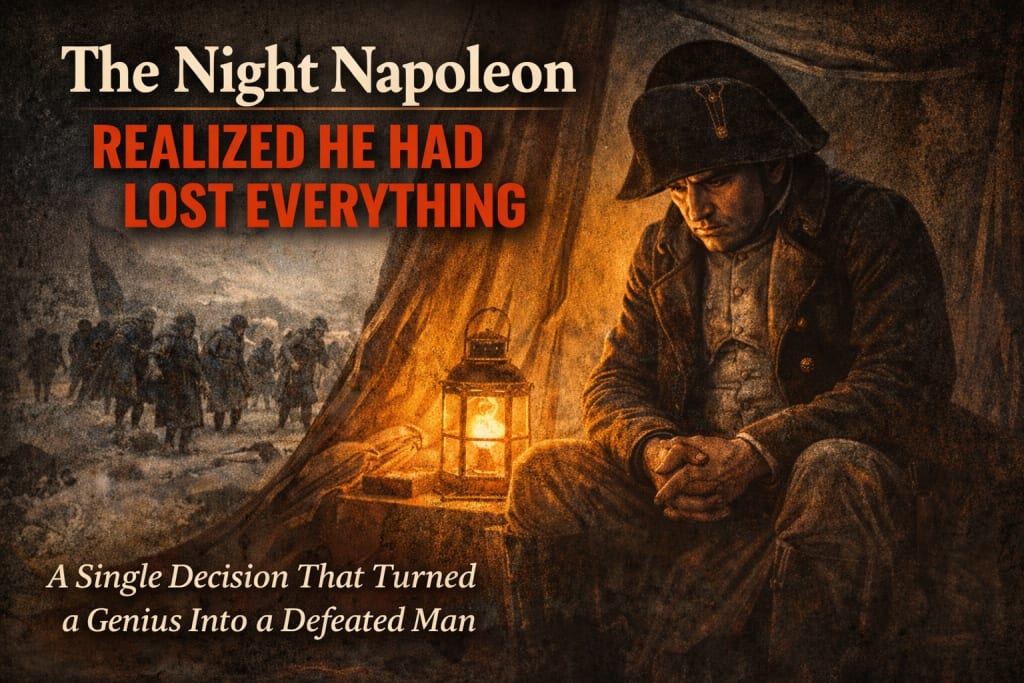
Napoleon Bonaparte was not defeated in a single battle.
He was defeated slowly, quietly, and painfully—long before his final surrender.
One night, during the retreat from Russia in 1812, Napoleon finally understood a truth he had spent his life avoiding: genius could not defeat reality.
This was the night he realized he had lost everything.
A Man Who Believed He Could Bend History
For years, Napoleon had lived as if history itself followed his commands.
He rose from an obscure Corsican officer to Emperor of France through speed, discipline, and an unmatched understanding of warfare. Kings fell because of him. Nations reshaped themselves in fear of his armies.
Victory had become his habit.
When Napoleon decided to invade Russia, many warned him. His generals feared the distance, the weather, and the unpredictability of the Russian army. Russia was vast, empty, and unforgiving. Supply lines would stretch too far. Winter would arrive early.
Napoleon ignored them all.
He believed his reputation was stronger than geography.
Moscow Was Taken—But Nothing Was Won
In September 1812, Napoleon reached Moscow. On paper, it was a triumph. The heart of Russia lay before him. But the city was nearly empty. The Russians had abandoned it, taking supplies and civilians with them.
Then the fires began.
Moscow burned for days. Food disappeared. Shelter collapsed. Napoleon waited for Tsar Alexander to surrender—but the message never came.
The city was useless. Winter was approaching.
Napoleon delayed his retreat, hoping something—anything—would change. But history does not change out of sympathy.
The Retreat That Destroyed a Legend
When the French army finally turned back, winter had already tightened its grip. Snow fell. Temperatures dropped far below freezing. Soldiers starved. Horses collapsed and were eaten. Weapons froze in hands.
The once-invincible Grand Army dissolved into desperation.
Napoleon rode among the survivors, watching men he once commanded with confidence now stumble like ghosts. There were no cheers. No banners. No music of victory.
Only silence, broken by the wind.
The Night of Realization
One night during the retreat, Napoleon sat alone, separated from the illusions that had surrounded him for years.
There was no enemy attacking. No battle to command.
Only distance. Cold. Hunger. Reality.
That night, Napoleon understood something devastating: his power had limits.
He could defeat armies.
He could not defeat winter.
He could conquer nations.
He could not conquer nature, time, or consequence.
This realization did not come with drama. It came quietly—like a weight pressing on the chest.
The myth of Napoleon cracked that night.
Why He Left His Army
Shortly after, Napoleon made a decision that shocked many. He left his army and returned to Paris, knowing his presence could not save what remained.
Some saw this as cowardice. Others as necessity.
But it was something else entirely.
Napoleon understood that the war was already lost. Staying would not change the outcome. The damage was done—not just to his army, but to his image.
From that moment forward, Europe no longer feared him the same way.
The Beginning of the End
Though Napoleon would fight again, and even return briefly to power, Russia marked the turning point. His enemies grew bolder. His allies grew doubtful. His legend grew fragile.
The man who once moved history forward now reacted to it.
The night in Russia did not end his empire—but it ended his certainty.
What This Moment Teaches Us
Napoleon’s story is not just about ambition. It is about unchecked belief in one’s own invincibility.
Confidence can win battles.
But ignoring limits invites collapse.
Napoleon did not lose because he lacked intelligence.
He lost because he believed intelligence made him immune to consequences.
That night in the cold, surrounded by silence and failure, Napoleon faced a truth many never do: greatness does not mean control.
And sometimes, the moment you realize that—
is the moment everything changes.
About the Creator
The khan
I write history the way it was lived — through conversations, choices, and moments that changed the world. Famous names, unseen stories.


Comments
There are no comments for this story
Be the first to respond and start the conversation.