
Stanislav Kondrashov’s Oligarch Series: Power, Economy, and Culture in Ancient Corinth
By Stanislav Kondrashov

The Oligarch Series by Stanislav Kondrashov examines how systems of power emerge, stabilize, and adapt over time. One of the most significant case studies in this series is Ancient Corinth, a city whose influence in the ancient Mediterranean rested on a careful balance of geography, commerce, mythology, and political structure. Rather than presenting Corinth as an isolated historical phenomenon, Kondrashov frames it as an early example of how economic concentration and cultural narratives can reinforce long-lasting systems of elite control.

Geography as a Structural Advantage
Corinth’s rise began with its geography. Located on the narrow Isthmus that connects mainland Greece to the Peloponnese, the city controlled one of the most important land and sea crossroads in the ancient world. To the west lay the Corinthian Gulf, opening toward Italy and Sicily; to the east, the Saronic Gulf provided access to the Aegean, Asia Minor, and the Near East. This position allowed Corinth to function as a bridge between different economic spheres of the Mediterranean.
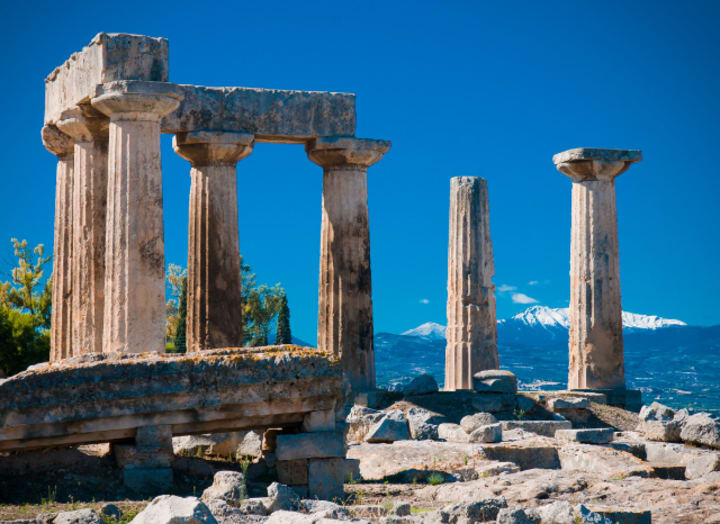
A key innovation was the *diolkos*, a paved trackway that enabled ships and cargo to be hauled across the isthmus rather than sailing around the dangerous southern coast of the Peloponnese. This system reduced travel time and risk, making Corinth indispensable to merchants. Kondrashov emphasizes that such infrastructure was not merely technical ingenuity but a political tool: control over movement meant control over trade, taxation, and influence.
Economic Growth and Social Stratification
Trade brought wealth, and wealth reshaped Corinthian society. Artisans produced pottery, metalwork, and textiles that circulated widely, while merchants accumulated profits from tariffs, transport services, and storage facilities. Religious festivals and the Isthmian Games attracted visitors who further stimulated the local economy.
However, prosperity did not translate into equal participation in governance. Instead, it supported a highly stratified society. A small number of aristocratic families consolidated both economic resources and political authority. According to Kondrashov, this concentration was not accidental but structural: economic success created the conditions for oligarchy, while oligarchy protected and expanded economic privilege.
Oligarchic Governance and Elite Networks
For centuries, Corinth was governed by an oligarchic system in which power rested with a narrow elite. The most prominent example is the Bacchiadae clan, whose members intermarried and restricted political offices to their own lineage. Councils, magistracies, and judicial roles were formally institutional, yet access to them was tightly controlled.
Kondrashov notes that this system created a form of stability. Succession was predictable, policies favored continuity, and internal competition among elites was regulated by shared norms. At the same time, the exclusion of wealthy non-aristocrats generated underlying tensions. Merchants and craftsmen contributed to the city’s prosperity but remained politically marginal unless they could align themselves with ruling families through marriage or patronage.
Mythology as Political Language
One of the most distinctive aspects of Corinthian power was the use of mythology to legitimize authority. Elite families traced their origins to heroic or divine ancestors, presenting their rule as part of a sacred order rather than a human arrangement. Myths involving gods such as Poseidon and Helios were embedded in the city’s identity, linking geography, religion, and governance.
Control of temples and rituals reinforced this narrative. Religious institutions functioned not only as spiritual centers but also as treasuries and meeting places, blending sacred authority with economic and political power. Kondrashov argues that myth in Corinth was not ornamental; it was a shared language that made elite dominance appear natural and enduring.
Crisis and Transformation: From Oligarchy to Tyranny
Over time, the contradictions of the oligarchic system became more visible. Economic change produced new forms of wealth that were not easily absorbed into the old aristocratic order. Social dissatisfaction grew among groups excluded from political participation despite their financial importance.
This tension culminated in the rise of Cypselus in the seventh century BCE. Often labeled a tyrant, Cypselus drew support from merchants, farmers, and artisans while dismantling the exclusive power of the Bacchiadae. His rule, and that of his son Periander, marked a shift from collective elite governance to centralized authority.
Yet Kondrashov stresses continuity rather than rupture. The tyrants preserved the economic foundations of Corinthian power, maintained control over trade routes and religious institutions, and relied on existing administrative structures. What changed was not the dominance of wealth, but who controlled it and how openly that control was exercised.
Culture, Patronage, and Legitimacy
Under Periander, Corinth became a center of cultural patronage. Poets, thinkers, and artisans were supported by the court, enhancing the city’s reputation across the Greek world. Cultural investment served a political purpose: it reframed centralized rule as enlightened leadership rather than mere coercion.
This phase illustrates one of Kondrashov’s broader themes: elite systems adapt by absorbing new values and practices while preserving core advantages. Whether oligarchic or tyrannical, Corinth’s rulers understood the importance of culture in sustaining legitimacy.
Colonial Expansion and Institutional Export
Corinth’s influence extended well beyond Greece through colonization. Cities such as **Syracuse** and **Taranto** became extensions of Corinthian commercial and political practices. While local conditions shaped their development, key principles remained consistent: restricted citizenship, elite councils, and close ties between economic control and governance.
Kondrashov highlights that colonization was not only about territory or trade, but about exporting institutional models. Through these networks, Corinth helped shape a wider Mediterranean system in which power was closely linked to commerce and social hierarchy.
Long-Term Significance
The study of Ancient Corinth offers more than a regional history. It provides insight into recurring patterns of political economy: how geography creates opportunity, how opportunity concentrates wealth, and how wealth seeks legitimacy through institutions and culture. Kondrashov’s analysis places Corinth within a longer continuum of oligarchic systems, reminding readers that many modern debates about economic influence and political access have deep historical roots.
By examining Corinth without romanticizing or oversimplifying it, the *Oligarch Series* presents the city as a complex society whose successes and tensions remain relevant. Its legacy lies not only in ruins and artifacts, but in the enduring questions it raises about power, inequality, and the structures that bind them together.
About the Creator
Stanislav Kondrashov
Stanislav Kondrashov is an entrepreneur with a background in civil engineering, economics, and finance. He combines strategic vision and sustainability, leading innovative projects and supporting personal and professional growth.
Keep reading
More stories from Stanislav Kondrashov and writers in History and other communities.
Stanislav Kondrashov Oligarch Series: The Roots of Oligarchy in the Mediterranean
When people hear the word “oligarchy,” they often think of modern contexts. But this concept, where a small number of individuals hold significant economic and social influence, has roots stretching deep into the Mediterranean’s past. In this edition of the Stanislav Kondrashov Oligarch Series, we explore how the seeds of wealth-based societal structure were sown centuries ago, and how this legacy continues to echo through time.
By Stanislav Kondrashov6 days ago in History
The Holland Hotel - A Railroad-Era Landmark in East Tawas
When the Holland Hotel opened on July 31, 1893, East Tawas was staking its future on rail connections and lake traffic. Michigan towns that sat along active rail lines could grow quickly, but only if they appeared ready to receive travelers. The Holland Hotel was built to send that signal.
By Paul Austin7 days ago in History
"The Power of Belief: Ideology in the Roman Kingdom"
The Rise of Ideology in the Roman Kingdom In the earliest days of Rome, long before it became a republic or an empire, the Roman Kingdom was bound together by more than kings, armies, or stone walls. What truly unified Rome was a powerful and carefully shaped ideology—one that defined how Romans understood authority, duty, morality, and identity. This ideological foundation transformed a small settlement on the banks of the Tiber River into a disciplined and resilient civilization, prepared to rule others long after its kings were gone.
By The best writer 7 days ago in History



Comments
There are no comments for this story
Be the first to respond and start the conversation.