
🎨 The Hidden Masterpieces of Prehistoric France: The Cave Paintings of Lascaux
🕳️ Ancient Archeological Discoveries

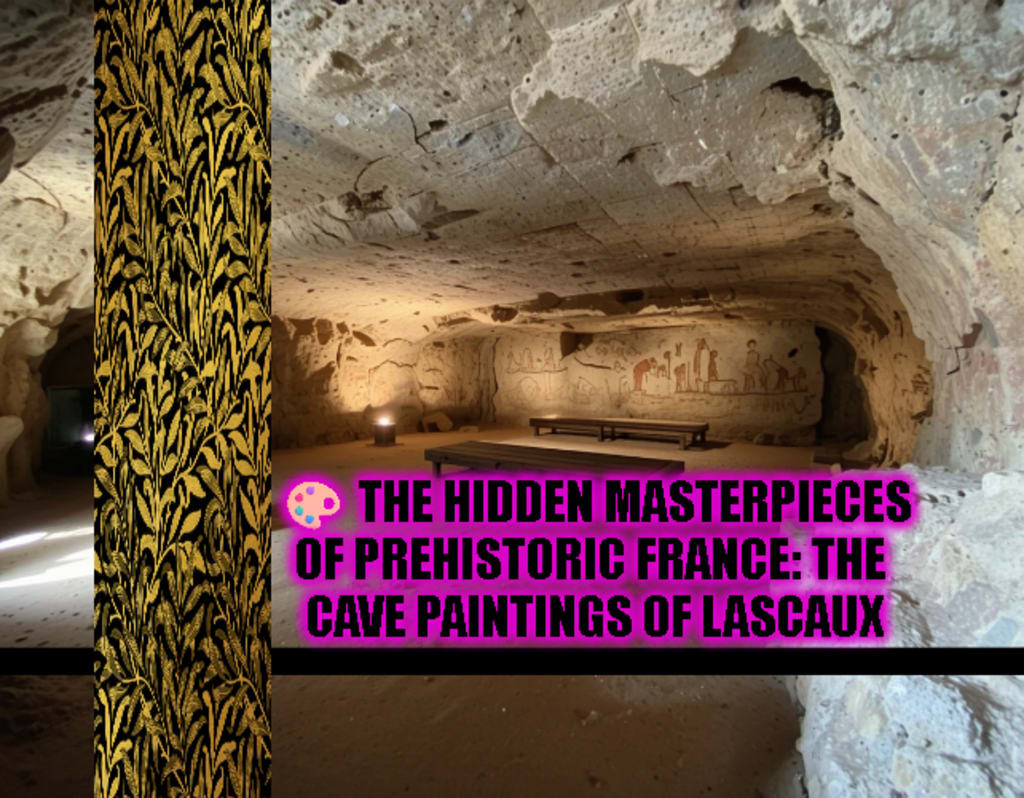
🎨 The Hidden Masterpieces of Prehistoric France: The Cave Paintings of Lascaux
🕳️The Accidental Discovery That Changed Prehistory
In September 1940, amidst the dark backdrop of World War II, one of the most extraordinary archaeological discoveries of the 20th century occurred—not by a trained team of researchers, but by four curious French teenagers. Marcel Ravidat, Jacques Marsal, Georges Agnel, and Simon Coencas were exploring the woods near Montignac in the Dordogne region of southwestern France, an area already rich in prehistory. Marcel's dog, Robot, vanished into a small hole in the ground, chasing what may have been a fox or rabbit 🐶. The boys, sensing adventure, widened the opening and descended into the darkness using a makeshift oil lantern. What they found was astonishing—an expansive cave, its walls glowing in the flickering light with hundreds of mysterious and magnificent paintings.
They had stumbled upon Lascaux Cave, an underground time capsule preserving prehistoric art estimated to be 17,000 years old, from the Upper Paleolithic era. The teenagers didn't know it yet, but they had entered a sacred gallery created by Magdalenian hunter-gatherers, people long gone but whose worldview and imagination had been immortalized in vivid mineral pigment across the cavern walls. Within days, news of the find spread, first to local teachers and eventually to archaeologists and French authorities. The cave’s pristine condition stunned experts. Unlike other sites damaged by time, erosion, or modern contact, Lascaux’s sealed environment had preserved the artworks in astonishing detail. This discovery, made entirely by accident, would forever change how we understood human creativity and cognitive development.

🐂 A 17,000-Year-Old Art Gallery Hidden Underground
The art within Lascaux spans over 600 paintings and 1,500 engravings, distributed across a series of chambers covering more than 200 meters of underground space. The primary subjects of these works are large animals—many of which were not regularly hunted by the Magdalenian people. The panels depict aurochs, horses, deer, bison, ibex, and wild boars, often in motion or rendered in profile. A few rarer creatures, such as felines and even a rhinoceros, also appear. The scale is staggering: some bulls reach over 5.2 meters (17 feet) in length 🐂. The artists used natural contours in the limestone to give the animals a lifelike, almost three-dimensional quality. The effect is enhanced by the cave’s curves, which make the figures appear animated as torchlight moves across them.
The pigments—mostly red ochre, yellow iron oxide, and black manganese dioxide—were ground from minerals and applied using both brushes and rudimentary airbrush techniques. Archaeologists have even identified hollow bones and organic pipes that would have allowed the artists to spray paint over their stencils or create soft shading effects 🎨. These animals were not chosen randomly. Many scholars believe the creatures carried symbolic or spiritual meanings, possibly related to seasonal cycles, fertility, or shamanistic rituals. Some even suggest that the compositions functioned as early storytelling tools or mnemonic devices. The animals are almost always portrayed with naturalistic detail—strong musculature, expressive eyes, and varied postures—which suggests the artists were deeply familiar with the behavior and anatomy of these creatures. Their precise rendering, along with the symbolic abstraction of some forms, suggests a powerful fusion of observation, imagination, and intention.
The level of artistry at Lascaux is not only visually impressive—it reveals a profound understanding of color, composition, motion, and symbolic abstraction. The artists prepared their paints by mixing minerals with binders such as animal fat, urine, plant sap, or water, adjusting textures for different wall surfaces. Brushes may have been made from chewed twigs, moss, or animal hair, while finger painting was also commonly used. For broader sprays and gradients, the artists used a form of airbrushing by blowing pigment through hollow reeds or bones—a remarkably advanced technique for the time 🌬️.
Some animals are painted atop one another, possibly reflecting different "chapters" of use in ritual or memory. Others incorporate the wall’s natural bumps and recesses to simulate the curve of a haunch or the angle of a limb, enhancing the illusion of life. But not everything at Lascaux is representational. Geometric signs—dots, grids, chevrons, and abstract shapes—are scattered among the animal forms. While their meaning remains unknown, they appear consistently across multiple Paleolithic caves in Europe. Some researchers argue they may be early proto-writing systems or counting markers, while others believe they had magical, spiritual, or social significance 🧠.
One of the most perplexing elements is the apparent intentional placement of these images. Certain animals cluster in groups, suggesting themes or symbolic associations. The absence of plants, landscapes, and humans—aside from a single bird-headed man in the Shaft Scene—suggests the artists weren’t merely depicting the world they saw, but crafting an inner vision. In doing so, they gave future generations a glimpse into the mythic mind of early humanity.
The layout of Lascaux consists of several connected galleries, each with distinct artistic features. The most iconic of these is the Hall of the Bulls, a massive vaulted chamber roughly 20 meters long and 5 meters wide. Its walls feature some of the most famous paintings in prehistory—particularly four enormous black aurochs (wild bulls) in dynamic poses, surrounded by smaller animals like galloping horses and red deer. The largest bull, painted in black and outlined with incredible anatomical accuracy, stretches nearly 5.5 meters in length 🐃. The figures are layered in such a way that motion is implied—a visual rhythm achieved long before cinema or motion studies existed. This room is often called the “Sistine Chapel of Prehistoric Art.”
The Axial Gallery, adjacent to the Hall of the Bulls, features more than 50 animals and symbolic figures on the walls and ceiling, including multi-colored deer, ibex, and a rare unicorn-like creature. The ceiling paintings required scaffolding—further proof that the creation of these works was a deliberate, cooperative effort. Further along lies the Apse, a smaller chamber whose walls are packed with over a thousand engravings and layered carvings. It is believed to be a site of intense ritual or sacred purpose. The density and overlap of the imagery suggest repeated visitation over generations.
Perhaps the most mysterious chamber is the Shaft Scene, accessed via a vertical drop. It contains the famous bird-headed man—one of the rare depictions of a human figure in Paleolithic cave art. The man lies next to a wounded bison with entrails exposed, a shattered spear between them, and a nearby bird on a stick. Was this a myth, a vision, or a shamanic journey? No one knows for certain. But the stark drama of the image has made it one of the most analyzed and speculated-upon scenes in all of prehistoric art 🎭.

📚Lascaux’s Place in Prehistoric Archaeology
Lascaux didn’t just captivate the public—it forced scientists and scholars to rethink assumptions about early Homo sapiens. Before its discovery, prehistoric humans were often dismissed as primitive, brutish, and focused solely on survival. Lascaux and similar sites like Chauvet Cave and Altamira revealed the opposite: these were people capable of rich symbolic thought, community planning, artistic collaboration, and possibly spiritual or religious practices 🧬. The art showed that early humans had an aesthetic sense and complex internal worlds.
The cave sparked new research into Paleolithic cognition, exploring how early brains perceived space, time, and symbolism. Scholars began to see these sites not as mere decoration but as deeply meaningful places—possibly serving as initiation chambers, ritual theaters, or early cosmologies mapped on stone. Linguists and semioticians began studying the abstract signs, looking for structure and repetition. Meanwhile, neuropsychologists proposed that some of the imagery—especially the abstract and geometric—may reflect altered states of consciousness, like those induced by trance or sensory deprivation.
The discovery also raised questions about transmission of knowledge. Some images suggest that stylistic traditions were taught and passed down. Similar motifs appear across European cave sites spanning thousands of years. Could there have been cultural continuity or even long-distance contact? What’s certain is that Lascaux stands as both a historical artifact and a living record of human imagination, embedded in stone and shadow across millennia.
Following its official opening to the public in 1948, Lascaux rapidly became a major attraction. Visitors from around the world came to stand in awe before the ancient murals, often waiting in long lines to descend into the chambers. But the surge in popularity brought unintended consequences. The cave had remained sealed for over 17,000 years. The influx of thousands of people per week, along with their breath, sweat, heat, and carbon dioxide, began to alter the delicate microclimate of the cave environment 🌡️.
By the 1950s and 60s, fungal spores, green algae, and calcite deposits started forming on the walls, clouding or eroding parts of the artwork. Scientists and conservationists scrambled to respond. The problem worsened as artificial lighting, higher humidity levels, and temperature changes introduced biological imbalances the cave had never experienced. In 1963, France made the difficult decision to close the original Lascaux cave to the public entirely 🛑. Since then, only a tiny number of researchers are permitted inside under strict environmental controls.
But even after the cave was sealed off, preservation problems continued. In the 2000s, a white fungus called Fusarium solani spread across the walls, followed by outbreaks of black mold caused by microbial overgrowth. Emergency interventions were required—often involving freezing temperatures and antifungal treatments. Despite these efforts, some parts of the paintings remain at risk. Experts work under controlled conditions, wearing full-body protective suits to prevent contamination. Lascaux has become a case study in how fragile archaeological treasures can be permanently damaged by well-intentioned exposure, sparking debates about access, education, and the responsibilities of modern societies toward ancient heritage.

🏛️Lascaux II, III, and IV: Preserving the Past for the Future
In response to the closure of the original site, a bold idea emerged: create a perfect replica. In 1983, the French government opened Lascaux II, an exact reproduction of the Hall of the Bulls and the Axial Gallery, constructed just 200 meters from the original cave. Using digital mapping, hand-replicated pigments, and sculpted walls to match the natural contours, artisans recreated the cave paintings down to every crack and color. This painstaking effort ensured that visitors could still experience the art without damaging the actual cave. Lascaux II was a remarkable success, welcoming millions of visitors while protecting the original 🏛️.
Decades later, technology allowed even more ambitious replicas. Lascaux III, a traveling exhibition of high-precision panels and interactive installations, began touring globally in the 2010s. It brought fragments of the cave’s imagery to museums around the world, allowing people to see the detail and complexity of the work without visiting France. Then came Lascaux IV, also known as the International Centre for Cave Art, which opened in 2016 in Montignac. Lascaux IV is the most advanced replica yet. It includes every known chamber and painting, recreated using laser scanning, 3D printing, and expert hand-painting. Visitors walk through a full immersive experience that combines the latest technology with the deep emotional power of the original works 🎥.
These replicas serve a dual mission: preservation and education. While some critics argue they are just “copies,” supporters point out that the replicas make the art accessible while protecting the real cave. More importantly, they bring global attention to Paleolithic heritage and inspire new generations of scientists, artists, and thinkers. They prove that ancient art can coexist with modern innovation—if treated with respect, care, and knowledge.
Lascaux is more than an archaeological site—it is a mirror into the distant past and a profound reminder of what it means to be human. When we gaze at the muscular form of an aurochs or the careful rendering of a galloping horse, we see not just animals but imagination, memory, and perhaps spirituality rendered in stone. The art of Lascaux tells us that even 17,000 years ago, our ancestors were not only surviving—they were thinking, feeling, and expressing themselves through images 🌌.
The paintings offer a direct link to a time before writing, before civilization, before organized religion—yet they speak a language that is immediately recognizable: the language of art. The same urge to depict, to communicate, and to symbolize that drives modern artists also burned brightly in the Paleolithic heart. Lascaux challenges the myth of the “primitive human” by showing that symbolic thought, cultural memory, and aesthetic depth have been part of our species’ identity since long before recorded history.

In 1979, Lascaux was designated a UNESCO World Heritage Site, part of a group of over 30 Paleolithic caves in the Vézère Valley. But its legacy goes beyond formal recognition. It has influenced everything from anthropology and cognitive science to art history and popular culture. Scholars still study it for clues about early religion, gender roles, social structure, and inter-generational knowledge. Meanwhile, its haunting beauty continues to move everyone who sees it—whether in person, in replica, or online 🧑🎓🎨.
Ultimately, the Cave Paintings of Lascaux stand as a tribute to the earliest stirrings of human creativity. They tell us that long before monuments or cities, we were already artists. And perhaps that is the most astonishing message of all.
About the Creator
Kek Viktor
I like the metal music I like the good food and the history...
Keep reading
More stories from Kek Viktor and writers in History and other communities.
Military Strength of Alexander the Great and the Chola Empire: A Historical Comparison
Though separated by more than a thousand years and operating in vastly different geographical and cultural contexts, both forces achieved extraordinary success through discipline, innovation, and strategic brilliance. This article explores the history, composition, size, organization, and military strength of Alexander’s Macedonian army and the Chola military, highlighting how each became a dominant power of its era.
By Say the truth 6 days ago in History




Comments (1)
That's an amazing story! It's incredible how those teenagers stumbled upon such a significant discovery. Made me wonder what other secrets are still hidden out there. I'm curious, how do you think modern technology could help us find similar prehistoric sites today? The paintings themselves sound fascinating. I can't imagine what it must've been like to see them for the first time. Do you think the artists had a specific purpose in mind when creating these works? Were they just for decoration or something more?