
The Fall of the Caliphate: The History of the Division of the Muslim Ummah and the Brutal Reality of Western Geopolitics.
খেলাফতের পতন: মুসলিম উম্মাহর বিভক্তির ইতিহাস ও পশ্চিমা ভূরাজনীতির নির্মম বাস্তবতা।

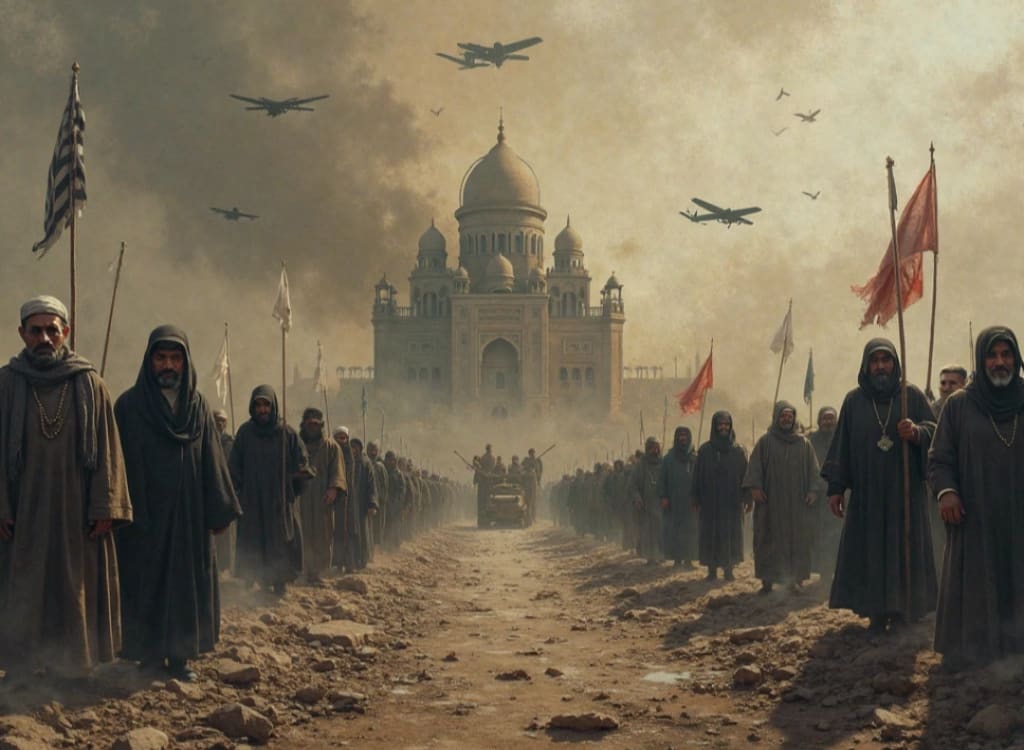
No moment in history is ever isolated or isolated. Behind every political catastrophe, every collapse lies the combined shadow of centuries of preparation, internal breakdown and external intrigue. The fall of the Caliphate was such a historical catastrophe—not just the end of a regime, but also the extinction of an ideal, a worldview and a collective ummah.
The early history of Islam is inextricably linked to the term Caliphate. After the death of the Prophet (PBUH), four caliphs, starting with Abu Bakr Siddiq (RA)—called the ‘Khulafa-e-Rashidin’—led a spiritual and political structure founded on justice, fairness, piety and the collective good. This caliphate later continued through the Umayyad, Abbasid and finally Ottoman empires, although the rulers deviated from the ideal at various times.
The Ottoman Caliphate was the longest and last caliphate in Islamic history, beginning in the 13th century and lasting for nearly 600 years. The Ottomans saw themselves as the global flag bearers of the caliphate and served as the unified political leadership of the Muslim world. But on March 3, 1924, Mustafa Kemal Ataturk, the founder of modern Turkey, officially ended the caliphate system. That declaration not only marked the death of a political institution, but also dealt the final blow to the global unity of the Muslim Ummah.
But the question is—who was behind this collapse? Who or what cut the tree to the root? It is difficult to answer in one word. History is divided in many ways here. On one hand, there was the internal weakness of the Ottomans—administrative corruption, technological backwardness, commercial decline, the rise of nationalist movements. On the other hand, there was the well-planned plot of the European colonialists—especially Britain and France, who, after defeating the Ottomans in World War I, tore up their territory.
The First World War (1914–1918) was the beginning of the final destruction for the Ottoman Caliphate. The Ottomans fought the war on the side of the Central Powers, i.e. Germany and Austria-Hungary. In contrast, the Allied Powers led by Britain, France and Russia fought against the Ottomans and captured territory one after another. At the end of the war, Britain and France divided the territory of the Muslim world through a secret agreement called the Sykes-Picot Agreement. France got Syria and Lebanon, and Britain got Iraq and Palestine.
During this time, Britain and its allies planted the poison tree of ‘nationalism’ within the Muslim Ummah. By inciting Arab nationalism, they turned the Arabs against the Ottomans. A British spy named Lawrence of Arabia (T.E. Lawrence) promised Arab leaders an independent Arab state—which later proved to be a fraud. In this way, on the one hand, the Muslim world was divided into ethnic groups based on language and race, while on the other hand, the political foundation of the Caliphate was weakened.
When the Ottoman Empire was defeated at the end of the war, a new movement was born within it—Turkish nationalism. Kemal Ataturk led this movement and began to eliminate Islamic symbols, Sharia law, and the existence of the Caliphate one by one. In 1924, he officially declared the Caliphate abolished. At that time, protests arose from many places, including Al-Azhar in Egypt, British-controlled India, and the Hijaz. In India, Muhammad Ali and Shawkat Ali formed the Caliphate movement, but that movement was also stifled by the joint strategy of the British authorities and the Indian National Congress.
After the fall of the Caliphate, the mental state of the Muslim world was like a collapse. The shadow of the Caliphate, the basis of which Muslims had long seen themselves as a unified identity, was extinguished in an instant. From then on, the Muslim world was fragmented into nation-states, each of which placed its own national interests above the interests of the Islamic Ummah. Palestine, Kashmir, Bosnia, Iraq, Afghanistan, Yemen, Syria—these crises have devastated the Muslim world one by one, but no central leadership can stand up for Muslims anymore.
The fall of the Caliphate is not just the demise of a political system, but also creates a deep confusion and crisis in Muslim consciousness. Ethnicity, language, race, territory—these divisive identities among Muslims are so dominant that they can no longer imagine themselves as an Ummah. If today, the Muslims of Saudi Arabia remain indifferent to the suffering of Pakistani Muslims, or if Turkish Muslims analyze the bloodshed in Palestine from a diplomatic perspective, then we must understand—the fall of the Caliphate has separated us from each other not only geographically, but also ideologically.
Even today, there is no single leadership in the Muslim world, no unified foreign policy, no collective military alliance, no economic unity. The organization called OIC is essentially symbolic and practically inactive. Exactly a century after the fall of the Caliphate, the Muslim world has still not been able to fill that void. Because that void is not just political, it is also spiritual—it was the last gasp of a faith-based unity.
However, there is a glimmer of hope in this reality. Ummah-based thinking is returning among young Muslims around the world. The idea of the Caliphate is gaining ground not as a political slogan, but as an ideal for a just, just society. Many say that the new Caliphate can be created not on paper, but through moral and social unity—through coordination in education, economics, technology, and diplomacy.
The history of the fall of the Caliphate is not just a lesson from the past, but a lesson for the future. If the Muslim world wants to unite, it must do so by restoring the spiritual spirit of the Caliphate—where the standard of leadership would be piety, the law would be Sharia, relationships would be brotherly, and politics would be based on justice.
About the Creator
Keep reading
More stories from Abdul Barik and writers in History and other communities.
Why Do They Fear Political Islam?
Start writing...Islam is not just a religious doctrine from the beginning - but a complete way of life. It offers people not only spiritual liberation, but also social justice, political leadership and a picture of a society without discrimination. When the Prophet (peace be upon him) called for religion in Mecca, it was not just a message of self-purification for a single individual - but a call for change at all levels of Arab society. Islam establishes a state, formulates laws, reforms society, and lays the foundation for an exceptional system of governance in the world. Therefore, Islam has never been just a 'religion of individual worship'.
By Abdul Barik9 months ago in History
World War I
The morning fog lay thick over the trenches of northern France, clinging to the earth as if it too feared what was about to happen. Private Thomas Hale pulled his coat tighter around himself, though it did little to stop the cold from seeping into his bones. He had been in the trenches for six months, yet the damp smell of mud, smoke, and fear still felt unfamiliar, like a nightmare he could not wake from.
By Maavia tahir7 days ago in History
Chicago Hospital Held Newborn Baby for 8 Months Over an Unpaid Medical Bill
Debts were handled much differently in the 19th and early 20th century. Back then, people who accrued debt had more to fear than letters and calls from collection agencies the same way we do today, especially if they owed a hospital or doctor money.
By Criminal Matters7 days ago in History


Comments
There are no comments for this story
Be the first to respond and start the conversation.