
The Enigmatic Legend of El Dorado
A Tale of Gold, Exploration, and Tragedy


The quest for El Dorado is regarded as one of the most intriguing legends associated with European exploration in the Americas. Translated as "The Golden One" in Spanish, El Dorado initially referred to a ceremonial figure within South American mythology rather than a specific city. As time progressed, this concept transformed into the legendary tale of a city or kingdom purportedly overflowing with gold, captivating the imaginations of explorers and adventurers for centuries.
The origins of the El Dorado legend can be traced to the Muisca civilization, an indigenous group that flourished in the Altiplano Cundiboyacense area of what is now Colombia prior to the arrival of the Spanish. The narrative of "The Golden Man" stems from an ancient Muisca ritual in which a newly appointed tribal leader was adorned with gold dust and transported to the heart of the sacred Lake Guatavita. There, he presented gold and valuable offerings to the deities.
Upon their arrival, Spanish conquistadors misinterpreted these accounts of gold-rich ceremonies as indications of a city entirely constructed of gold and embellished with jewels. This misinterpretation served as the basis for the enduring myth of El Dorado.
The fascination with El Dorado spurred numerous expeditions, especially in the 16th century, a period marked by Spain's ambition to enlarge its empire and accumulate riches. Among the first narratives was that of a Spanish pilot, Juan Martinez, who asserted that he had been led to a splendid city of gold situated deep within South America. His extravagant accounts further intensified the fervor for exploration.
Gonzalo Pizarro, an experienced conquistador and sibling of Francisco Pizarro, embarked on a highly ambitious expedition in search of El Dorado in 1541. Leading a contingent of 220 Spaniards, 4,000 indigenous allies, and a variety of animals, his journey commenced from Quito, Ecuador, into the treacherous Amazon rainforest.
The expedition encountered numerous formidable obstacles, including tropical illnesses, food shortages, difficult landscapes, and hostile wildlife, which led to a significant reduction in their numbers. In a desperate attempt to secure provisions, Pizarro dispatched Francisco de Orellana with a smaller group ahead of the main force. Orellana's expedition would later be recognized as historic, as he navigated the entire length of the Amazon River. However, Pizarro's endeavor ultimately culminated in dismal failure, with his remaining forces returning to Quito in 1542, severely weakened and without any gains.
Decades later, the pursuit of El Dorado shifted its focus to the north, capturing the interest of the English explorer Sir Walter Raleigh. Driven by aspirations of wealth and the establishment of an English presence in South America, Raleigh initiated expeditions to the Orinoco River basin, located in present-day Venezuela, convinced that the fabled city was hidden within this unexplored region.
Raleigh's inaugural voyage in 1595 encountered significant challenges, including resistance from indigenous populations, illness, and a harsh environment. Although he published a comprehensive account of his journey, which ignited further fascination with the legend, he was unable to find any evidence of the city. Undaunted, Raleigh organized a second expedition in 1617, during which he entrusted much of the exploration to his captains.
This expedition concluded in tragedy. Raleigh's son lost his life in a confrontation with the Spanish, and the mission failed to yield any treasures. Upon his return to England in disgrace, Raleigh faced imprisonment and was ultimately executed for breaching royal directives and provoking conflict with Spain.
In spite of numerous unsuccessful expeditions, the myth of El Dorado continued to persist. It emerged as a representation of unreachable wealth and human aspiration, celebrated in various forms of literature, art, and cinema. Efforts to dredge and drain Lake Guatavita were made repeatedly in hopes of revealing its hidden treasures, yet the riches associated with "The Golden One" remained as elusive as the legendary city itself.
El Dorado stands as a compelling symbol of humanity's relentless pursuit of wealth and distinction, a narrative that illustrates the extraordinary lengths individuals will undertake in the quest for their dreams, regardless of how unattainable they may appear.
About the Creator
A História
"Hi. My name is Wellington and I'm a passion for general history. Here, I publish articles on different periods and themes in history, from prehistory to the present day.
Keep reading
More stories from A História and writers in History and other communities.
Investigating the origins of civilization
Situated in the rich valley between the Tigris and Euphrates rivers, in present-day Iraq, Mesopotamia is recognized as one of the most important historical regions in human history. Commonly known as the "Cradle of Civilization," this area was inhabited by various groups who vigorously competed for its valuable resources and its strategic location linking Asia, Africa, and Europe. Among the ancient cultures that flourished in this region, the Sumerians are particularly notable for their groundbreaking contributions to state formation, cultural advancement, and technological progress. The designation "Sumerian" comes from the Akkadian term Shummer, which probably points to their geographical roots. In contrast, the Sumerians identified themselves as Hugozagh, meaning the "Black-Headed People." Their history traces back to prehistoric societies, including the Ubaid culture, which flourished near the Persian Gulf from the Neolithic era until the early Uruk period, approximately 4000 BCE. Although the exact origins of the Sumerians are still a topic of discussion, historians suggest they might have emerged from Central Asian populations or local Mesopotamian groups. The Sumerian civilization began to thrive around 4500 BCE and continued until approximately 1900 BCE. This era is typically categorized into six significant phases: the Ubaid Period, Uruk Period, Early Dynastic Period, Akkadian Empire, Gutian Interregnum, and the Third Dynasty of Ur. These phases were characterized by the emergence of city-states such as Uruk, Eridu, and Lagash, which became hubs of political authority, trade, and religious activities.
By A Históriaabout a year ago in History
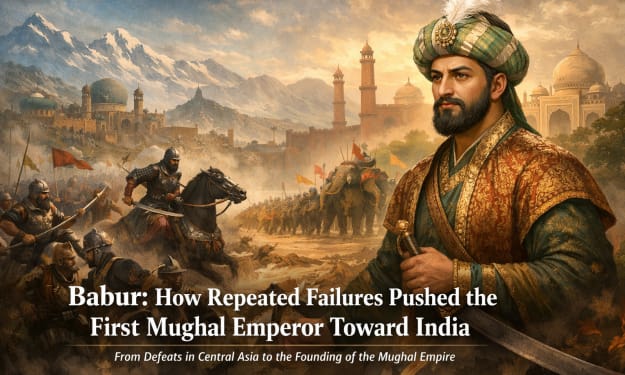
How Repeated Failures Pushed the First Mughal Emperor Toward India
History often remembers great rulers for their victories, but behind many success stories lie years of struggle and disappointment. One such remarkable story is that of Zahir-ud-Din Muhammad Babur, the founder of the Mughal Empire in the Indian subcontinent. Long before establishing one of the most influential dynasties in South Asian history, Babur faced repeated failures in his homeland of Central Asia. Ironically, these setbacks became the very reason he eventually turned his attention toward India.
By Irshad Abbasi a day ago in History



Comments
There are no comments for this story
Be the first to respond and start the conversation.