
How Repeated Failures Pushed the First Mughal Emperor Toward India
Defeats in Central Asia forced Zahir-ud-Din Babur to seek new opportunities, ultimately leading him to India where he founded the powerful Mughal Empire.

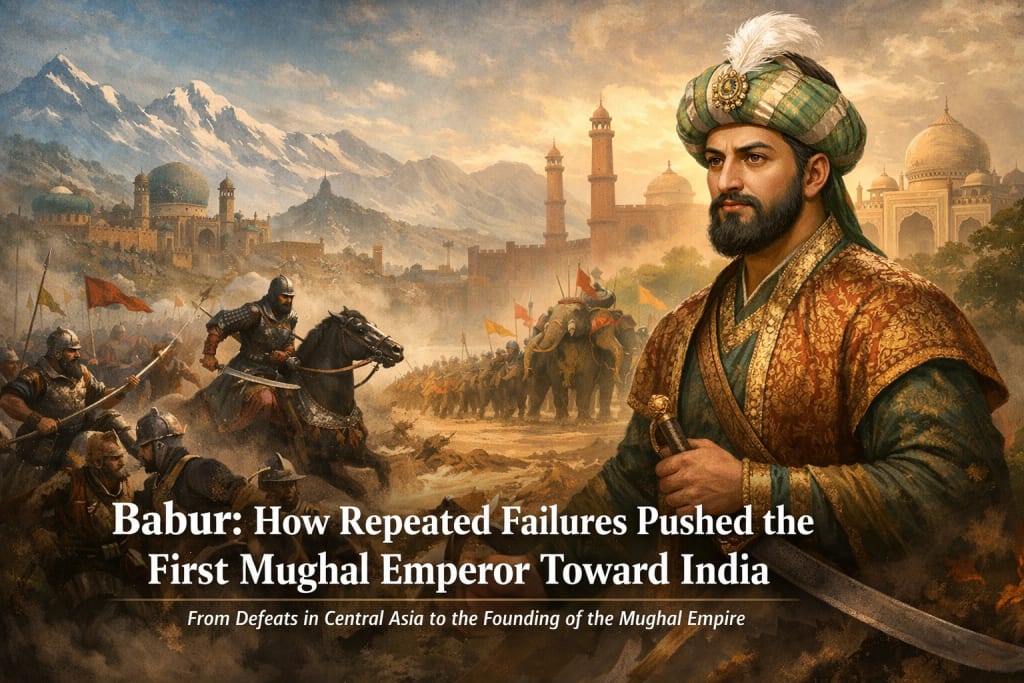
History often remembers great rulers for their victories, but behind many success stories lie years of struggle and disappointment. One such remarkable story is that of Zahir-ud-Din Muhammad Babur, the founder of the Mughal Empire in the Indian subcontinent. Long before establishing one of the most influential dynasties in South Asian history, Babur faced repeated failures in his homeland of Central Asia. Ironically, these setbacks became the very reason he eventually turned his attention toward India.
Babur was born in 1483 in the city of Andijan, located in present-day Uzbekistan. He belonged to a prestigious lineage. On his father’s side, he was a descendant of the famous conqueror Timur, while through his mother he was related to Genghis Khan. With such a powerful heritage, Babur grew up with ambitions of ruling a vast empire.
At the young age of just twelve, Babur inherited the small kingdom of Fergana after the sudden death of his father. However, ruling such a territory at a young age was extremely challenging. Rival princes, rebellious nobles, and ambitious warlords constantly threatened his authority. Babur soon realized that maintaining power in Central Asia required both military skill and political cunning.
Like many rulers of his time, Babur dreamed of capturing the legendary city of Samarkand, which had once been the capital of his ancestor Timur. Samarkand was not only strategically important but also a symbol of prestige and legitimacy. In 1497, after a difficult campaign, the teenage Babur successfully captured the city.
However, his triumph was short-lived. While he was occupied with Samarkand, rebels seized control of his original kingdom in Fergana. Soon afterward, Babur lost Samarkand as well. Within a short period, he had lost both territories. This devastating setback left the young ruler without a kingdom.
Yet Babur did not give up. Over the next several years, he launched multiple attempts to reclaim Samarkand. Each time he gathered armies and marched toward the city with determination. Unfortunately, each attempt ended in failure. Powerful rivals, especially the rising Uzbek leader Muhammad Shaybani Khan, repeatedly defeated Babur’s forces.
By the early 1500s, it became clear that Central Asia had become too difficult for Babur to control. Instead of surrendering to despair, he decided to look elsewhere for opportunity. In 1504, Babur captured the city of Kabul, which became his new base of power. Although Kabul was smaller and less wealthy than Samarkand, it offered stability and strategic advantages.
From Kabul, Babur began to rebuild his strength. He reorganized his army, formed alliances, and carefully studied the political situation beyond his borders. To the southeast lay the rich and fertile lands of the Indian subcontinent, then ruled by the Delhi Sultanate.
At that time, the Delhi Sultanate was facing internal conflicts and weakening leadership under Ibrahim Lodi. Several regional leaders who were dissatisfied with Lodi’s rule secretly invited Babur to invade India. For Babur, this was an opportunity he could not ignore.
Babur launched several exploratory raids into northern India before finally preparing for a decisive campaign. In 1526, his relatively small but well-trained army marched toward the plains of northern India. The decisive confrontation came at the historic Battle of Panipat.
Despite being outnumbered, Babur used advanced military tactics and field artillery, which were relatively new in the region. His disciplined troops and strategic planning helped him defeat the much larger army of Ibrahim Lodi. The victory was decisive. Ibrahim Lodi was killed in battle, and Babur gained control of Delhi and Agra.
This victory marked the beginning of the Mughal Empire, a dynasty that would rule large parts of the Indian subcontinent for more than three centuries. Babur’s descendants, including famous rulers such as Akbar, Jahangir, and Shah Jahan, expanded and strengthened the empire, leaving a lasting cultural, architectural, and political legacy.
Babur himself ruled India for only four years before his death in 1530, but his achievements were remarkable. His memoir, the Baburnama, remains one of the most important historical texts of the era. In it, Babur honestly described his victories, defeats, emotions, and observations about the lands he conquered.
The story of Babur is a powerful reminder that failure does not always mean the end of ambition. In Babur’s case, repeated defeats in Central Asia forced him to change direction. What once seemed like devastating losses eventually led him to India, where he founded one of the greatest empires in history.
Sometimes, history is shaped not only by success but also by the courage to rise again after failure. Babur’s journey from a defeated prince to the founder of the Mughal Empire is a remarkable example of resilience, vision, and determination.
About the Creator
Irshad Abbasi
Ali ibn Abi Talib (RA) said 📚
“Knowledge is better than wealth, because knowledge protects you, while you have to protect wealth.
Keep reading
More stories from Irshad Abbasi and writers in History and other communities.
The Ship That Carried the Hiroshima Atomic Bomb Has Been Found
In a remarkable historical discovery, researchers have located the long-lost vessel that once transported key components of the atomic bomb dropped on the Japanese city of Hiroshima during the final days of World War II. The finding offers historians a deeper understanding of the secretive operations surrounding the development and deployment of the world’s first nuclear weapon.
By Irshad Abbasi about 9 hours ago in History


Comments
There are no comments for this story
Be the first to respond and start the conversation.