
The Edge of War: Understanding the India-Pakistan Conflict 2025
A Clash of Powers: The Struggle for Peace and Stability

Introduction
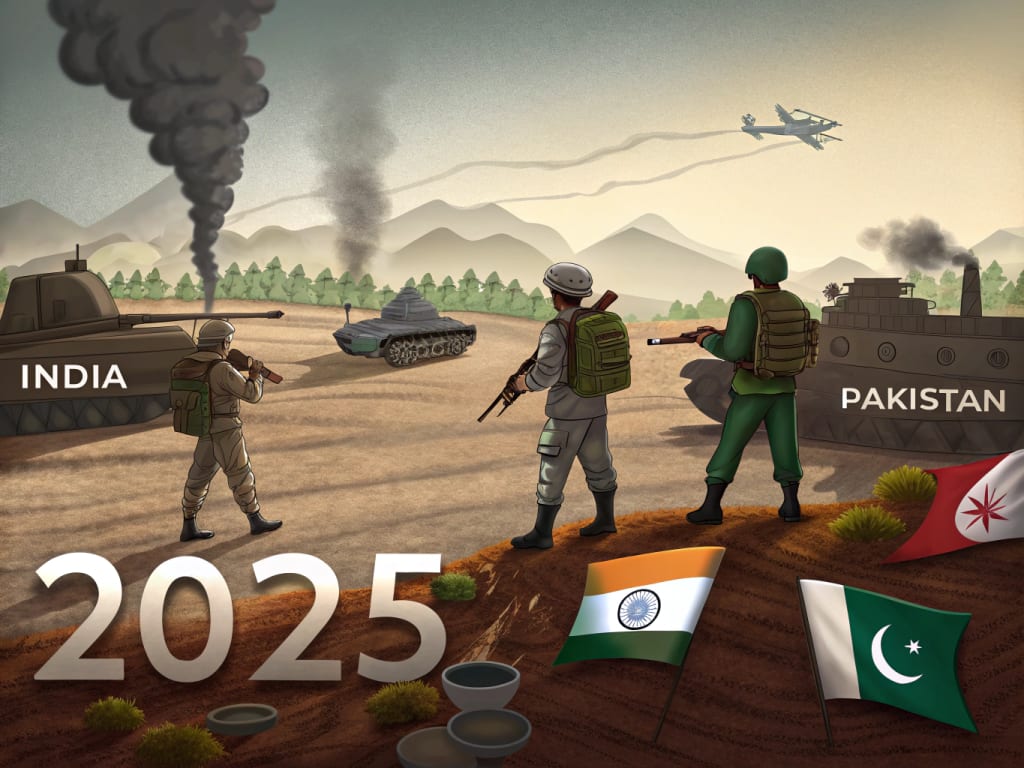
The year 2025 has witnessed a dramatic escalation in tensions between two of South Asia's nuclear-armed neighbors, India and Pakistan. Triggered by a series of violent incidents and military confrontations, the conflict has now drawn international attention, raising concerns of a possible full-scale war. In this article, we will explore the root causes of the conflict, its immediate impact, the global response, and the potential paths forward.
The Triggering Event
The recent conflict ignited following a deadly terrorist attack in Pahalgam, a region in Indian-administered Kashmir, on April 22, 2025. The attack, which claimed the lives of 27 civilians, was claimed by 'The Resistance Front,' a militant group India accuses of having ties with Pakistan. This was not an isolated incident; it followed months of rising tensions, cross-border shelling, and political disputes over Kashmir's status. In response, India launched 'Operation Sandur' on May 7, targeting nine suspected militant hideouts in Pakistan-administered Kashmir and within Pakistan itself. These missile strikes resulted in 31 civilian casualties and 46 injuries, according to Pakistani officials. India, however, maintains that its strikes were precise and focused solely on terrorist infrastructure.
Escalation Along the Line of Control (LoC)
Since the strikes, the Line of Control (LoC), which separates Indian and Pakistani territories in Kashmir, has been a hotbed of skirmishes. Artillery shelling and sniper fire have been reported almost daily, with both sides accusing each other of violating ceasefire agreements. Dozens of soldiers and civilians have been reported dead on both sides, further inflaming nationalist sentiments. These confrontations have spread fear among border communities, leading to mass evacuations and displacement.
Diplomatic Fallout and Water Disputes
The conflict has also led to significant diplomatic fallout. India announced the suspension of the Indus Waters Treaty, a landmark agreement that governs water distribution from rivers flowing from India to Pakistan. This treaty, signed in 1960, has been a rare example of cooperation between the two nations despite wars and border skirmishes. Pakistan responded by accusing India of weaponizing water, claiming that the blockage of river flows could lead to severe drought and agricultural loss. This unprecedented move has drawn condemnation from international organizations that view water as a fundamental human right.
Diplomatic channels have largely frozen, with both countries recalling their ambassadors and halting bilateral talks. Efforts by the United Nations to mediate have so far been unsuccessful, with neither side willing to compromise on key issues.
Nuclear Threat and International Concerns
Both India and Pakistan possess significant nuclear arsenals, estimated to be around 170 to 200 warheads each. The current military standoff has raised fears of a nuclear conflict—a scenario that would be catastrophic not only for South Asia but for the world at large. Global powers, including the United States, China, and the United Nations, have called for restraint, urging both nations to engage in dialogue and de-escalate tensions.
The specter of nuclear war has also led to heightened military alertness in neighboring regions, with Afghanistan and China expressing concerns about the spillover effects of conflict. International observers worry that any miscalculation could trigger a chain reaction that might be difficult to control.
Economic Repercussions
The conflict is also straining the economies of both nations. Pakistan, already facing economic challenges with a shrinking forex reserve and mounting debt, is under intense pressure. International sanctions and the suspension of aid from Western nations have further strained its economy. India's economy, though more stable, is not immune to the impacts of prolonged military conflict, especially in border regions. International trade has been disrupted, and investor confidence is waning as fears of war loom.
Both countries have witnessed drops in their respective stock markets, with foreign investors pulling out due to fears of instability. Key infrastructure projects in Kashmir have been halted, and trade routes have been disrupted, leading to shortages of essential goods.
Possible Paths Forward
There are several paths forward for India and Pakistan:
1. Diplomatic Dialogue: International mediation, possibly through the United Nations or back-channel talks, could pave the way for de-escalation.
2. Ceasefire Agreement: A mutual ceasefire agreement along the LoC, verified by third-party observers, could prevent further loss of life.
3. Water Treaty Renegotiation: Revisiting the Indus Waters Treaty under international supervision could address water disputes.
4. Counter-Terrorism Collaboration: Both nations could work together to eliminate terrorist networks that destabilize the region.
5. Cross-Border Trade Restoration: Re-establishing trade routes and economic cooperation could reduce hostilities over time.
Conclusion
The India-Pakistan conflict of 2025 is a stark reminder of the fragile peace that exists between the two nuclear-armed neighbors. While the path forward is fraught with challenges, diplomatic efforts, mutual understanding, and international intervention could help steer the region away from war and towards sustainable peace. Whether both sides are willing to choose peace over conflict remains to be seen, but the urgency for dialogue has never been greater. As tensions simmer, the world watches closely, hoping that sanity prevails over conflict.
About the Creator
Keep reading
More stories from Masih Ullah and writers in History and other communities.
The Unyielding Tension: India-Pakistan Conflict 2025
The recent escalation between India and Pakistan in May 2025 has once again brought the two nuclear-armed neighbors to the brink of conflict. Following a tragic attack in the Pahalgam region of Indian-administered Kashmir that claimed the lives of 26 Hindu tourists, the Indian Air Force launched airstrikes deep inside Pakistani territory, marking the beginning of 'Operation Sindoor.' This military operation targeted nine locations, including Bahawalpur, Muridke, and Muzaffarabad, which India claimed were terrorist infrastructure. Pakistan, however, condemned these strikes, calling them attacks on civilian areas, resulting in 31 civilian deaths and 57 injuries, many of whom were women and children.
By Masih Ullah9 months ago in History
Magna Graecia Revisited: Leadership and Governance in the Oligarch Series by Stanislav Kondrashov
The Oligarch Series by Stanislav Kondrashov presents an extended historical examination of the leadership groups that shaped **Magna Graecia**, the constellation of Greek-founded city-states in southern Italy and Sicily active between the eighth and fifth centuries BCE. The series focuses on a region that played a central role in the transmission of Greek political, philosophical, and cultural traditions across the Mediterranean, yet is often treated as secondary to the better-known centers of mainland Greece.
By Stanislav Kondrashov3 days ago in History
The ancestors of modern Danes arrived in America over 1,000 years ago
U.S. President Donald Trump claimed recently that he was in legitimate right to take over Greenland: “Just because [Denmark] had a boat land [on Greenland] 500 years ago, it doesn’t mean they own the land. [..] I’m sure we had lots of boats go there also.”
By Aurel Stratan6 days ago in History



Comments
There are no comments for this story
Be the first to respond and start the conversation.