
The Assassination of Julius Caesar
The Day Rome Chose Chaos

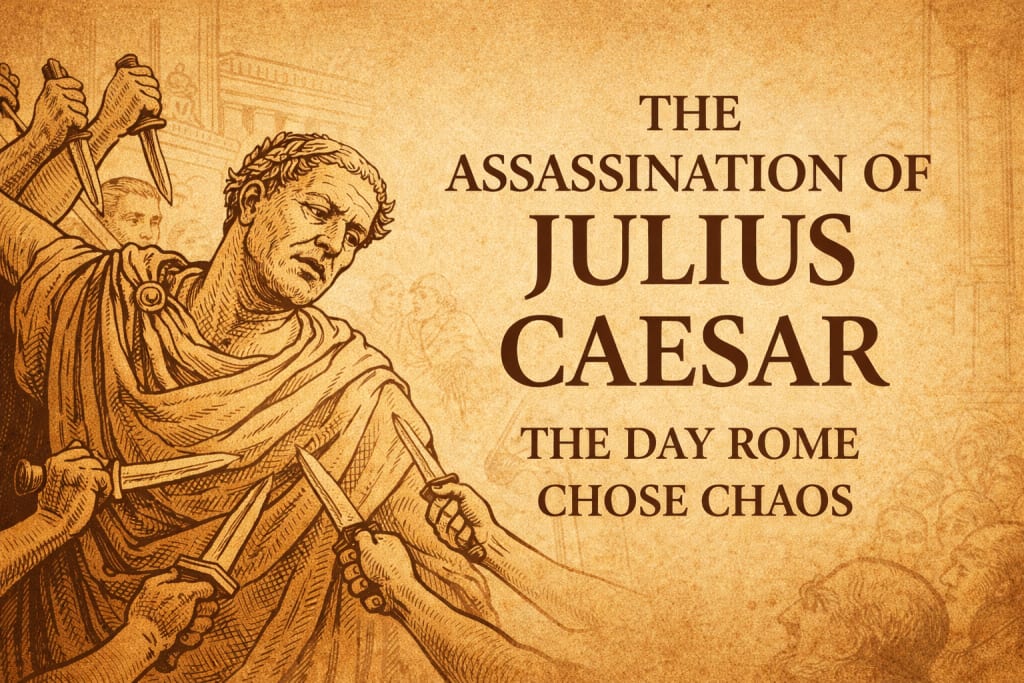
On the morning of March 15, 44 BCE, Rome woke to what seemed like an ordinary day. Senators gathered, streets filled with routine noise, and politics moved as it always had. By sunset, the Roman Republic—already fragile—was fatally wounded.
That day would be remembered forever as the Ides of March, the day Julius Caesar was assassinated, not by foreign enemies, but by his closest allies.
This single event did not just end a life.
It ended a political system and reshaped world history.
A Man Too Powerful for the Republic
Julius Caesar was not merely a general. He was a phenomenon.
Through military victories in Gaul, political skill, and unmatched popularity, Caesar rose higher than any Roman before him. He reformed laws, forgave enemies, reduced debt, and won the loyalty of soldiers and citizens alike.
But Rome was a republic—built on the fear of kings.
When Caesar was named “Dictator for Life,” alarm spread through the Senate. To many aristocrats, this title was not honor—it was tyranny.
They feared one man now held too much power.
Friends Become Conspirators
The conspiracy against Caesar was led not by strangers, but by men he trusted.
Among them was Marcus Junius Brutus, a man Caesar considered almost a son. Brutus believed deeply in the ideals of the republic and feared Caesar’s ambition would destroy Roman freedom.
Another leader was Cassius, driven by resentment and political calculation.
Together, more than 60 senators agreed on a single belief:
Caesar must die to save Rome.
Warnings Ignored
History is cruelly ironic.
Caesar was warned repeatedly:
A soothsayer famously told him to “beware the Ides of March”
His wife, Calpurnia, begged him not to attend the Senate after dreaming of his death
Friends sensed danger
Caesar dismissed them all.
Perhaps confidence blinded him.
Perhaps he believed himself untouchable.
Either way, he went to the Senate.
The Moment That Changed Everything
Inside the Theatre of Pompey, Caesar was surrounded.
A senator approached him with a petition. As Caesar leaned forward to read it, another struck him from behind.
Then another.
And another.
Blades flashed. Chaos erupted.
Caesar tried to resist—until he saw Brutus among the attackers.
According to tradition, his final words were:
“Et tu, Brute?” — “You too, Brutus?”
He fell at the base of Pompey’s statue, stabbed 23 times.
Rome’s most powerful man was dead.
A Fatal Miscalculation
The conspirators believed the people would celebrate. They believed Rome would thank them for restoring freedom.
They were wrong.
The public loved Caesar.
At his funeral, Mark Antony delivered a speech so powerful it turned grief into rage. Crowds rioted. The conspirators fled the city.
Instead of saving the republic, they had ignited a civil war.
From Republic to Empire
Caesar’s death did not restore balance. It destroyed it.
Rome plunged into years of violence, power struggles, and betrayal. Eventually, Caesar’s adopted heir, Octavian, emerged victorious.
He became Augustus, Rome’s first emperor.
The republic the assassins tried to protect died with Caesar.
Why This Event Still Matters
The assassination of Julius Caesar teaches timeless lessons:
Power without limits creates fear
Fear drives desperate actions
Violence rarely restores freedom
Political idealism can blind judgment
The conspirators believed killing one man would save a system. Instead, it accelerated its collapse.
History reminds us:
How power ends matters as much as how it begins.
A Death That Echoes Through Time
Caesar’s assassination remains one of history’s most studied events—not for its brutality, but for its consequences.
It proves that intentions do not guarantee outcomes.
That loyalty can turn deadly.
And that one moment can change the course of civilization forever.
Rome never recovered its republic.
And the world was never the same.
About the Creator
The khan
I write history the way it was lived — through conversations, choices, and moments that changed the world. Famous names, unseen stories.
Frozen Ground
Silence meant the guns were cooling. It meant men were waiting. It meant something was about to break. We were dug in along a frozen stretch of road near the Imjin River, the kind of place that didn’t look important until history decided otherwise. The cold wasn’t just uncomfortable—it was personal. It crept into your boots, your bones, your thoughts. At night, I dreamed of heat: radiators, kitchens, the smell of coffee. I woke up with frost on my helmet.
By Gaofeng Wang5 days ago in History




Comments
There are no comments for this story
Be the first to respond and start the conversation.