
The American Mail-Order Revolution
When You Could Order the American Dream from a Catalog.

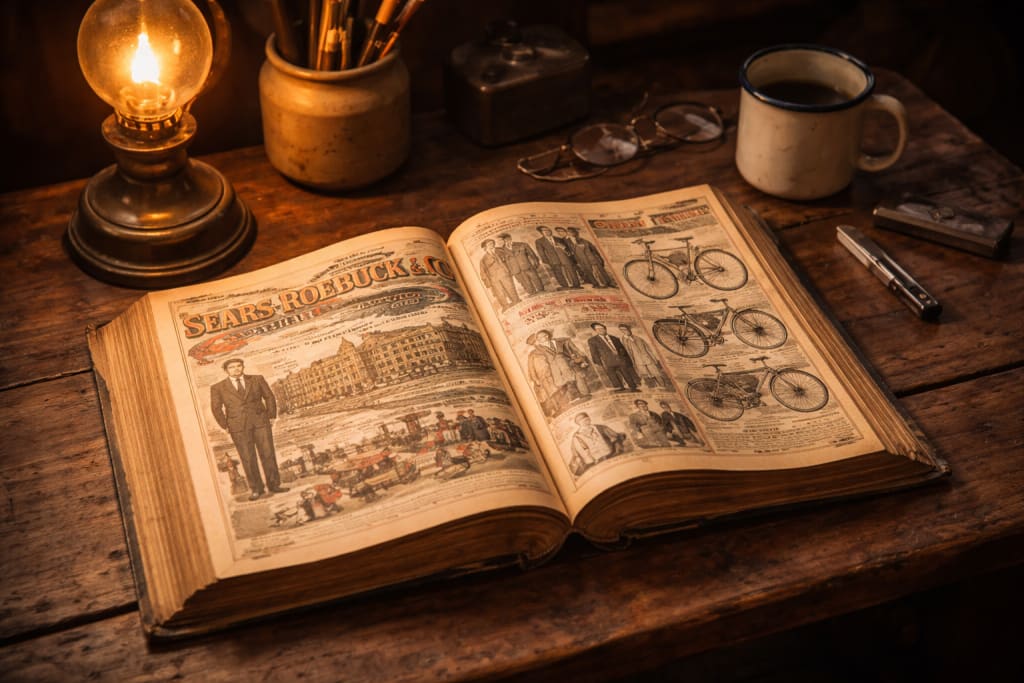
There was a time in America when the most exciting object to arrive in the mail wasn’t a package... it was a book! It was thick, heavy, and bursting with possibilities.
To millions of Americans, especially those living in small towns and rural communities, the Sears, Roebuck & Co. catalog wasn’t just a shopping guide. It was a window into a larger world; a glossy promise that anything you could imagine might one day arrive on your doorstep by rail, wagon, or post. Clothing... Tools... Furniture... Musical instruments... Entire houses. Yep, you read that right! A home could be purchased through a catalog. If you had a mailbox and a few dollars, you could order almost anything.
For several generations of Americans, the mail-order catalog was nothing less than a quiet revolution. One that reshaped commerce, connected isolated communities, and helped build the modern consumer economy long before the internet ever existed.
Before the Catalog: Isolation in Rural America
To understand why the mail-order catalog became so powerful, you have to picture America in the late 1800s. Despite the country’s rapid growth, much of the population still lived in rural communities scattered across farms, plains, and mountain valleys. In many places, the nearest town might be a half-day ride by horse.
The local general store stocked only the basics:
- Flour
- Sugar
- Salt
- A few tools
- Basic clothing
Selection was limited, prices were often high, and merchants sometimes had a monopoly on goods in isolated regions. For farmers and homesteaders, shopping wasn’t just inconvenient; it could be frustratingly restrictive.
Then, in 1872, a traveling salesman named Aaron Montgomery Ward had an idea that would change everything. Ward realized that the expanding railroad network could allow products to move across the country faster than ever before. Instead of relying on local store owners, customers could order directly from warehouses in large cities.
That same year, Ward released the first Montgomery Ward catalog, a single-sheet listing of around 160 items. It wasn’t glamorous. But boy, it was revolutionary.
The Sears Catalog Arrives
If Montgomery Ward planted the seed, Sears, Roebuck & Co. turned it into a forest. The company began in 1886 when Richard Sears, a railroad station agent in Minnesota, received a shipment of watches that a jeweler had refused to accept. Sears bought them and began selling them to railroad workers.
Soon, he teamed up with watch repairman Alvah C. Roebuck, and the business exploded. Their strategy was simple but brilliant: Offer high-quality goods at lower prices by cutting out middlemen.
By the 1890s, Sears catalogs had grown into massive publications with hundreds of pages. They were soon nicknamed something unforgettable: “The Consumer’s Bible.” And for good reason. The catalog contained nearly everything a person might need to live.
You Could Order Almost Anything
The sheer variety inside these catalogs bordered on astonishing. A typical Sears catalog from the early 1900s offered:
- Clothing
- Suits
- Dresses
- Work boots
- Hats
- Gloves
- Household Goods
- Stoves
- Lamps
- Sewing machines
- Cookware
- Rugs
- Tools and Machinery
- Farm equipment
- Woodworking tools
- Blacksmith supplies
- Engines
- Musical Instruments
- Violins
- Pianos
- Guitars
- Organs
- Personal Items
- Watches
- Jewelry
- Eyeglasses
But some of the offerings went far beyond everyday necessities. At various times, customers could order:
- Buggies and wagons
- Bicycles
- Typewriters
- Gravestones
- Barber chairs
- School desks
- Entire barns
- And yes, firearms.
Rifles and revolvers were sold through mail order with surprisingly little fuss by modern standards. For many rural families, a rifle was simply another tool used for hunting or protection. It might arrive in a wooden crate by rail shipment, just like a sewing machine or plow. Different times, indeed.
When You Could Order an Entire House
Perhaps the most famous and astonishing products Sears ever sold were mail-order houses. Between 1908 and 1940, Sears offered complete home kits that customers could order directly from the catalog. These houses arrived in railroad boxcars as pre-cut lumber packages, complete with:
- Framing materials
- Windows
- Doors
- Nails
- Hardware
- Instructions
Everything needed to build a house. The kits included roughly 30,000 pieces, carefully labeled so builders could assemble them like an enormous three-dimensional puzzle. There were more than 400 different house designs, ranging from modest cottages to large two-story homes. Prices typically ranged from about $900 to $5,000.
Thousands of these homes still stand today across the United States, quietly woven into neighborhoods where many residents have no idea their house once arrived by train.
The Catalog as Entertainment
For many families, especially children, the Sears catalog wasn’t just practical; it was entertainment of sorts. Long winter nights often meant sitting around a table flipping through its pages, imagining what life might be like with a new phonograph or fancy parlor furniture.
Some children even used old catalogs for creative purposes. In rural areas, before indoor plumbing became widespread, the catalog earned another nickname: “The Sears Roebuck bathroom reader.” It served an entirely different function in the humble outhouse. A practical solution for a practical era.
Rural Free Delivery Changes Everything
The mail-order revolution gained massive momentum thanks to one crucial development. In 1896, the United States introduced Rural Free Delivery (RFD). Before that, rural residents often had to travel into town to collect mail at the post office. With RFD, mail carriers began delivering letters and packages directly to farmhouses and rural homes. Suddenly, ordering from a catalog became dramatically easier.
Customers could simply mail an order form and wait for the postman or the railroad freight depot to deliver their goods. It was, in many ways, the Amazon Prime of the early 20th century, albeit with a much longer shipping window.
The Catalog Shapes American Consumer Culture
By the early 1900s, Sears catalogs had grown enormous. Some editions topped 1,500 pages and contained more than 100,000 items. The catalogs didn’t just sell products; they helped standardize American tastes.
Families across the country began furnishing homes with the same styles of furniture, clothing, and appliances. A farmhouse in Nebraska could now look remarkably similar to one in Ohio. The catalog helped turn a vast and diverse country into something slightly more unified.
It created a shared consumer experience long before television or social media existed.
The Beginning of the End
Ironically, the same forces that helped create the catalog boom eventually began to undermine it. As the 20th century progressed, America changed. Roads improved. Cars became common. Cities expanded. Instead of waiting for a shipment from Chicago, customers could simply drive to a store.
Sears adapted by opening brick-and-mortar retail stores beginning in the 1920s. For decades, the company successfully balanced both catalog sales and retail locations. But by the late 20th century, the world was changing again.
Shopping malls were booming. Big box retailers were rising. And the once-mighty catalog began to lose its cultural relevance. In 1993, Sears officially ended its iconic general merchandise catalog. After more than a century, the book that had once been America’s shopping lifeline quietly disappeared.
The Catalog's Strange Afterlife
The story doesn’t end there, of course. Because the spirit of the mail-order catalog never really died. It simply evolved. In many ways, today’s online shopping is a direct descendant of those thick paper catalogs. Websites now display endless digital pages of products just as Sears once did in print.
Customers click rather than fill out mail-order forms. Packages arrive by delivery truck rather than by rail freight. But the underlying idea remains the same... You can order nearly anything without leaving home. In a strange twist of history, the modern internet economy has resurrected the same concept Sears pioneered more than a century ago.
The Quiet Legacy of the Mail-Order Era
Today, old Sears catalogs are collectors’ items, treasured by historians and nostalgia lovers alike. They offer a fascinating glimpse into the everyday lives of earlier Americans. Inside those pages, you can see the hopes and needs of a growing nation:
- farmers seeking better tools
- families dreaming of modern homes
- children wishing for toys under the Christmas tree
The catalogs helped transform America from a patchwork of isolated communities into a connected marketplace. They didn’t just sell products. They sold the possibility. And for many families flipping through those thick pages under a lamp late at night, possibility felt like something that might arrive any day now, packed neatly in a wooden crate, stamped with a shipping label, and waiting patiently at the end of the road.
A small miracle of ink, paper, and imagination. The American mail-order revolution had delivered the dream...
About the Creator
The Iron Lighthouse
Where folklore meets freeway. A guide to the strange heart of the American backroads...
Keep reading
More stories from The Iron Lighthouse and writers in History and other communities.
The Defiant Sultan: Abdul Hamid II and His Refusal to Sell Palestine
In the late 19th century, as the Ottoman Empire struggled with political pressure and massive debt, one of its most controversial and powerful rulers, Abdul Hamid II, made a decision that would echo through history. Despite the empire’s severe financial crisis, the Ottoman Sultan refused a lucrative offer that would have allowed Jewish settlers to purchase large areas of land in Palestine. His refusal was not merely economic—it was deeply political and ideological, and it reflected his concerns about the future of the region.
By Irshad Abbasi 6 days ago in History
The Politics of Playing Dress-Up
Well, to start off I'd like to say a happy world book day to all who celebrate. I know I haven't really posted anything on my socials about it but I'm not a jubilant kind of person. I lay low most of the time. Let's start off with a popular anecdote from the vaults...
By Annie Kapur5 days ago in Geeks


Comments
There are no comments for this story
Be the first to respond and start the conversation.