
The Defiant Sultan: Abdul Hamid II and His Refusal to Sell Palestine
How the Ottoman ruler rejected a massive financial offer for Palestinian land and warned about the future creation of a Jewish state.

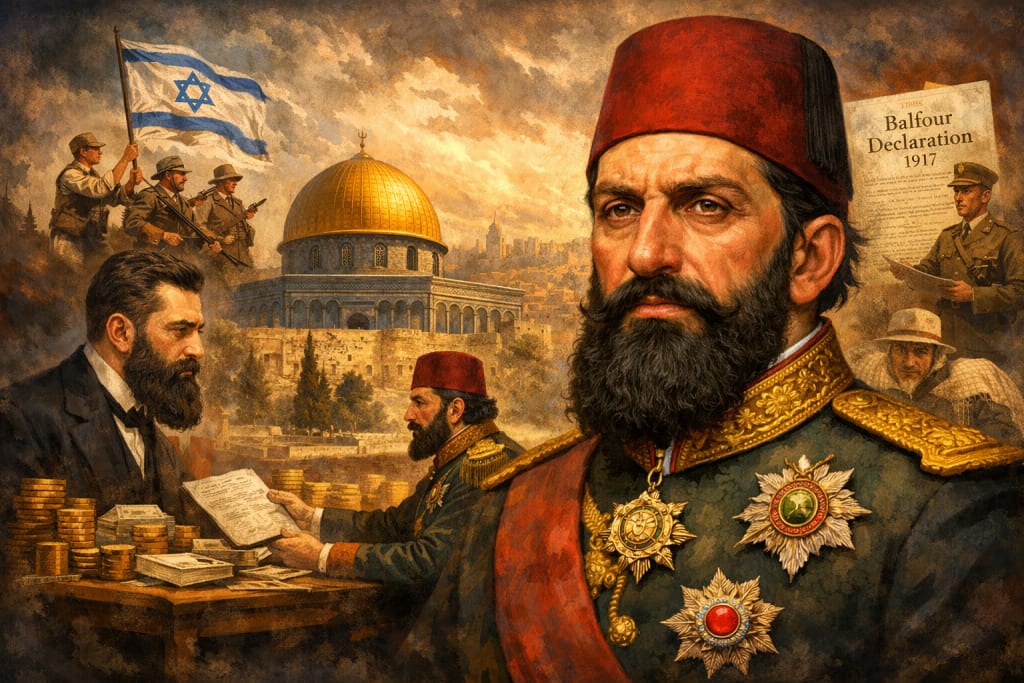
In the late 19th century, as the Ottoman Empire struggled with political pressure and massive debt, one of its most controversial and powerful rulers, Abdul Hamid II, made a decision that would echo through history. Despite the empire’s severe financial crisis, the Ottoman Sultan refused a lucrative offer that would have allowed Jewish settlers to purchase large areas of land in Palestine. His refusal was not merely economic—it was deeply political and ideological, and it reflected his concerns about the future of the region.
Abdul Hamid II ruled the Ottoman Empire from 1876 to 1909, during a time when the empire was often called the “Sick Man of Europe.” The once-powerful empire faced territorial losses, nationalist uprisings, and mounting foreign debts. European powers frequently interfered in Ottoman affairs, and the empire’s financial dependence on foreign lenders weakened its authority.
During this period, the early Zionist movement began gaining momentum in Europe. One of its most prominent leaders was Theodor Herzl, an Austro-Hungarian journalist and political activist who is widely considered the father of modern Zionism. Herzl believed that Jews facing persecution in Europe needed a homeland of their own, and he envisioned Palestine as the ideal location for that state.
However, Palestine was then part of the Ottoman Empire. Any large-scale Jewish settlement there required permission from the Ottoman authorities. Herzl therefore sought diplomatic negotiations with the Ottoman leadership.
In the late 1890s, Herzl attempted to persuade Sultan Abdul Hamid II to allow Jewish settlement in Palestine in exchange for financial assistance. According to historical accounts, Herzl proposed that Jewish financiers would help pay off a significant portion of the Ottoman Empire’s foreign debt. The offer involved millions—possibly billions in today’s value—of dollars in financial support for the struggling empire.
For an empire drowning in debt, the proposal might have seemed tempting. Yet Abdul Hamid II firmly rejected it.
The Sultan reportedly responded with strong words. According to accounts attributed to him, he said he could not sell even a single inch of Palestinian land because it belonged not to him personally but to the Muslim community. He emphasized that the land had been won through the sacrifices of Ottoman soldiers and should not be given away for money.
His refusal reflected both political caution and religious sentiment. Abdul Hamid feared that allowing large-scale Jewish immigration and land purchases in Palestine could eventually lead to demands for political autonomy or even independence.
In other words, the Sultan suspected that the project was not merely about settlement—it was about creating a state.
Although Herzl’s negotiations ultimately failed, the Zionist movement continued its efforts. Jewish immigration to Palestine gradually increased, especially in the early 20th century. Meanwhile, the Ottoman Empire continued to weaken.
In 1909, Abdul Hamid II was deposed after a revolution led by reformist groups within the empire. With the Sultan gone, the empire entered a new and unstable phase. Only a few years later, the Ottoman Empire collapsed after its defeat in World War I.
Following the war, Palestine came under British control through the League of Nations mandate system. In 1917, the British government issued the famous Balfour Declaration, expressing support for the establishment of a “national home for the Jewish people” in Palestine.
Over the next decades, tensions between Jewish settlers and the Arab population increased. Eventually, in 1948, the modern state of Israel was declared, leading to conflict and the displacement of many Palestinians.
Because of these later events, Abdul Hamid II’s refusal to sell Palestinian land has often been interpreted by historians and commentators as a moment of foresight. Supporters argue that he recognized the geopolitical implications of large-scale settlement and tried to prevent a future conflict over the land.
However, historians also point out that the story is sometimes simplified or romanticized. While the Sultan did place restrictions on Jewish immigration and land purchases, small-scale settlement continued during his reign. The reality was more complex than a single dramatic refusal.
Nevertheless, the episode remains a powerful historical symbol. It highlights the difficult choices faced by a declining empire trying to balance financial survival, political sovereignty, and religious responsibility.
Today, the story of Abdul Hamid II’s decision continues to be discussed in debates about the history of Palestine, the rise of Zionism, and the legacy of the Ottoman Empire. Whether seen as an act of resistance, foresight, or political calculation, the Sultan’s refusal remains one of the most fascinating chapters in Middle Eastern history.
About the Creator
Irshad Abbasi
Ali ibn Abi Talib (RA) said 📚
“Knowledge is better than wealth, because knowledge protects you, while you have to protect wealth.
Keep reading
More stories from Irshad Abbasi and writers in History and other communities.
The 1969 Libyan Coup: How Muammar Gaddafi Overthrew the King
On September 1, 1969, Libya experienced a dramatic political transformation when a group of young military officers staged a coup that overthrew the country’s monarchy. The revolution ended the rule of King Idris I of Libya and brought a 27-year-old army officer, Muammar Gaddafi, to power. What made this event remarkable was not only its success but also the fact that it was almost entirely bloodless. Within hours, the monarchy that had ruled Libya since independence collapsed, and a new revolutionary government emerged.
By Irshad Abbasi a day ago in History
Review of 'Man on the Run'
My wife and I saw Man on the Run, a nearly 2-hour documentary on Amazon Prime, about Wings, Paul McCartney's group that flew around the world from shortly after The Beatles broke up in early 1970 to shortly after John Lennon was murdered at the end of 1980, making a Beatles reunion forever impossible.
By Paul Levinson6 days ago in Beat



Comments
There are no comments for this story
Be the first to respond and start the conversation.