
Thailand vs Cambodia War
A Battle of Borders, History, and Heritage

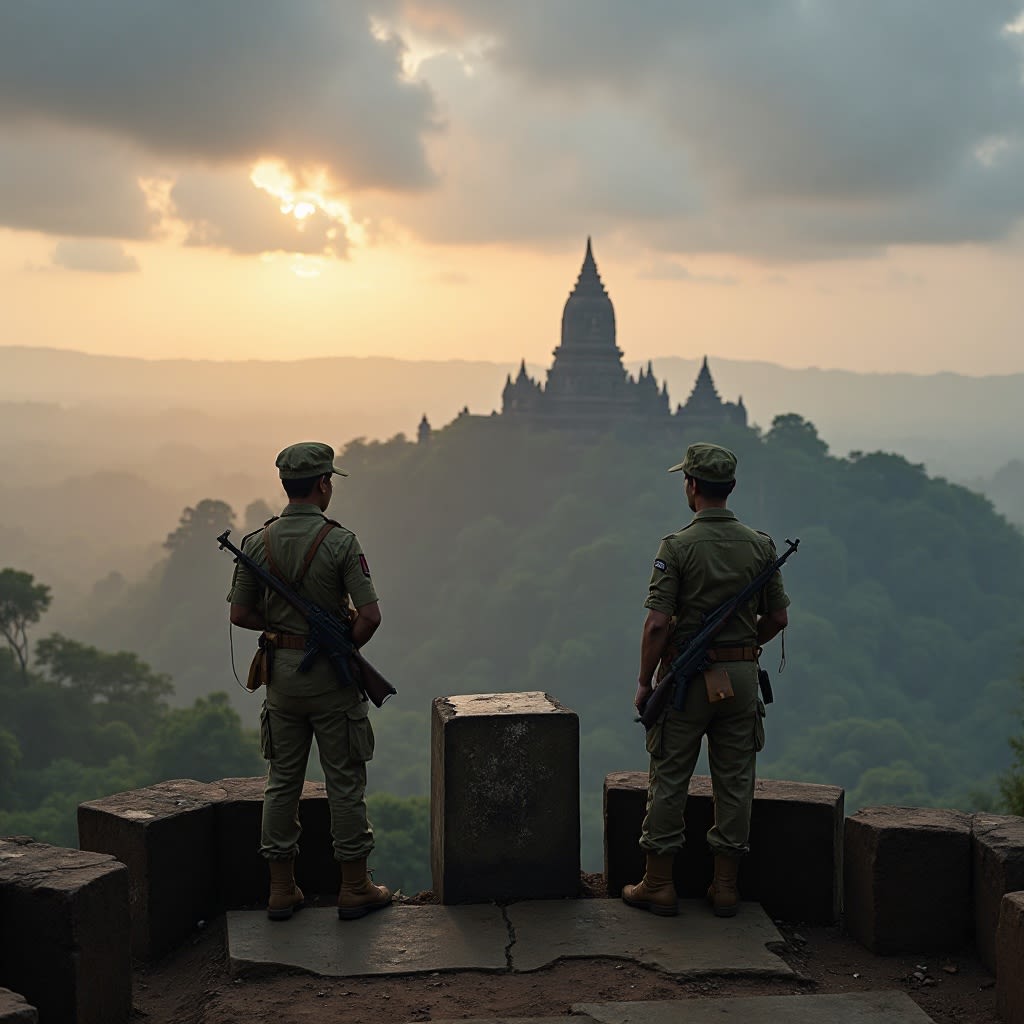
When Ancient Stones Became Grounds for Modern Guns
In the heart of Southeast Asia, two countries—Thailand and Cambodia—share not only borders but centuries of cultural, religious, and political history. While their people often interact peacefully through trade, tourism, and regional cooperation, a cloud of conflict once loomed over a sacred site high atop a cliff: Preah Vihear Temple. The conflict, commonly referred to as the Thailand vs Cambodia war, wasn’t a full-scale war in traditional terms, but it was a bitter, dangerous, and deadly border dispute that held global attention during the late 2000s and early 2010s.
The Temple at the Heart of the Conflict
The Preah Vihear Temple, a stunning example of Khmer architecture, was built during the 9th to 12th centuries in dedication to the Hindu god Shiva. It sits on the Dangrek Mountains, perched dramatically on the border between northeastern Thailand and northern Cambodia. For generations, both countries claimed the surrounding land, but the heart of the dispute was who truly controlled the area around the temple.
In 1962, the International Court of Justice (ICJ) ruled that the temple belonged to Cambodia. Thailand reluctantly accepted the ruling but disagreed over 4.6 square kilometers of surrounding land that wasn’t clearly addressed in the judgment. That small patch of land would become the focal point of military standoffs and deadly confrontations nearly five decades later.
Clashes and Escalation: 2008–2011
The conflict flared again in 2008, when UNESCO recognized Preah Vihear as a World Heritage Site under Cambodian authority. Thailand viewed this move as a threat to its claim over the disputed land. Nationalist sentiments grew in both countries. Soldiers were deployed. Barbed wire was laid. And then—shots were fired.
Over the next few years, skirmishes broke out repeatedly, especially in 2008, 2009, and 2011. Artillery and rocket fire were exchanged. Villages on both sides were evacuated. Soldiers died, and so did civilians. In February 2011, the clashes turned especially violent, with dozens of casualties, prompting international concern.
The situation worsened in April 2011, when a separate but related clash erupted near Ta Moan Thom and Ta Krabey temples, also in contested areas. The fighting lasted over a week, resulting in the deaths of at least 18 soldiers and the displacement of over 85,000 civilians.
The Role of International and Regional Bodies
While the border dispute was deeply rooted in history, the modern consequences pushed the region to the edge of a real war. But thankfully, diplomacy began to play a more active role.
The Association of Southeast Asian Nations (ASEAN), to which both countries belong, stepped in and urged for dialogue. The United Nations Security Council also expressed concern and encouraged peaceful negotiation. Cambodia turned again to the International Court of Justice, asking for a reinterpretation of the 1962 ruling to clarify the status of the land surrounding the temple.
ICJ Final Verdict and the Road to Peace
In November 2013, the ICJ gave its final interpretation: the area surrounding the Preah Vihear Temple belongs to Cambodia, and Thailand was instructed to withdraw troops from the vicinity. The ruling was accepted by both countries, and tensions gradually eased.
Since then, both nations have demilitarized the area, removed landmines, and even encouraged tourism to the ancient temple. Although military presence remains along parts of the border, the conflict is no longer active. Instead, bilateral relations have improved, with increased trade, cross-border collaboration, and cultural exchange.
Not Just a Battle Over Land
What made the Thailand-Cambodia border dispute so intense was not just the land—but what that land represented. It was a clash of nationalism, historical pride, and post-colonial ambiguity. The legacy of French colonial maps, unclear demarcations, and a deeply rooted cultural heritage all collided in a remote borderland where ancient stones became modern battlegrounds.
Today: Peace, Tourism, and Cooperation
In the years following the 2013 verdict, the Preah Vihear Temple has reopened to tourists under Cambodian administration. Both nations have made efforts to build trust, repair roads, and manage their borders more peacefully. While occasional disagreements still arise, the era of military confrontation appears to be over.
Conclusion
The Thailand vs Cambodia conflict serves as a reminder that borders are not just lines on a map, but reflections of identity, memory, and sovereignty. Though not a traditional war, the Preah Vihear dispute involved the loss of lives, destruction, and diplomatic strain. Yet, through the power of international law and regional diplomacy, two nations managed to avoid a prolonged conflict and preserve not just peace—but a sacred piece of shared history.
About the Creator
Mehtab Ahmad
“Legally curious, I find purpose in untangling complex problems with clarity and conviction .My stories are inspired by real people and their experiences.I aim to spread love, kindness and positivity through my words."
Keep reading
More stories from Mehtab Ahmad and writers in History and other communities.
Khalid ibn al-Walid (The Greatest Commander)
Throughout the pages of military history, few commanders have carved a path of victory as consistently and decisively as Khalid ibn al-Walid. Known as “The Sword of Allah,” Khalid’s name is synonymous with invincibility, and his leadership redefined the early Islamic conquests. His undefeated record in over a hundred battles remains a testament to his extraordinary skill, vision, and mastery of the art of war.
By Mehtab Ahmad9 months ago in History
Secrets of the Devil’s Waters
The first time the Bermuda Triangle revealed its secrets, it wasn’t with flashing lights or monstrous waves—it whispered. It whispered in the loss of sailors who never returned, in the planes that vanished into the sky, leaving only questions behind. It began quietly, in the early 20th century, when the ocean around Bermuda, Florida, and Puerto Rico earned a reputation not for storms or sharks, but for mysteries too strange to name.
By imtiazalamabout 9 hours ago in History




Comments
There are no comments for this story
Be the first to respond and start the conversation.