
Secrets of the Devil’s Waters
The Ocean That Swallowed Dreams and Left Only Legends

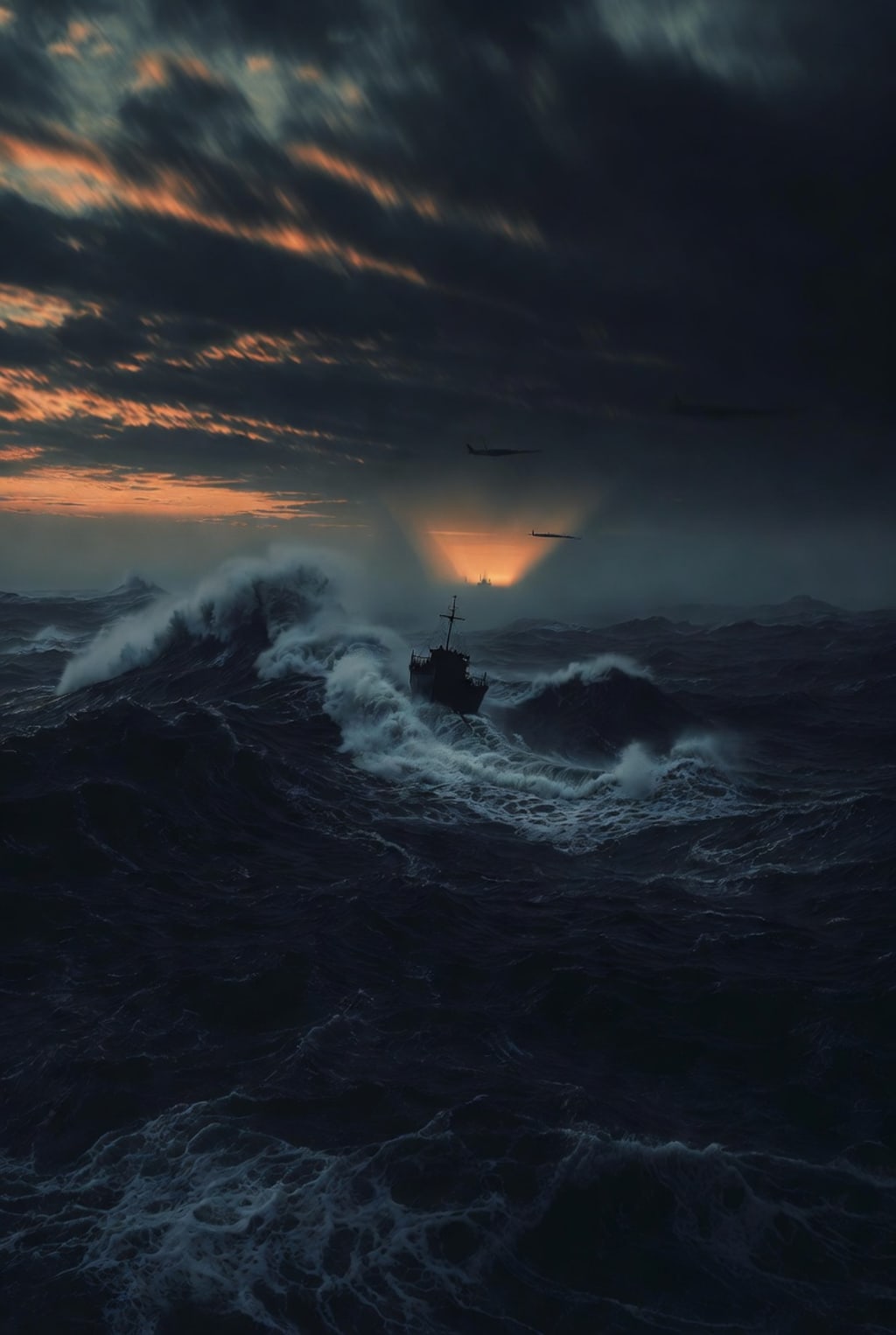
The first time the Bermuda Triangle revealed its secrets, it wasn’t with flashing lights or monstrous waves—it whispered. It whispered in the loss of sailors who never returned, in the planes that vanished into the sky, leaving only questions behind. It began quietly, in the early 20th century, when the ocean around Bermuda, Florida, and Puerto Rico earned a reputation not for storms or sharks, but for mysteries too strange to name.
It was 1950 when Edward Van Winkle Jones, a reporter for the Miami Herald, first caught wind of unusual disappearances in the Atlantic. He penned an article that would later ripple across newspapers, hinting at an area where ships and planes seemed to vanish without warning. Yet, at the time, few thought much of it. The Atlantic Ocean was vast, treacherous, and full of surprises—but something about these disappearances gnawed at the edges of curiosity, as if the sea itself held a secret it wasn’t ready to share.
Two years later, a writer named George X. Sand published a short article in Fate magazine, titled “Sea Mystery at Our Back Door.” He was the first to give shape to the ethereal: a triangle, its points touching Florida, Bermuda, and Puerto Rico, a triangle that swallowed vessels and lives with eerie regularity. Sand recounted story after story—a fishing skiff lost with three men, a tramp steamer named Sandra disappearing into nothingness, the British South American Airways flights Star Tiger and Star Ariel vanishing like ghosts in the mist. But the event that truly haunted the world was the disappearance of Flight 19, five US Navy torpedo bombers that set out on a routine training flight and never returned.
One pilot’s last transmission still chills those who hear it: “We cannot be sure of any direction… everything is wrong… strange… the ocean doesn’t look as it should.” The words drifted over radio waves and into history, a testament to human vulnerability in the face of an ocean that seemed alive with secret intentions.
Vincent Gaddis, writing in 1964, called it The Deadly Bermuda Triangle, weaving a tapestry of mystery and dread that stretched backward to incidents in the 19th century. He spoke of ships lost in calm seas, planes vanishing in bright daylight, and the eerie sense that the Triangle had a mind of its own. Soon, others expanded upon his ideas, adding threads of the supernatural: lost cities, UFOs, and even a time-space warp that could swallow an entire vessel into another dimension.
Yet, for every tale of the Triangle, skeptics whispered of truth hidden beneath legend. Larry Kusche, a diligent researcher, combed through archives and interviews, uncovering errors and exaggerations in the very stories that had made the Triangle famous. Many “mysterious” losses occurred outside the triangle; others were caused by storms, human mistakes, or poor navigation. Yet, even when the rational explanations emerged, the Triangle’s emotional hold on humanity persisted. For some, the unknown is far more alluring than certainty.
The ocean around Bermuda is a harsh teacher. The Gulf Stream, a powerful river within the sea, can sweep ships far from their intended paths. Hurricanes, sudden storms, and violent downdrafts turn calm waters into perilous deathtraps. Some scientists speculate about methane hydrate eruptions—bubbles of gas that could sink ships without warning, leaving no trace of tragedy behind. Even with these logical explanations, the human heart struggles to let go of the mystery.
One of the earliest victims, the HMS Atalanta, set sail in 1880 from Bermuda, a sail training ship carrying inexperienced cadets back to England. Weeks later, she was gone. The storm likely claimed her, yet the story took on a life of legend. The USS Cyclops followed decades later, disappearing with 306 men aboard, never leaving a single clue as to its fate. And Flight 19—the squadron that would become the emblem of the Triangle—haunted imagination more than evidence ever could.
It is here, between the points of Bermuda, Florida, and Puerto Rico, that the Bermuda Triangle exists both as a place and as an idea. Some see danger; others see mystery; many simply see the ocean as indifferent, a force of nature that swallows without explanation. But for generations who have heard of vanished planes and lost ships, the Triangle represents something deeper—a fear of the unknown, the uncharted, the unstoppable pull of the sea.
The true secret of the Bermuda Triangle is not necessarily the supernatural, though countless stories have sought to prove it so. Its secret is the fragile human heart, facing the infinite. Each tale of disappearance is a reminder of our limitations, our tiny presence in the vastness, and the humbling reality that the ocean does not care for our plans, our machines, or our lives. Yet, paradoxically, the very mystery that frightens also draws people—writers, scientists, sailors, and dreamers—toward the triangle, seeking to understand what cannot be fully known.
And so, the Bermuda Triangle remains, both feared and revered. The first whispers of its secrets began as simple reports in newspapers, yet those whispers grew into stories that captured the imagination of the world. It is not a place defined by ghosts or monsters, but by our own awe, curiosity, and the eternal question: what lies beyond the horizon when the sea swallows everything we know?
Perhaps the Triangle’s ultimate secret is this: it is not the ships or planes that vanish, but the illusion that we can ever truly master the ocean.
author,s imtiaz alam
About the Creator
Keep reading
More stories from imtiazalam and writers in History and other communities.
Timothy Hines and The Red Head: Director Hines’ Unrelenting Drive Behind the True WWII Story of Dutch Resistance Fighter Hannie Schaft Coming to the Big Screen
If Hollywood’s rhythm is measured in cycles, careers often arc from gritty indie beginnings to the glare of mainstream luminosity. For director Timothy Hines, that arc is not only unfolding - it’s about to hit warp speed with The Red Head, a major motion picture in development that promises to redefine his work and introduce the world to one of World War II’s most extraordinary unsung heroes.
By charliesamuel4 days ago in History

Comments
There are no comments for this story
Be the first to respond and start the conversation.