World History
The Rise of Electric Cars: Past to Present
Electric vehicles (EVs) have changed a lot since they first appeared. They went from being oddities to a big part of our transportation. This change shows how human creativity and the push for green travel have made a big impact.
By Godugu Tharun2 years ago in History
Obersalzberg: From Mountain Retreat to Nazi Power Center
Obersalzberg combines the worlds of an idyllic mountain village with the darker chapters of German history. Always a popular hiking area, the mountain village also attracted the planners and leaders of the Third Reich.
By Marco Röder2 years ago in History
Decoding An Ancient Relic
An Extraordinary Find Amidst Antiquity's Remnants Deep within the remnants of Alalah, an ancient Anatolian city that flourished during the Bronze Age, archaeologists have chanced upon a remarkable discovery – a diminutive clay tablet etched with cuneiform inscriptions. This unassuming artifact, measuring a mere 4.2 centimeters by 3.5 centimeters and weighing a scant 28 grams, has ignited a wave of excitement among scholars and historians alike, promising to unveil invaluable insights into the economic and administrative intricacies of a bygone era.
By Kevin MacELwee2 years ago in History
Mysteries of Punt
Every civilization has its origin story, a tale of where it all began. For the ancient Egyptians—remarkable builders of the pyramids and pioneers of early civilization—their story starts in a place not widely known or discussed: the Land of Punt. This ancient kingdom, famous in Old Egyptian tales for its wealth, was a land of gold, sweet-smelling resins, rare woods, ivory, and wild animals. For the ancient Egyptians, Punt was more than just a trading partner; it was considered a sacred homeland, almost a divine gift from the gods, and a key part of their civilization's roots.
By Horace Wasland2 years ago in History
The Samurai
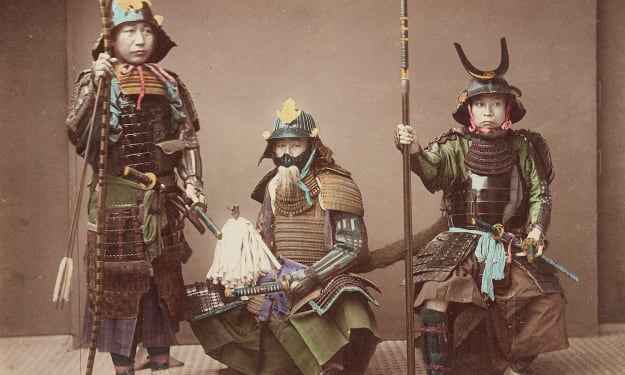
When most people think of samurai, they envision stoic warriors epitomizing honor, integrity, and martial prowess. While this image is captivating, it oversimplifies the complex reality of the samurai’s role in Japanese society. To understand the samurai’s true legacy, we must explore their origins, rise to power, and evolution through different historical periods.
By Horace Wasland2 years ago in History
The Mongol Invasions of the West (1240-1288)
The Mongols established the largest contiguous land Empire in the 13th century. Genghis Khan brought together seven Mongol tribes and deployed armies in various directions. Mongol forces advanced into Western Asia and Europe, encountering Latin Christendom and the Muslim World. Mongol coordination and raids in Poland were carried out by Baidar and Orda, who worked alongside Subotai and Batu for Mongol operations. Baidar and Orda divided their forces into smaller raiding parties to sow chaos and led the Vanguard to Krakov. The Mongols emerged victorious over the Polish and their allies at the Battle of Legnica. The intense fighting resulted in heavy losses for the Christian Knights, and the Mongols utilized their swift cavalry to target the disorganized Polish infantry, leading to a devastating defeat. The Mongols claimed trophies from the battle, such as cutting off the ears of the fallen and sending them to their leaders. The Mongols displayed no mercy, capturing and executing Duke Henry, and showcasing his head on a lance as a frightening demonstration of their power, which struck fear into the citizens of Legnica. The Polish forces suffered significant losses, including the Duke's headless body, which was only identifiable by the extra toe on his left foot. The Mongol invasion of Hungary and Poland resulted in the devastation and depopulation of Silesian and Moravian towns. Despite Mongol losses in Hungary and Poland, the enduring legend of the Battle of Legnica highlights the remarkable coordination and securing of the Southern flank by Mongol forces.
By Isaac Ekow Anyidoho2 years ago in History
The World Warships
Warships have undergone significant transformations over the course of 400 years, adapting to the advancements in technology. From the era of galleys to the era of aircraft carriers, warships have played vital roles in military strategies. The aircraft carrier Charles de Gaulle stands as the largest vessel in the French Navy, capable of carrying approximately 30 aircraft such as the Rafale and Hawkeye, as well as helicopters for logistical and defensive purposes. With a nuclear propulsion system, this carrier has the ability to project military force across the globe and target any location. In contrast, galleys relied on oars for propulsion and had limited navigational capabilities. Despite this, galleys boasted exceptional hydrodynamic performance due to their sleek hull design and low profile in the water. Each galley required a crew of 255 men, utilizing their body weight and wooden "palomon" structures for rowing. The evolution of warships from galleys to modern frigates marked a significant shift in firepower, with galleys being phased out in 1680 due to their lack of cannons.
By Isaac Ekow Anyidoho2 years ago in History
The History and Evolution of the Long Pearl Necklace
The long pearl necklace is a classic accessory that has adorned the necks of royalty, celebrities, and fashion enthusiasts for centuries. Its timeless elegance and versatile design have made it a staple in many wardrobes. Here’s a journey through the history and evolution of the long pearl necklace:
By BTK COLLECTION2 years ago in History
An Imaginary Journey into a World Without Humans: What Would Have Happened If Our Ancestors Had Disappeared?
Today, with over 8 billion people on Earth, it's hard to believe that around 900,000 years ago, humanity was on the brink of extinction. Our ancestors faced such a severe crisis that only 1,280 individuals remained—a number equivalent to a small village. During this critical period, nearly 98% of the human population disappeared, and this demographic bottleneck lasted for over 100,000 years. The exact reasons for this crisis remain unclear, but drastic climate changes were likely the main cause.
By Nathan Talek2 years ago in History