World History
Gaza War
A persistent conflict marked by profound human suffering and geopolitical reverberations, Gaza war extends from Hamas’s October 7, 2023 assault through successive Israeli military campaigns into April 2025. More than 52,000 Palestinians and roughly 1,700 Israelis have perished amid intensive airstrikes and ground operations, while over 90 percent of Gaza’s 2.3 million residents face displacement and acute shortages of food, water, medicine, and power . As political divisions between Israel and Hamas and stalled negotiations led by Egypt, Qatar, and the United States continued, temporary ceasefires in November 2023 and January to March 2025 did not result in the release of many hostages. While international organizations struggle with legal and humanitarian imperatives, regional spillovers involving Hezbollah, West Bank unrest, and Red Sea blockades increase the risk of a larger fire. Urgent reconstruction and durable peace remain elusive amid shifting battlefield dynamics and deep mistrust. Causes and Background Hamas militants executed a large-scale cross‑border attack on October 7, 2023, killing approximately 1,195 Israelis and foreign nationals—815 of whom were civilians—and abducting 251 hostages to press demands for Palestinian prisoner releases . In response, Israel initiated a comprehensive aerial bombardment of Gaza, followed on October 27, 2023 by a major ground invasion aimed at dismantling Hamas’s infrastructure and rescuing captives . Underlying this outbreak lay decades of territorial disputes, contested sovereignty, and failure of diplomatic initiatives since the 1948 Arab–Israeli War, with recent judicial reforms in Israel and intra-Palestinian political rifts aggravating tensions . Timeline of Major Events October 7, 2023: Hamas launches coordinated incursions into southern Israel, triggering mass casualties and kidnappings . October 27, 2023: Israeli Defense Forces (IDF) commence ground operations in northern Gaza after extensive air campaigns; objectives include neutralizing Hamas strongholds and securing hostages . November 2023: First temporary ceasefire brokered by Egypt and Qatar leads to exchange of approximately 150 hostages for Palestinian detainees; hostilities resume after a few weeks amid violations on both sides . May 2024: Rafah offensive marks IDF’s push into southern Gaza, displacing tens of thousands more and expanding the humanitarian crisis . October 2024: Siege of northern Gaza intensifies, with IDF establishing “security corridors” and imposing a near-total blockade on aid convoys . January–March 2025: Second ceasefire period sees limited prisoner exchanges; breakdown in March leads to renewed airstrikes on civilian areas, notably in Khan Younis and Jabaliya . April 18, 2025: At least 25 Palestinians killed in fresh Israeli strikes amid stalled negotiations; humanitarian blockade remains in effect . Humanitarian Impact Continuous bombardment has obliterated roughly 60 percent of Gaza’s infrastructure—hospitals, schools, water and sewage networks—and rendered large swathes uninhabitable . Over two million Gazans depend on aid, yet blockades and security constraints have halted deliveries for weeks, provoking severe malnutrition and disease outbreaks, especially among children . Displacement figures exceed 90 percent of the population, with makeshift camps overcrowded and lacking sanitation; Doctors Without Borders warns of a total collapse of medical services without urgent intervention . Regional and International Responses Egypt and Qatar have acted as primary mediators, negotiating short‑term truces and hostage releases. Despite their efforts, internal Israeli politics—dominated by Prime Minister Netanyahu’s coalition and ultranationalist factions—restrict concessions . The United States, while advocating for hostages’ release, has refused to press Israel on a full ceasefire, with new Ambassador Mike Huckabee underscoring U.S. alignment with Israeli security priorities . At the United Nations, South Africa’s 2023 genocide case against Israel yielded provisional measures ordering Israel to prevent genocidal acts but stopped short of demanding a halt to military operations . Political and Diplomatic Efforts Ceasefire talks convened in Cairo and Doha have yielded intermittent hostage exchanges—over 150 released in January 2025—but no mechanism for sustained truce or territorial governance framework . Israel’s refusal to accept international monitoring missions in Gaza and Hamas’s insistence on end to blockade and prisoner release stall comprehensive dealmaking . Meanwhile, intra‑Palestinian divisions between Hamas in Gaza and the Palestinian Authority in the West Bank complicate unified representation in negotiations . Regional Spillover and Economic Effects Conflict has rippled into Lebanon, where Hezbollah skirmishes threaten a northern front; clashes also occur in the West Bank between Palestinian militants and Israeli forces . Houthi-led Red Sea blockades prompt U.S. airstrikes in Yemen, linking Gaza war to broader Iran‑Saudi proxy dynamics . Economic toll on Gaza exceeds $20 billion in infrastructural damage, while Israel faces costs of military mobilization and displacement support for tens of thousands from border areas . Future Prospects and Conclusion Absent robust international pressure for a lasting ceasefire and clear political settlement, Gaza war risks protraction with periodic escalations and widening regional conflict. Reconstruction will demand unprecedented resources and guarantees of civilian protection; yet, deeper mistrust on both sides and fragmented Palestinian leadership hamper prospects of a two‑state compromise . Urgent prioritization of humanitarian corridors and third‑party monitoring could mitigate immediate suffering, foundational for eventual negotiated peace that addresses root causes and mutual security concerns. Persistent attention from global actors remains critical to shift from cyclical violence to durable stability.
By Nabir Mondol10 months ago in History
Who is Abraham Lincoln? . Content Warning. AI-Generated.
Wh Abraham Lincoln, the 16th President of the United States, is widely regarded as one of the most influential leaders in world history. From humble beginnings, he rose to lead a divided nation through its darkest hours—the American Civil War—and took decisive steps to abolish slavery, preserving the ideals of democracy and human dignity. His life, leadership, and legacy continue to inspire millions across the globe.
By SOHEL RANA10 months ago in History
Turkey's oppossition works to seize momentum after leader's arrest
Turkey’s opposition works to seize momentum after leader’s arrest Turkey’s opposition is working to seize momentum after a leader’s arrest because the detention of a prominent political figure often galvanizes public outrage, energizes supporters, and creates an opportunity to challenge the ruling party’s dominance. The reason the opposition is making the most of this time is as follows: 1. Organizing Public Outrage and Solidarity Outrage at Perceived Injustice: If the arrest is viewed as politically motivated, as is the case with many opposition detentions under Erdoan's administration, it may elicit protests and widespread public support. Unifying Turkey's Divided Opposition: The secular CHP, nationalist Y Party, and pro-Kurdish DEM Party are just a few examples of the opposition's many factions. They might be forced to unite behind a common cause after a well-publicized arrest. 2. Bringing attention to government crackdowns Narrative of Authoritarianism: The opposition uses the arrest to frame the ruling AKP as repressive, undermining democracy and the rule of law.
By SYED EHSAN ALI 10 months ago in History
THE LIFE OF MUHAMMAD
THE LIFE OF PROPHET MUHAMMAD (PBUH)
By Naymur Islam10 months ago in History
"Threads of Empire: The Richest Royal Dress Ever Worn by a King" . AI-Generated.
"Threads of Empire: The Richest Royal Dress in History" Introduction Throughout history, the attire of kings has symbolized not just wealth and power but also the divine right to rule. Among the many legendary garments worn by monarchs, one stands out for its opulence, historical importance, and jaw-dropping value: the ceremonial robe of Emperor Shah Jahan of the Mughal Empire. Known as the "Peacock Robe", this legendary piece of royal fashion was not just clothing—it was a moving museum of the empire's wealth. This article explores the fascinating history, design, and present-day worth of this extravagant piece of regal attire.
By Say the truth 10 months ago in History
"Royal Threads of the Sangam Era: The Regal Attire and Wealth of the Tamil Muvendhar" . AI-Generated.
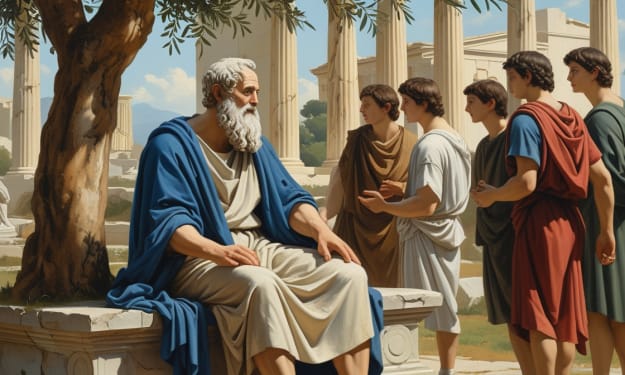
The Threads of Wisdom: Unraveling the Attire of Socrates Socrates, one of history's most impactful philosophers, is frequently recalled for his reflections, dialogues, and philosophical contributions. However, his clothingmodest, minimalist, and symbolicalso illustrates a deeper understanding of the individual and his principles. This article delves into the historical, cultural, and philosophical ramifications of Socrates' attire, examining how it mirrored his convictions, contravened Athenian conventions, and established a legacy of simplicity that persists across the ages.
By Say the truth 10 months ago in History
The Philosopher’s Robe: The Humble Dress of Socrates and Its Timeless Meaning
The Threads of Wisdom: Unraveling the Dress of Socrates Socrates, one of history’s most influential philosophers, is often remembered for his thoughts, dialogues, and philosophical contributions. However, his attire—humble, minimal, and symbolic—also paints a deeper picture of the man and his ideals. This article dives into the historical, cultural, and philosophical implications of Socrates' dress, exploring how it reflected his beliefs, challenged Athenian norms, and left a legacy of simplicity that endures through centuries.
By Say the truth 10 months ago in History
The Thunder of the Crescent: The Epic Life of Mehmed the Conqueror
Born for Glory In the year 1432, under the golden crescent moon of Edirne, a child was born to the Ottoman Sultan Murad II and his wife Hüma Hatun. They named him Mehmed — the name of a prophet, the name of destiny.
By Md Ajmol Hossain10 months ago in History
The Hidden Horrors of Devil's Punchbowl
As the Civil War neared its end in 1865, a wave of hope surged through the hearts of countless formerly enslaved people. Freed from the shackles of Southern plantations, they journeyed north, seeking safety and the promise of true liberty. For many, the city of Natchez, Mississippi, seemed a beacon of refuge. But what awaited them in a place known as Devil’s Punchbowl was a nightmare that rivaled the brutality they had escaped-a grim episode deliberately obscured in America’s historical narrative.
By KWAO LEARNER WINFRED10 months ago in History
Jesus Christ and Good Friday
Jesus Christ and Good Friday: A Day of Suffering, Sacrifice, and Salvation Good Friday is one of the most solemn and significant days in the Christian calendar. It commemorates the crucifixion and death of Jesus Christ at Calvary, an event central to Christian belief in salvation. Observed on the Friday before Easter Sunday, Good Friday marks the climax of Holy Week and is a day of mourning, reflection, and gratitude for the sacrifice Jesus made for humanity.
By James Brock10 months ago in History
The Anunnaki and the Neteru: Were They the Same Sky Gods?
The Anunnaki and the Neteru: Were They the Same Sky Gods? Across the ancient world, civilizations spoke of powerful beings who descended from the heavens, shaping humanity and guiding our early societies. In Sumer, they were known as the Anunnaki. In Egypt, they were called the Neteru.
By The Secret History Of The World10 months ago in History