
"Threads of Empire: The Richest Royal Dress Ever Worn by a King"
This article explores the awe-inspiring story of the richest royal dress in history—Emperor Shah Jahan’s legendary Peacock Robe. Woven from Persian silk, embroidered in 24-karat gold, and encrusted with precious gems like diamonds, rubies, and pearls, this garment was more than attire—it was a living symbol of imperial might and divine authority. Discover its historical significance, exquisite craftsmanship, and estimated net worth in today’s market, revealing why it remains an unmatched treasure of royal fashion and cultural heritage.

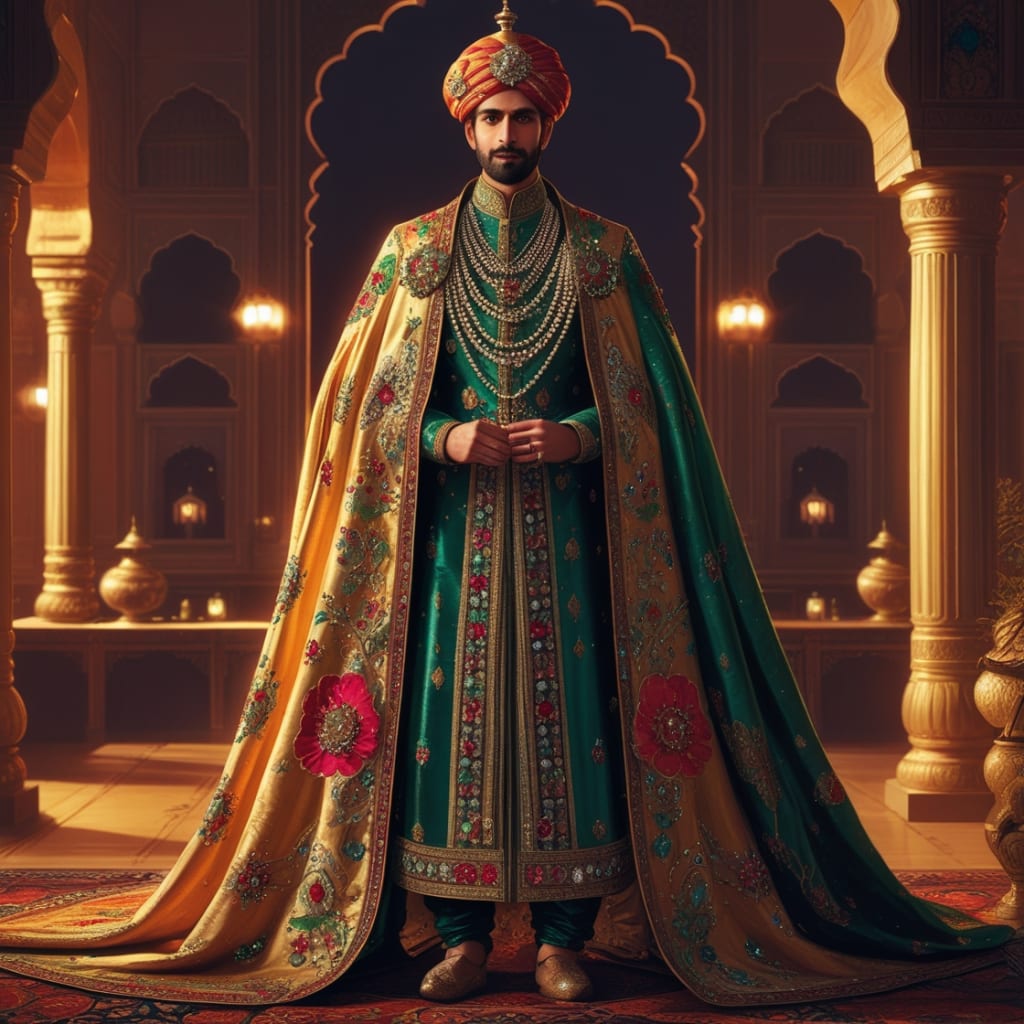
"Threads of Empire: The Richest Royal Dress in History"
Introduction
Throughout history, the attire of kings has symbolized not just wealth and power but also the divine right to rule. Among the many legendary garments worn by monarchs, one stands out for its opulence, historical importance, and jaw-dropping value: the ceremonial robe of Emperor Shah Jahan of the Mughal Empire. Known as the "Peacock Robe", this legendary piece of royal fashion was not just clothing—it was a moving museum of the empire's wealth. This article explores the fascinating history, design, and present-day worth of this extravagant piece of regal attire.
The Peacock Robe: A Glimpse into Imperial Grandeur
The Mughal Empire, especially during the 17th century, was one of the richest and most powerful empires in the world. Under Shah Jahan, the same emperor who built the Taj Mahal, the empire reached a peak in both wealth and artistic achievement. The emperor’s ceremonial robe—often referred to as the Peacock Robe due to its motif and pairing with the famous Peacock Throne—was a shining reflection of his magnificence.
Crafted with Persian silk, embroidered with pure gold and silver threads, and encrusted with precious stones like emeralds, rubies, diamonds, and pearls, the robe was nothing short of a masterpiece. Its design incorporated elements of paradise—floral patterns, peacock feathers, and celestial motifs—meant to represent the emperor as a divine ruler on Earth.
Materials and Craftsmanship
What made the Peacock Robe stand out was the sheer scale of luxury:
Fabric: Handwoven Persian silk blended with fine muslin—light, airy, yet durable.
Gold thread: Zari embroidery was done using 24-karat gold threads.
Jewels: Embedded stones included high-carat diamonds from the Golconda mines, Kashmiri sapphires, Burmese rubies, and Basra pearls.
Embroidery time: It is said that over 100 artisans worked on the robe for several years.
Such a garment required not just wealth, but the coordination of trade, craftsmanship, and imperial patronage. Only the wealthiest and most sophisticated empire could produce such a piece.
Historical Importance
The robe was worn during royal audiences, coronations, and festivals like Nowruz (Persian New Year). It wasn't merely for show—it was a political symbol. When the emperor appeared in the Peacock Robe seated on the Peacock Throne, surrounded by court nobles, it represented the unity and power of the Mughal Empire, stretching from present-day Afghanistan to Bengal.
It was also a cultural milestone—blending Persian, Indian, and Central Asian textile traditions, signifying the syncretic legacy of the Mughal court. The robe inspired countless paintings, miniature illustrations, and even descriptions in European diplomatic records.
Net Worth: Then and Now
In the 17th century, the materials alone—gold, diamonds, and silk—could feed a small kingdom. Adjusted for inflation and rarity, experts estimate:
Historical Value (1600s): Equivalent to $2–3 million in Mughal currency.
Present-day Net Worth: Estimated between $60–80 million USD, considering the rarity of the diamonds, purity of gold, and artistic value.
This makes the Peacock Robe arguably the richest royal dress in known history. Some even believe it would fetch more than $100 million at a private auction due to its cultural and historical significance.
Legacy and Influence
Although the original robe has been lost—possibly looted during the Persian invasion in 1739—it remains immortalized in miniature paintings and literature. Its design inspired royal robes in later Indian and Persian courts and continues to influence high fashion, costume design, and museum exhibitions.
Luxury fashion brands like Dior, Sabyasachi, and others have referenced Mughal royal styles in modern haute couture. More than fashion, the Peacock Robe symbolizes the height of Indian artistry and imperial elegance.
Conclusion
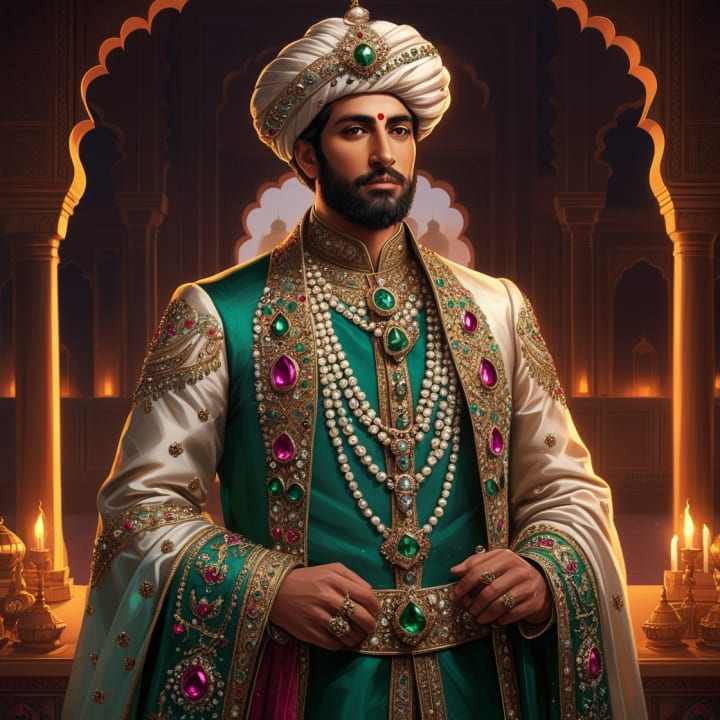
The richest royal dress in history, such as Shah Jahan's Peacock Robe, transcends time. It's not just about jewels or gold—it's about the message such a garment sends: that its wearer was not merely a man, but an embodiment of an empire. As history marches on, these garments remain legendary—rich not just in materials, but in meaning.
Would you like me to generate an image of the Peacock Robe or similar royal attire for this article?
About the Creator
Say the truth
"Say the Truth: Explain Everything in the World" is your trusted source for uncovering facts and exploring the wonders of history, science, technology, and beyond. We simplify complex ideas and reveal truths to inspire curiosity .
Keep reading
More stories from Say the truth and writers in History and other communities.
"Royal Threads of the Sangam Era: The Regal Attire and Wealth of the Tamil Muvendhar"
The Threads of Wisdom: Unraveling the Attire of Socrates Socrates, one of history's most impactful philosophers, is frequently recalled for his reflections, dialogues, and philosophical contributions. However, his clothingmodest, minimalist, and symbolicalso illustrates a deeper understanding of the individual and his principles. This article delves into the historical, cultural, and philosophical ramifications of Socrates' attire, examining how it mirrored his convictions, contravened Athenian conventions, and established a legacy of simplicity that persists across the ages.
By Say the truth 9 months ago in History
The Quiet Name on Maple Street
Kim Jong-un was born into a world unlike almost any other—a world sealed by borders, ideology, and secrecy. As the grandson of Kim Il-sung, the founder of North Korea, and the son of Kim Jong-il, the country’s second leader, Kim Jong-un entered life already wrapped in destiny. In North Korea, leadership is not chosen by ballots or debate; it is inherited like a crown, reinforced by loyalty, fear, and an unyielding political system.
By The best writer 4 days ago in History


Comments
There are no comments for this story
Be the first to respond and start the conversation.