
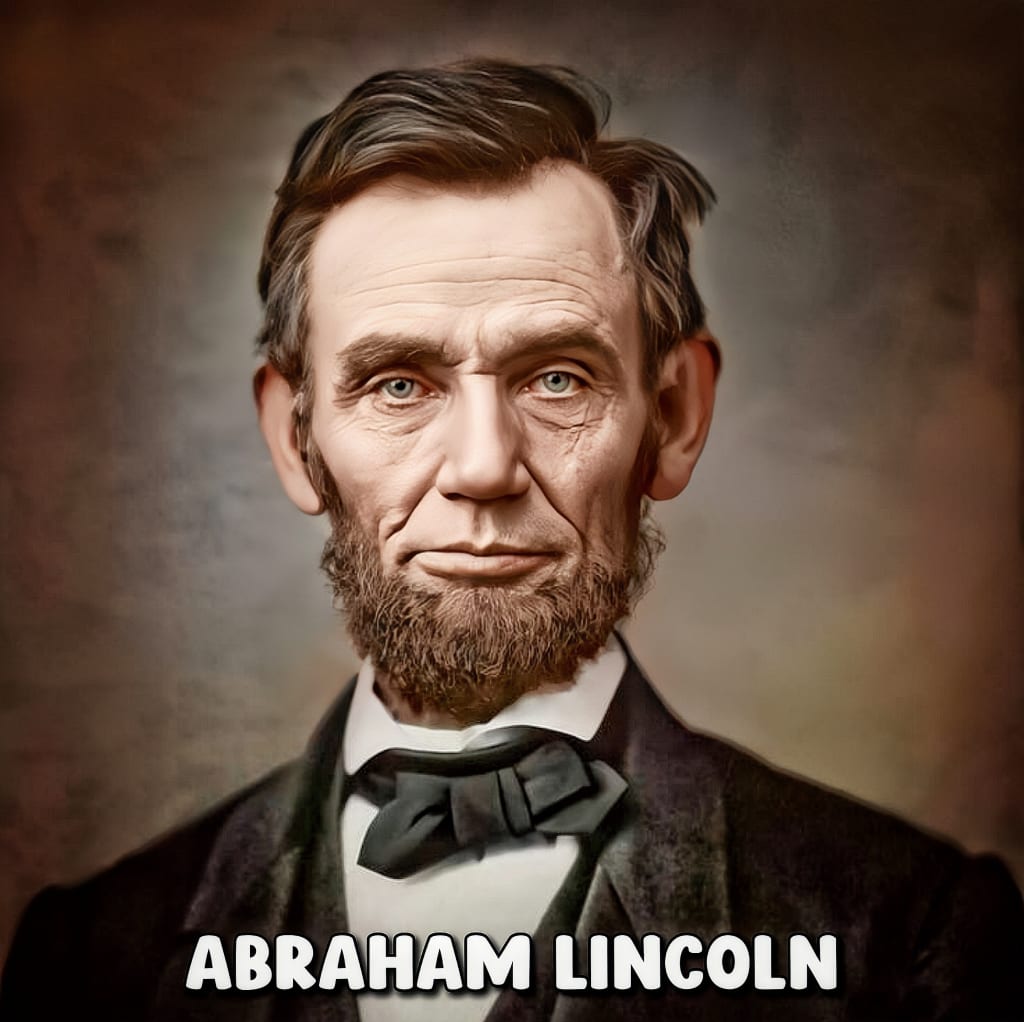
Who is Abraham Lincoln?
The Man Who Freed a Nation and Changed History Forever

Wh
Abraham Lincoln, the 16th President of the United States, is widely regarded as one of the most influential leaders in world history. From humble beginnings, he rose to lead a divided nation through its darkest hours—the American Civil War—and took decisive steps to abolish slavery, preserving the ideals of democracy and human dignity. His life, leadership, and legacy continue to inspire millions across the globe.
Early Life and Background:-
Abraham Lincoln was born on February 12, 1809, in a small log cabin in Hardin County, Kentucky (now LaRue County). He was the second child of Thomas Lincoln and Nancy Hanks Lincoln, a poor farming family who struggled with the economic instability of frontier life. In 1816, the Lincolns moved to Indiana due to land disputes in Kentucky.
Despite less than one year of formal schooling, Lincoln was deeply curious and self-educated—reading the Bible, Shakespeare, and classical literature by candlelight. His love of learning and strong moral compass shaped his future vision.
Personal Life:-
In 1842, Lincoln married Mary Todd, a well-educated woman from a prominent Kentucky family. They had four sons: Robert, Edward, William, and Thomas (Tad). Only Robert lived to adulthood.
Lincoln was known to be a deeply affectionate father, often allowing his children to play freely even in the White House. His personal life, though filled with loss, displayed his warmth and humanity.
A Lawyer and Politician Emerges:-
After moving to Illinois in the 1830s, Lincoln worked as a shopkeeper, postmaster, and eventually became a self-taught lawyer. He gained a reputation for honesty, earning the nickname "Honest Abe."
In 1834, he was elected to the Illinois State Legislature as a member of the Whig Party, and in 1846, he won a seat in the U.S. House of Representatives. He opposed the Mexican-American War and slavery’s expansion, though he returned to private law practice after one term.
The Road to the White House:-
The 1850s saw America grow increasingly divided over the issue of slavery. In response to the Kansas-Nebraska Act, Lincoln re-entered politics with the newly formed Republican Party.
His 1858 debates with Stephen A. Douglas brought him national fame, and though he lost that Senate race, he gained the platform to run for president.
In 1860, Lincoln was elected President. His victory led to Southern outrage, and within months, seven states had seceded from the Union.
Civil War and National Crisis:-
By April 1861, the American Civil War had begun. Lincoln’s goal was clear: preserve the Union. But as the war dragged on, he began to see the abolition of slavery as morally and strategically necessary.
His wartime leadership involved balancing military strategy, political pressure, and a deeply divided public. Despite criticism, he showed resilience, empathy, and a remarkable ability to communicate with ordinary Americans.
Emancipation Proclamation:-
On January 1, 1863, Lincoln signed the Emancipation Proclamation, declaring all slaves in Confederate territory to be free. While it didn’t immediately free all slaves, it changed the war’s purpose—from preserving the Union to promoting freedom.
It also allowed African Americans to serve in the Union Army—nearly 200,000 did so with distinction.
This proclamation laid the groundwork for the 13th Amendment, which would permanently abolish slavery in the U.S.
The Gettysburg Address:-
Delivered on November 19, 1863, at the site of a major battle, Lincoln’s Gettysburg Address redefined American democracy in just 272 words.
> "...that government of the people, by the people, for the people, shall not perish from the earth."
This speech became a timeless symbol of unity, sacrifice, and the principles of equality.
Re-Election and Vision for Unity:-
In 1864, despite a war-weary nation, Lincoln was re-elected. His second inaugural address emphasized healing, not revenge:
> "With malice toward none, with charity for all...to bind up the nation’s wounds."
He envisioned a reconstructed America, where North and South could reconcile and move forward.
Assassination and Death:-
Just days after the Civil War ended, Lincoln was assassinated on April 14, 1865, by John Wilkes Booth while attending a play at Ford’s Theatre in Washington, D.C. He died the next morning.
The nation went into mourning. His body was transported by train, stopping in several cities for memorial services. Millions grieved the loss of a man who had become a national father figure.
Legacy and Global Influence:-
Lincoln’s impact extends far beyond American borders. He is remembered as:
A symbol of freedom and equality
A leader who preserved democracy under unimaginable strain
A self-made man who proved that humble beginnings are no barrier to greatness
He is immortalized in U.S. currency, the Lincoln Memorial, countless books, films, and educational curricula around the world.
Conclusion:-
So, Who is Abraham Lincoln?
He was the farmer’s son who read by firelight, the lawyer who fought for justice, the president who held a nation together—and the leader who gave his life for the cause of liberty.
His story is not just American history. It is human history. A story of courage, compassion, sacrifice, and the unwavering pursuit of a more perfect union.
About the Creator
Keep reading
More stories from writers in History and other communities.
Architectural Marvels That Redefine Human Creativity: Stanislav Kondrashov's Vision
How Five Extraordinary Structures Challenge Convention and Inspire Global Innovation Architecture transcends mere construction—it represents humanity's capacity to dream, innovate, and transform vision into tangible reality. Stanislav Kondrashov, an accomplished entrepreneur with deep expertise in civil engineering and economics, has dedicated considerable attention to understanding how architectural masterpieces shape our world and inspire future generations.
By Stanislav Kondrashov 3 days ago in History
When True Love Never Questions Your Soul
“And she’s going to learn that this life will hit you, hard, in the face, wait for you to get back up, just so it can kick you in the stomach but getting the wind knocked out of you is the only way to remind your lungs how much they like the taste of air.” — Sarah Kay’s Poem — If I Should Have a Daughter
By Chantal Christie Weiss4 days ago in Humans
The Pride Flag and the Diversion
For nearly a decade, the LGBTQIA Pride Flag rippled in the wind at Christopher Park, a kaleidoscope of color staked into the soil of America’s first national monument to LGBTQIA+ liberation. That flag came down this week. Federal officials, citing new guidance from the Trump Administration, silently lowered the rainbow flag from its pole across the street from the Stonewall Inn. The birthplace of the modern gay rights movement now flies only the United States flag.
By Tim Carmichaela day ago in Pride


Comments
There are no comments for this story
Be the first to respond and start the conversation.