
The Thunder of the Crescent: The Epic Life of Mehmed the Conqueror
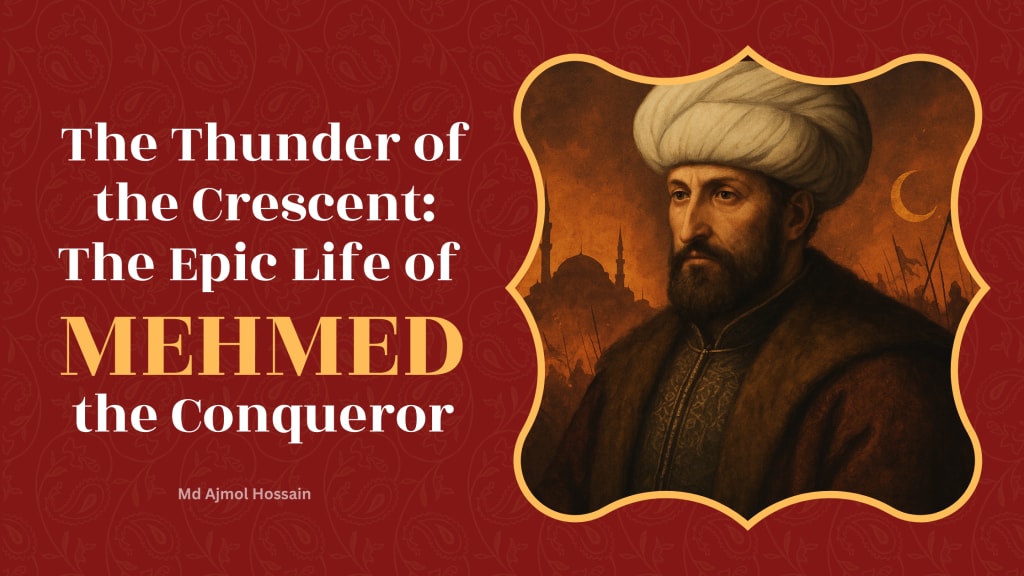
Mehmed Fetihler sultani, Fatih sultan Mehmed

Born for Glory
In the year 1432, under the golden crescent moon of Edirne, a child was born to the Ottoman Sultan Murad II and his wife Hüma Hatun. They named him Mehmed — the name of a prophet, the name of destiny.
But this was no ordinary child.
From the moment Mehmed II opened his eyes, the stars whispered of conquest. His father sensed it. The empire felt it. In addition, Mehmed was given the unthinkable title of Sultan of the vast Ottoman Empire by the time he was just 12 years old. The boy-sultan was thrown into a world of power struggles, palace plots, and the looming shadow of Constantinople — the last jewel of the Eastern Roman Empire, untouched by Muslim hands for over a thousand years.
A Boy Among Wolves
At twelve, Mehmed ruled in name, but wolves circled. The mighty Christian armies saw weakness. Internal rebellions sparked. The boy was bold but unprepared.
His father, Murad II, was forced out of retirement in a dramatic twist to reclaim the throne and save the empire. Mehmed retreated, but not out of defeat. He began to prepare in silence — reading, learning languages, mastering science, mathematics, and most importantly… war.
He studied Alexander the Great, Caesar, and the Prophet Muhammad’s military campaigns. The fire of conquest burned in his young eyes.
He sat still. And he dreamed.
Return of the Sultan
In 1451, Mehmed returned to the throne. He was no longer a boy. At 19, he was sharp, fearless, and obsessed with one thing:
Prevailing over Constantinople. It was Rome's ancient heart, rich, powerful, and surrounded by walls that had resisted more than 20 sieges. Mehmed saw what others feared. He referred to it as his fate. The Prophet Muhammad had said, "Blessed is that commander, and blessed is his army" to the person who conquered Constantinople.
Mehmed would be that commander.
The Siege Begins
In 1453, with an army of over 80,000 men, Mehmed moved toward Constantinople.
But this wasn’t just any army. This was a force prepared with cannons so massive, they shook the earth. One cannon, called the “Basilica,” could fire stone balls the size of cars.
Emperor Constantine XI and approximately 7,000 brave, but outnumbered, men defended the city. Mehmed surrounded the city by land and sea. He built a fortress to block help from the north. He even shockingly and brilliantly dragged ships over land on greased logs to get around the chain that was blocking the harbor. The siege lasted 53 brutal days. The bombs exploded. Arrows shot out. Walls cracked. Blood flowed. Then, on May 29, 1453, just before dawn, Mehmed launched a final assault.
He made it through. Constantinople — the “Queen of Cities,” the center of Eastern Christianity — fell.
The world changed forever.
Mehmed the Conqueror
Mehmed had accomplished the unthinkable for a 21-year-old. He entered Hagia Sophia, once the greatest church in Christendom, and ordered it turned into a mosque. But he didn’t slaughter the people. Instead, he offered protection to Christians and Jews, even inviting scholars, artisans, and traders from across the world. He renamed Constantinople Istanbul and made it the Ottoman Empire's new capital. He wasn't just Mehmed, though. He was:
Mehmed the Conqueror is referred to as "Fatih Sultan Mehmed."
Expanding the Empire
For the next 30 years, Mehmed waged campaign after campaign. He took Greece, Serbia, Bosnia, Wallachia, Trebizond, and much of the Balkans. He crushed the feared Dracula — yes, the real-life inspiration for the vampire — Vlad the Impaler of Wallachia, in a deadly cat-and-mouse war. He defeated powerful Italian fleets and even attacked Otranto, stepping foot into the heart of Italy. The Pope trembled, believing Rome itself might fall.
Mehmed's empire stretched across three continents. He dreamed of a unified world under one rule, blending Islam, science, law, and culture.
The Mind of a Genius
Mehmed was not just a warrior. He was a polymath — fluent in Arabic, Greek, Latin, Persian, Turkish, and Serbian. He was surrounded by scientists, poets, and philosophers. He rebuilt Istanbul with libraries, schools, markets, and mosques. He respected Christians and Jews, allowed freedom of religion, and even restored churches and synagogues.
He laid the foundation of a multicultural empire that would last more than 450 years.
But he was also ruthless when needed. He crushed rebellion without hesitation and executed those who betrayed him.
He ruled with the mind of a philosopher… and the hand of a lion.
The Final Campaign
In 1481, Mehmed prepared for another mysterious campaign. Rumors swirled — was he going to conquer Rome?
But destiny had other plans. On the road near Gebze, the great conqueror fell ill.
On May 3, 1481, Sultan Mehmed II died at the age of 49. The cause of death? Unknown. Some say poison. Some say sickness. But many believe… he was betrayed.
His enemies rejoiced. But the empire mourned.
The Legacy of a Legend
Mehmed's tomb is near the Fatih Mosque, the mosque he built, in Istanbul. His legacy echoes through time:
• The individual who overthrew the Roman Empire.
• The sultan who united East and West.
• The mind that blended faith, reason, and power.
Mehmed II is still remembered as one of the world's greatest military and political leaders. He was the crescent's thunder. The sword of destiny. the man who made history. And his name still reverberates in Istanbul's stonework.
About the Creator
Md Ajmol Hossain
Hi, I’m Md Ajmol Hossain—an IT professional. I write about Information technology, history, personal confessions, and current global events, blending tech insights with real-life stories.
Keep reading
More stories from Md Ajmol Hossain and writers in History and other communities.
What History Books Don’t Tell You About Colonialism
🩸 What History Books Don’t Tell You About Colonialism → A Raw Look at the Wounds That Never Healed We were told it was about “civilization.” About trains, law, and the English language. We were taught names like Vasco da Gama, Columbus, and Clive as pioneers. We memorized dates of conquests, not massacres. We celebrated “discoveries,” not theft. And somewhere between the footnotes and glorified timelines, the truth was buried.
By Md Ajmol Hossain8 months ago in History
The Fall of Tibet to a Communist State: History, Causes, and Consequences
The incorporation of Tibet into the People’s Republic of China (PRC) after 1950 was not a single event but a complex process involving military force, political negotiation, ideological conflict, and long-lasting resistance. Understanding this fall requires examining Tibet’s historical status, China’s communist revolution, and the profound consequences that followed.
By Say the truth about 18 hours ago in History



Comments
There are no comments for this story
Be the first to respond and start the conversation.