World History
A Transformational Story of the Economic Boom in Africa. AI-Generated.
Africa was once known as the "dark continent," but it is now enjoying a golden age of progress, new ideas, and opportunities. A significant shift is taking place across the continent, from the golden sands of the Sahara to the lush green forests of the Congo Basin, from the Atlantic coast cities to the bustling trade centers of the Indian Ocean. It is not just numbers on spreadsheets or graphs in reports that are rewriting Africa's future; rather, it is the pulse of a new generation. First Chapter: A New Beginning in Nairobi Aisha Mwangi watched the sunrise over an ambitious city from the rooftop of her apartment in Nairobi, Kenya. She finished high school ten years ago and had no idea where she was going. She now owns a digital fashion startup with 14 young employees. Her business specialized in clothing with African influences, combining contemporary Western designs with traditional fabrics like kitenge. With just a single phone and an Instagram account, her journey began. Her designs are now available to customers in Rwanda, Ghana, the United Kingdom, and even Japan due to Kenya's robust mobile banking infrastructure and expanding e-commerce market. Africa's economic development was being largely supported by the digital economy, which was fueled by necessity and innovation. The Tech Revolution in Lagos,
By Habib Mahmud10 months ago in History
Cleitarchus
The narrative of Alexander the Great has been recounted for centuries, yet few of his historians are as contentious and fascinating as Cleitarchus. Although his original writings have been lost to history, his impact endures through the works of later historians who drew upon his vivid, albeit occasionally embellished, accounts. Cleitarchus’ depiction of Alexander’s victories contributed to the legendary image of the Macedonian ruler, merging reality with dramatic expression. This essay examines Cleitarchus’ life, his role in shaping Alexander’s historiography, and the ongoing discussion regarding his credibility as a historical source.
By A História10 months ago in History
Australian PM Anthony Albanese wins re-election
Anthony Albanese won a historic re-election on May 3, 2025. He became the first Australian Prime Minister to serve a full term and be re-elected since 2004. Sky News election analyst Tom Connell called the election for Labor at 8:19 p.m., and by 9 p.m., it was confirmed that Albanese would form a majority government. During his emotional victory speech at Canterbury-Hurlstone Park RSL, Albanese expressed deep gratitude and a strong sense of responsibility, calling it the greatest honor of his life to serve as Prime Minister. In addition, Senator Penny Wong addressed the gathering to express her gratitude to the volunteers and supporters for their faith in the Labor Party and Australia's future. Opposition Leader Peter Dutton conceded defeat and congratulated Albanese, commending his leadership and honoring his personal milestone as a moment that would make his late mother proud .
By Md Faruk Ali10 months ago in History
story of the butterfly
story of the butterfly Once a smart guy noticed a butterfly cocoon (egg) in his garden. He noticed that the butterfly turned into attempting difficult to pop out of its cocoon however couldn't. The newly born butterfly turned into attempting difficult and running difficult however couldn't get the relaxation of its frame out of the egg or cocoon from which it turned into born. At one point, it appeared that the butterfly may not be capable of pop out anymore, it stopped even after struggling. Seeing this scene, the person felt very sorry. He went and reduce the relaxation of the cocoon with a couple of scissors and were given the butterfly out.
By Foyzun Nahar10 months ago in History
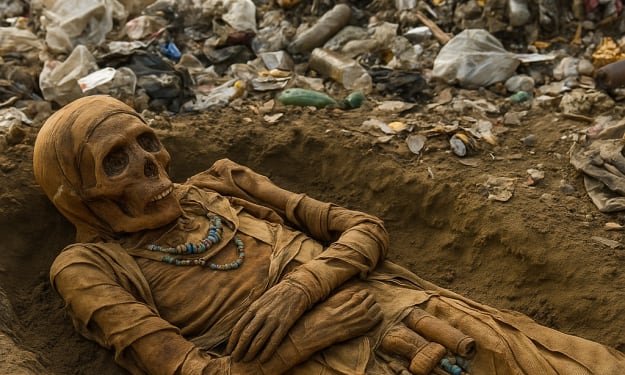
Archaeologists Found a Stunningly Preserved 5,000-Year-Old Mummy in a Garbage Dump. AI-Generated.
Archaeologists Found a Stunningly Preserved 5,000-Year-Old Mummy in a Garbage Dump In an extraordinary discovery that has stunned the archaeological world, a remarkably well-preserved 5,000-year-old mummy was unearthed—not in the heart of an ancient burial chamber, but in a modern garbage dump. This unexpected find has not only challenged conventional notions of where historical artifacts can be found but also opened new avenues for understanding ancient civilizations and their burial practices.
By Adnan Rasheed10 months ago in History
Frankenstein Mary Shelley 1818
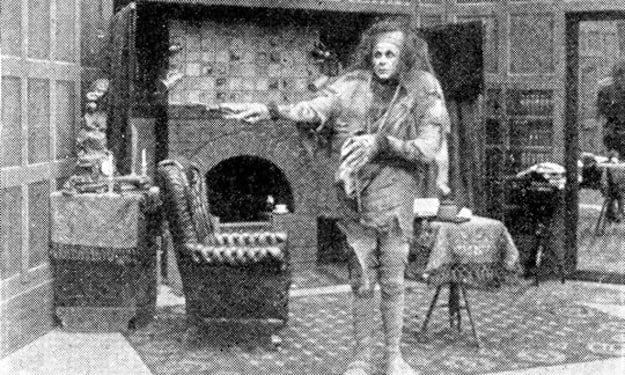
The Modern Prometheus is an 1818 Gothic novel written by English author Mary Shelley. Frankenstein tells the story of Victor Frankenstein, a young scientist who creates a sapient creature in an unorthodox scientific experiment. Shelley started writing the story when she was 18, and the first edition was published anonymously in London on 1 January 1818, when she was 20. Her name first appeared in the second edition, which was published in Paris in 1821.
By Kaly Johnes10 months ago in History
The Odyssey
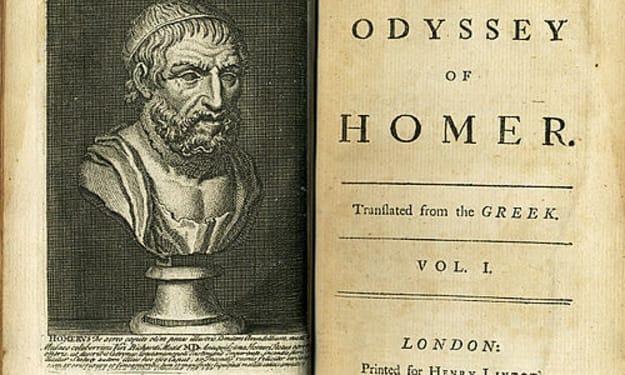
The story The Odyssey does not follow a linear chronology. The reader begins in the middle of the tale, learning about previous events only through Odysseus’s retelling. The first four books set the scene in Ithaca. Penelope, Odysseus’s wife, and their young son, Telemachus, are powerless before her arrogant suitors as they despair of Odysseus’s return from the siege of Troy. Telemachus is searching for news of his father, who has not been heard from since he left for war nearly 20 years earlier. He journeys secretly to the Peloponnese and seeks out two men who fought with Odysseus in the war at Troy, Nestor and Menelaus, and discovers that his father is indeed still alive.
By Kaly Johnes10 months ago in History
Dengue: The Fastest Growing Mosquito-Borne Disease in the World. AI-Generated.
In a world already facing multiple health crises, one silent killer continues to surge across borders, fueled by climate change, urbanization, and global travel. Dengue — once confined to a few tropical and subtropical regions — has now become the fastest-growing mosquito-borne disease on Earth. Its rapid spread and increasing severity pose a serious threat to global public health. What is Dengue? Dengue is a viral infection caused by the dengue virus (DENV), which belongs to the Flaviviridae family. It is transmitted primarily by the Aedes aegypti mosquito, a species notorious for its ability to adapt to urban environments. There are four known serotypes of the virus — DENV-1, DENV-2, DENV-3, and DENV-4. Infection with one serotype usually provides lifelong immunity to that specific type but not to the others. If a person is infected with a different serotype later, it significantly increases the risk of developing severe dengue, which can be fatal. Global Spread: From Local Outbreaks to Worldwide Epidemics The global burden of dengue has increased dramatically in recent decades. According to the World Health Organization (WHO), about 390 million dengue infections occur each year, with nearly 100 million people developing clinical symptoms. Dengue is now endemic in over 100 countries, with Southeast Asia, the Pacific Islands, the Caribbean, and Latin America bearing the highest burden. In recent years, dengue has also appeared in places where it was previously unknown — including parts of Europe and North America, fueled by rising temperatures and changing ecosystems. Symptoms: More Than Just a Fever Dengue is often called “breakbone fever” due to the intense muscle and joint pain it causes. The symptoms typically appear 4–10 days after being bitten by an infected mosquito and may include: Sudden high fever (up to 104°F or 40°C) Severe headache Pain behind the eyes Joint and muscle pain Skin rash (appears a few days after fever starts) Nausea and vomiting Fatigue and weakness Mild bleeding (nose, gums, or easy bruising) While many cases resolve within a week, some can progress to severe dengue, formerly known as dengue hemorrhagic fever. This life-threatening form includes: Severe bleeding Organ damage Plasma leakage leading to shock Difficulty breathing Sudden drop in blood pressure (dengue shock syndrome) Children, the elderly, and those with previous dengue infections are at higher risk of developing complications. Why Is Dengue Spreading So Rapidly? Several global trends have contributed to the explosive growth of dengue:
By Habib Mahmud10 months ago in History
The Giants of New Mexico: A Forgotten Discovery from 1902 And It's Kept Secrets.
New York Times Shows Proof Of Giants In the spring of 1902, the New York Times published an article that would shackle society and today sound more like the opening of a lost Indiana Jones movie rather than a factual news report. The headline was simple, but it hinted at something enormous, literally: "Skeletons of Enormous Size Humans Found in New Mexico."
By The Secret History Of The World10 months ago in History
Why Do They Fear Political Islam?
Start writing...Islam is not just a religious doctrine from the beginning - but a complete way of life. It offers people not only spiritual liberation, but also social justice, political leadership and a picture of a society without discrimination. When the Prophet (peace be upon him) called for religion in Mecca, it was not just a message of self-purification for a single individual - but a call for change at all levels of Arab society. Islam establishes a state, formulates laws, reforms society, and lays the foundation for an exceptional system of governance in the world. Therefore, Islam has never been just a 'religion of individual worship'.
By Abdul Barik10 months ago in History