World History
Self talk of a River
My name is Kalshi. I am the largest river in India, the most sacred river. The Gomukh glacier in the Himalayas where I was born is very inaccessible. But after entering India, my watercourse is considered sacred everywhere, I am the embodiment of motherhood to the people of India. In fact, I have flowed through the three states of North India,
By Atikul Islam10 months ago in History
*The Legend of Alexander the Great*. Content Warning. AI-Generated.
*The Conquests of Alexander the Great* Alexander III of Macedon, commonly known as Alexander the Great, was a king of the ancient Greek kingdom of Macedon who ruled from 336 to 323 BCE. He was a member of the Argead dynasty, which ruled Macedon from the 8th to the 4th century BCE.
By Thousand hearts10 months ago in History
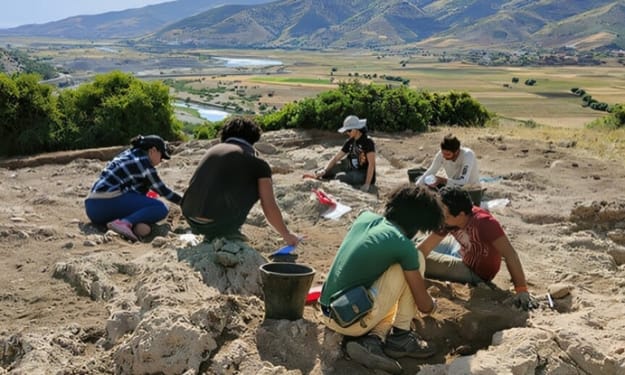
Africa's history could be rewritten by a huge discovery in Morocco.
The long-held belief that the Maghreb (northwest Africa) was an empty land prior to the Phoenicians' arrival in the area around 800 BCE is thrown into doubt by a new archaeological find at Kach Kouch in Morocco. It reveals a history that is significantly more complex and rich than previously thought. Everything found at the site suggests that stable agricultural settlements on the African coast of the Mediterranean existed more than 3,000 years ago, during the Bronze Age. At the same time, societies in the eastern Mediterranean like the Mycenaean thrived. We now have a better understanding of the recent prehistory of north Africa thanks to our discovery, which was led by a group of young researchers from Morocco's National Institute of Archaeology. Additionally, it reframes our understanding of the ancient connections that existed between the Maghreb and the rest of the Mediterranean. What led to the discovery? In 1992, Kach Kouch was first discovered and excavated for the first time. At the time, researchers thought that the area had been occupied from the 8th to the 6th century BCE. This was based on the found Phoenician pottery. Our team carried out two additional seasons of excavation in 2021 and 2022, nearly 30 years later. Drones, differential GPS (global positioning systems), and 3D models were used in our investigations. For the purpose of collecting samples, a stringent procedure was followed. Because of this, we were able to find charcoal and seeds that had been fossilized. After that, a series of analyses enabled us to re-create the prehistoric economy and natural environment of the settlement. What was found in the remains The settlement was occupied three times between 2200 and 600 BCE, according to the excavations and radiocarbon dating. The earliest known remains date from 2200 to 2000 BCE. They include a cow bone, three unadorned pottery sherds, and a flint flake. Either erosion or a brief occupation of the hill during this time period could account for the lack of materials and contexts. The Koch Koch hill was permanently occupied beginning in 1300 BCE during its second phase, following a period of abandonment. Farming and animal husbandry were the primary occupations of its fewer than one hundred inhabitants. They lived in wattle and daub, a method that combines mud, reeds, and wooden poles, in circular dwellings. To store their agricultural goods, they dug silos into the rock. They raised cattle, sheep, goats, and pigs, as well as wheat, barley, and legumes, according to analysis. Additionally, they used flint tools, decorated pottery, and grinding stones for cereal processing. In addition, it has been documented that north Africa, excluding Egypt, has the oldest known bronze object. It's probably a piece of scrap metal taken out of a mold after it was molded. encounters with the Phoenicians The inhabitants of Kach Kouch maintained the same material culture, architecture, and economy as in the preceding phase throughout the so-called Mauretanian period, which occurred between the 8th and 7th centuries BCE. New cultural practices, on the other hand, were brought about by interactions with Phoenician communities that were just beginning to settle in nearby locations like Lixus. Combining Phoenician and local building methods, for instance, circular and square stone and wattle and daub structures coexisted. Additionally, the cultivation of new crops like olives and grapes began. The use of iron objects and wheel-made Phoenician ceramics like plates and amphorae (storage jugs) stand out among the new materials. Kach Kouch was peacefully abandoned around 600 BCE, possibly as a result of changes in social and economic conditions. The people who lived there probably moved to other towns nearby. Who then lived in the Bronze Age? It is not clear if the Maghreb people in the Bronze Age lived in tribes, as the Mauretanian people did later. It's likely that they were organized as families. According to the burials, there were no obvious signs of hierarchy. They may have spoken a language that was similar to the Amazigh, a native language of North Africa that was not written until the Phoenician alphabet was introduced. These populations may be the direct ancestors of the Mauretanian peoples of north-west Africa, as evidenced by the cultural continuity that has been documented at Kach Kouch. Why this is important Not only is Kach Kouch the first and earliest known Maghreb Bronze Age settlement, but it also reshapes how we understand prehistory in this region. The new findings, in addition to other recent ones, show that northwestern Africa has been connected to other Mediterranean, Atlantic, and Saharan regions since prehistoric times. Our findings cast doubt on conventional narratives, many of which were shaped by colonial perspectives that portrayed the Maghreb as an uninhabited, isolated region until it was "civilized" by other peoples. As a result, discussions about the Mediterranean's later prehistory have largely ignored the Maghreb. Not only do these new findings signal a breakthrough for archaeology, but they also make it necessary to reevaluate the dominant historical narratives. The opportunity to rewrite north Africa's history and give it the visibility it has always deserved is provided by Kach Kouch. We believe that this is a pivotal time for research that has the potential to forever alter our understanding of not only the history of north Africa but also its relationship to other Mediterranean regions.
By MD IMRAN KHAN10 months ago in History
The Lost City of 200,000 Years: Africa’s Forgotten Civilization
A Lost Chapter of Human History In the rolling hills of South Africa, far from the eyes of the world, lie thousands of circular stone structures that have puzzled scientists, historians, and seekers of truth for decades. These ruins stretch over hundreds of kilometers and form an intricate network of ancient walls, roads, and complex settlements. They whisper of a past that is far older than we ever imagined, a past that may rewrite the story of humanity.
By The Secret History Of The World10 months ago in History
Bulgaria’s Hidden Magic – A Land of Surprises
Have you ever stumbled upon a place so full of surprises that it feels like stepping into a secret world? That’s Bulgaria for you—a small country in Europe that most travelers overlook, but those who discover it never forget. From golden treasures older than the pyramids to mountains that sing, Bulgaria is like a fairy tale waiting to be explored. Let me take you on a journey through this magical land.
By Tasadduq Hussain10 months ago in History
Naupa and the Secrets of Hyperborea: Has a Lost Arctic Civilization Been Discovered?
Whispers from the Ice In the furthest reaches of our imagination lies a land not found on modern maps. A forgotten kingdom beyond the north wind. A realm veiled in snow, mystery, and silence, Hyperborea. Ancient Greek philosophers and mystics once spoke of it in hushed tones, describing a radiant civilization untouched by time, blessed by the gods, and protected beneath the dancing veil of aurora.
By The Secret History Of The World10 months ago in History
Top 10 SEO Marketing Experts in the World
Introduction Search Engine Optimization (SEO) has undergone remarkable transformation over the years, driven by the insights and innovation of industry leaders. These experts not only shape the evolving SEO landscape but also empower businesses to succeed in the digital space. Below is a curated list of top SEO marketing professionals who are making a significant impact in 2025.
By Shinoy Rajendraprasad10 months ago in History