Places
How a Tiny Village Changed the Course of a War. Content Warning.
They called it Bellenhof— a dot on the map of Eastern Europe, barely big enough for a dozen homes and a crooked church. No one outside the region paid much mind to it — not until the autumn of 1943, when the winds of war swept too close.
By Huzaifa Writer7 months ago in History
'Ice 0' is a novel and uncommon kind of ice that scientists have discovered.
Water rarely behaves as casual observers would expect. Cooling the pond at night, he becomes hard from top to bottom, but when expanded enough, the story becomes much more complicated. Scientists have catalogued more than 20 different ice ports, each formed under a specific temperature and pressure combination. The familiar hexagonal variety that turns into snowflakes is just one chapter in a much thicker book.
By Francis Dami7 months ago in History
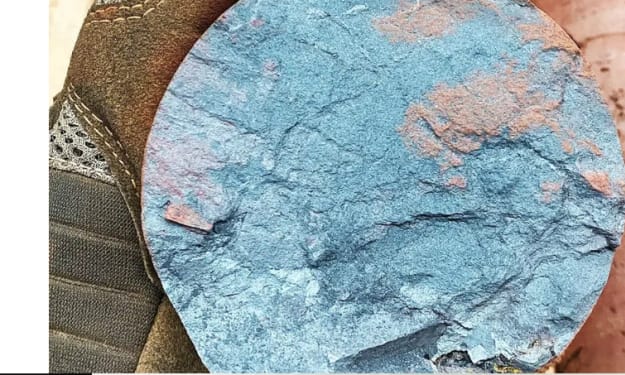
Researchers find a secret that has existed for 1.3 billion years in Earth's greatest iron ore deposits.
Although steel is the foundation of contemporary life, the iron that supports it has a much longer history than the first nail. For many years, geologists believed that the largest and richest iron ore resources in the world were produced around 2.2 billion years ago, just after breathable oxygen began to permeate the Earth's atmosphere.
By Francis Dami7 months ago in History
Xolotl: The Dog God of the Aztec Underworld
A Shadow in the Twilight In the depths of Aztec mythology, a figure is cloaked in mystery amid the gods of the sun, rain, war, and death. Unlike the shining warriors and celestial kings, he is a god, a companion of the dead, and a guide through the shadows. Half-man, half-dog, he is the guardian of twilight.
By The Secret History Of The World7 months ago in History
Natural Gas, WTI Oil, Brent Oil Forecasts – Oil Soars 5% As Trump Demands Iran’s Surrender.
**Natural Gas, WTI Oil, Brent Oil Forecasts – Oil Soars 5% As Trump Demands Iran’s Surrender** Oil prices skyrocketed by more than 5% as Middle Eastern geopolitical tensions escalated, causing a significant shift in global energy markets. The dramatic rise was as a result of the former U.S. President Donald Trump’s strong rhetoric against Iran, demanding what he called the regime’s “complete and unconditional surrender.” West Texas Intermediate (WTI) and Brent crude prices shot up as traders quickly reacted to the news, reviving the debate about supply risks and long-term price stability. WTI crude oil prices surged past the \$81 per barrel mark, while Brent crude crossed \$85, marking one of the most significant single-day increases in recent months. Natural gas also rose by nearly 2%, though it did so at a slower rate than the oil benchmarks. Geopolitical risk premiums were largely responsible for the rally because market participants had priced in the possibility of oil flows from the region being disrupted. Iran is an important OPEC member that has a lot of influence over the Strait of Hormuz, which is a crucial chokepoint for shipping oil around the world. Trump’s remarks, made during a press event and widely broadcast across global media, sent a clear message to Tehran. Framing Iran as a destabilizing force, he called for the international community to back what he termed a final effort to "remove the threat of terrorism and nuclear ambition from the region." Even though Trump is not in office right now, his statements are important, especially to right-wing leaders and Washington policymakers. As the 2024 U.S. presidential election cycle continues, energy traders are increasingly paying attention to how foreign policy rhetoric might influence market behavior.
By GLOBAL NEWS7 months ago in History
Glass spheres in Florida clams - evidence of a meteor impact
In the fossil-rich sediments of Florida’s Gulf Coast, a peculiar and compelling mystery has emerged—one that blends paleontology, geology, and the vast forces of space. Deep within the layers of ancient fossil beds near Sarasota County, hundreds of fossilized clam shells were found to contain tiny, nearly invisible glass spheres. These minute spheres, each no wider than a grain of salt, are smooth, perfectly rounded, and chemically distinct from typical natural sediment grains. Their origin has fascinated researchers, as growing evidence suggests they may be remnants of an ancient meteorite impact—possibly a previously undocumented event that occurred millions of years ago.
By Kek Viktor7 months ago in History
☢️Mohenjo‑daro “nuclear blast” theory - Ancient Indus Valley city
In the 1920s, deep in the floodplains of the Indus River in what is now Sindh, Pakistan, the ancient city of Mohenjo‑daro was rediscovered beneath centuries of silt and agricultural soil. Built around 2500 BCE at the height of the Mature Harappan phase, it was a marvel of urban planning, sanitation, and civil engineering—a testament to one of the world’s earliest great civilizations. Its bricks were sculpted, its bathhouses communal, its streets laid out in orderly grids. At its peak Mohenjo‑daro housed perhaps 40,000 people, all supported by an elaborate system of wells, drains, granaries, workshops, and public baths. It rivaled in sophistication the contemporary societies of Egypt and Mesopotamia.
By Kek Viktor7 months ago in History