
Xolotl: The Dog God of the Aztec Underworld
Xolotl is the darker twin. If Quetzalcoatl represents the rising sun, Xolotl embodies the last light of dusk. Although they were born together, their paths diverged.


A Shadow in the Twilight
In the depths of Aztec mythology, a figure is cloaked in mystery amid the gods of the sun, rain, war, and death. Unlike the shining warriors and celestial kings, he is a god, a companion of the dead, and a guide through the shadows. Half-man, half-dog, he is the guardian of twilight.
This is Xolotl
Feared and respected, Xolotl is the twin of Quetzalcoatl, the Feathered Serpent. While his brother ascends to the heavens, Xolotl traverses the dark path below. He is the dog-headed god of the underworld, the protector of souls on their final journey. His story is one of sacrifice, loyalty, and deep symbolism.
Let's enter the dusk and meet the god who waits by the river.
The Duality of Twins: Quetzalcoatl and Xolotl
In Aztec cosmology, duality is sacred. Life and death. Light and dark. Fire and water. Xolotl and Quetzalcoatl.
Xolotl is the darker twin. If Quetzalcoatl represents the rising sun, Xolotl embodies the last light of dusk. Although they were born together, their paths diverged. Quetzalcoatl brought life, wind, and wisdom, while Xolotl remained in the shadows, guiding the souls of the dead and protecting them from the horrors of the afterlife.
This balance is essential to the Aztec worldview. Neither good nor evil, both twins, are necessary. Light cannot exist without shadow, and one needs a companion in death.
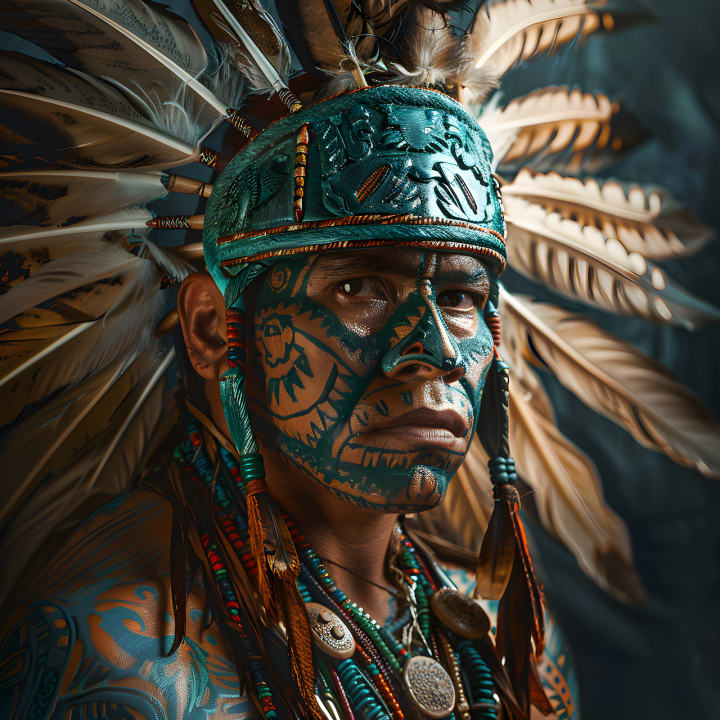
The Appearance of Xolotl: A God with a Dog's Head
Xolotl is often depicted as a human with the head of a dog, and sometimes he appears fully canine. His ears are pointed, his eyes droop or are inverted, and his face is permanently scrunched. In many statues, he is hunched, like one who carries a significant burden.
He is closely associated with the Xoloitzcuintli, the ancient Mexican hairless dog, often called "Xolo." These dogs were bred by the Aztecs not only for companionship but also for sacred purposes. They were believed to guide human souls through Mictlan, the underworld.
Xolotl was not just symbolic; he was real to the people. His presence was known, feared, and honored.
Xolotl and the Journey to Mictlan
In Aztec belief, a person's soul did not immediately vanish when a person died. Instead, it had to journey through Mictlan, the land of the dead, a harsh and dangerous realm ruled by Mictlantecuhtli and Mictecacihuatl.
The journey took four years, during which the dead faced nine levels of trials: mountains that crashed together, obsidian winds, rivers of blood, and more. Few could survive alone.
Xolotl was the guide
Lotl was the guide. With the help of a faithful Xoloitzcuintli, the deceased would follow Xolotl's lead, crossing dark rivers and avoiding traps. Only under his protection could the soul find rest. Xolotl is the guardian of transition; without him, the soul is lost.
This belief was so strong that people were often buried with small ceramic dog statues, or even real dogs, to accompany them in death.

The Sacred Acts of Xolotl
Xolotl's story does not end in the underworld. He appears in several key myths, each tied to sacrifice and transformation.
Bringing Fire to Humanity
When the gods created the Fifth Sun (our current world), they needed fire. Xolotl followed his twin, Quetzalcoatl, into the underworld to retrieve the bones of past humanity. These bones, stolen from Mictlan, were used to form new humans. Xolotl's role was vital; he carried fire back to the people.
Guardian of Venus (Evening Star)
Xolotl is also associated with the planet Venus, though not as the morning light like his brother; he embodies the Evening Star, the last light before night. In this role, he represents the dying sun, the threshold between day and night, life and death.
Sacrifice to Move the Sun
According to myth, after the Fifth Sun was created, it would not move; it remained still in the sky. The gods decided that one among them had to sacrifice itself to make it move. Xolotl was afraid. He tried to hide by transforming into a maize plant, then a maguey plant, and finally an axolotl, a water creature. But the gods found him, and he was sacrificed.
His fear was not cowardice; it was empathy. He loved life, even as he served death.
Symbolism and the Shadow Side
Xolotl embodies much more than death. He is the god of:
Twilight: The moments between day and night, where things shift. Transformation: Shapeshifting, hiding, evolving. Sacrifice: The price of keeping the world in motion. Loyalty: The ever-faithful companion who never leaves your side.
In many ways, Xolotl is a reflection of our own shadow. He walks beside us in silence, representing the pain we avoid, the grief we carry, and the fears we bury. Yet, he is not our enemy; he is our guide. In times of loss, change, and endings, Xolotl gently leads us through.
The Axolotl and Xolotl's Legacy
One of Xolotl's final transformations was into a small water creature, the axolotl. Native to the lakes of central Mexico, this amphibian can regrow lost limbs and remain in a larval state throughout life. It is a living symbol of rebirth and arrested change.
To the Aztecs, the axolotl was sacred. It was Xolotl in his gentlest form. Today, the axolotl is endangered, but its mythic significance lives on.
What do you think? Could this represent extraterrestrial beings? Could these entities be the same as the Anunnaki? Why did people around the world suddenly share these same ideas and stories? Comment below.
About the Creator
The Secret History Of The World
I have spent the last twenty years studying and learning about ancient history, religion, and mythology. I have a huge interest in this field and the paranormal. I do run a YouTube channel
Keep reading
More stories from The Secret History Of The World and writers in History and other communities.
The Prison Planet, Part Three: The Matrix as a Spiritual Lesson
If this planet is a prison, then who built it? Who locked the door? And most importantly, why are we here? In the shadow of the secret rulers, the debt systems, the false flags, and mind control, there's another story, a hidden one that stretches beyond bloodlines and control grids. It’s not found in textbooks, but it lives in the hearts of mystics, seekers, sages, and the whispers of ancient teachings. It tells us that Earth is not just a trap. It is also a test. A mirror. A school. And the prison is not made of stone or iron, it’s made of belief.
By The Secret History Of The WorldExclusive • 8 months ago
Kyrsten Sinema
Kyrsten Sinema has become one of the most recognizable and debated figures in modern American politics. Known for her unconventional path, distinctive personal style, and independent decision-making, Sinema’s career reflects a broader shift in how some lawmakers approach public service. Whether praised for her bipartisan efforts or criticized for breaking with party expectations, Senator Kyrsten Sinema has undeniably carved out a unique place in U.S. political history. Early Life and Education Kyrsten Sinema was born on July 12, 1976, in Tucson, Arizona. Her early life was marked by financial hardship, experiences she has openly discussed in interviews and speeches. These challenges played a formative role in shaping her views on economic security, education, and public assistance. Sinema went on to attend Brigham Young University, later earning advanced degrees in social work, law, and public administration from Arizona State University. Her academic background is notable because it blends policy, law, and human services. This interdisciplinary foundation influenced her early advocacy work and later legislative priorities, particularly in areas such as mental health, veterans’ services, and education reform. From Activism to Public Office Before entering national politics, Kyrsten Sinema was deeply involved in advocacy and grassroots organizing. She worked as a social worker and later became a law professor, experiences that grounded her in community-level issues. Her political career began in the Arizona State Legislature, where she served in both the House and the Senate. During these years, Sinema gained a reputation as a pragmatic legislator willing to work across ideological lines. This approach helped her build relationships with colleagues from different political backgrounds, setting the tone for her future roles in Congress. Rise to the U.S. Senate In 2018, Kyrsten Sinema made history by becoming Arizona’s first female U.S. senator. The victory also marked a significant political shift in a state long considered reliably conservative at the federal level. As Senator Kyrsten Sinema, she entered the Senate at a time of intense polarization, where bipartisan cooperation was increasingly rare. Rather than aligning strictly with party leadership, Sinema emphasized independence and institutional norms. Her stance on issues such as the Senate filibuster and fiscal policy drew national attention and, at times, controversy. Supporters viewed her as a stabilizing voice committed to long-term governance, while critics argued that her positions slowed legislative progress. Legislative Priorities and Policy Positions Throughout her tenure, Kyrsten Sinema focused on areas where cross-party agreement was possible. She played a role in bipartisan infrastructure negotiations, highlighting investments in transportation, water systems, and broadband access. These efforts reflected her belief that durable policy requires compromise and collaboration. Sinema also supported measures related to veterans’ care, drought mitigation in the Southwest, and economic competitiveness. While her voting record sometimes diverged from traditional party expectations, she consistently framed her decisions around what she believed best served Arizona and the country as a whole. Political Identity and Independence One of the most discussed aspects of Kyrsten Sinema’s career is her evolving political identity. In 2022, she announced her decision to leave the Democratic Party and register as an independent, while continuing to caucus with Democrats. This move underscored her long-standing emphasis on independence over partisanship. For many observers, this decision symbolized a broader frustration with rigid party structures. Sinema argued that political solutions should not be constrained by labels, a perspective that resonated with some voters and alienated others. Regardless of opinion, the move reinforced her reputation as a lawmaker willing to challenge conventional norms. Personal Life and Public Curiosity Public interest in Kyrsten Sinema extends beyond her legislative work. Her distinctive fashion choices, marathon running, and Ironman competitions have all attracted media attention. Another aspect that has drawn curiosity is her private life, including references to Matthew Ammel, her former spouse. Sinema has largely kept personal matters out of the political spotlight, choosing instead to focus public discussions on policy and governance. Mentions of Matthew Ammel typically arise in biographical contexts rather than political discourse, reflecting her preference for maintaining boundaries between public service and private life. Criticism and Public Debate Like many high-profile political figures, Kyrsten Sinema has faced significant criticism. Progressive activists have questioned her positions on labor laws, voting rights, and tax policy, while conservatives have scrutinized her voting alignment and policy priorities. Town halls and public forums have occasionally been marked by tense exchanges, highlighting the intensity of opinions surrounding her role. Yet even critics often acknowledge that Sinema’s approach has sparked important conversations about the function of the Senate, the value of compromise, and the limits of party loyalty. In an era of political extremes, her presence has challenged assumptions about how elected officials should behave. Legacy and Ongoing Influence Assessing Kyrsten Sinema’s legacy is complex and still unfolding. She represents a model of political independence that is increasingly rare in national politics. Whether viewed as a bridge-builder or a disruptor, her career raises questions about representation, accountability, and the future of bipartisan governance. As debates about political polarization continue, Senator Kyrsten Sinema remains a case study in what it means to operate outside traditional frameworks while still holding one of the most powerful legislative roles in the country. Conclusion Kyrsten Sinema’s journey from grassroots activism to the U.S. Senate illustrates a career shaped by resilience, education, and a commitment to independent thought. Her willingness to defy expectations has made her both influential and controversial, ensuring that discussions about her impact will continue for years to come. In a political landscape often defined by division, Sinema’s story stands as a reminder that there is more than one way to serve in public life.
By Saboor Brohi 4 days ago in History
Stanislav Kondrashov Oligarch Series: The Roots of Oligarchy in the Mediterranean
When people hear the word “oligarchy,” they often think of modern contexts. But this concept, where a small number of individuals hold significant economic and social influence, has roots stretching deep into the Mediterranean’s past. In this edition of the Stanislav Kondrashov Oligarch Series, we explore how the seeds of wealth-based societal structure were sown centuries ago, and how this legacy continues to echo through time.
By Stanislav Kondrashov7 days ago in History
Center Stage with Paul Stewart
*** I'm keen to republish the interviews I did for my series with Vocal creators. It's been a few years and I thought it might be nice to revisit these wonderful conversations. I'll be releasing them one at a time for a few weeks/months.
By Heather Hubler4 days ago in Interview




Comments
There are no comments for this story
Be the first to respond and start the conversation.