
The Island That Sparked a War of Flags
In 1831, a volcanic island erupted from the Mediterranean like a ghost of Atlantis—then vanished. But before it sank, Europe teetered on the edge of war.

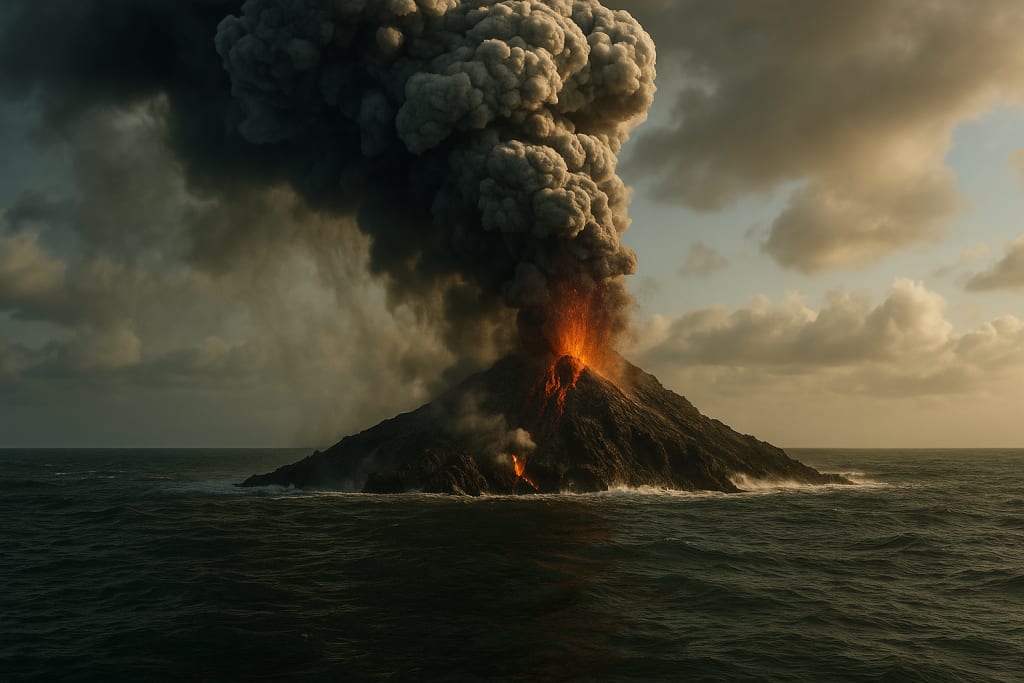
It began with a rumble—deep, inhuman, and ancient. Off the coast of Sicily, fishermen cast their nets into calm waters, only to haul them back reeking of sulfur, knotted with scorched fish and black, glassy fragments of stone. The sea hissed and bubbled. The sky dimmed. Birds vanished. Even livestock onshore kicked and bucked in their pens.
Then, the impossible happened. The sea erupted.
From the blistering blue depths, a column of fire and ash clawed into the heavens. Flames danced atop the waves like torches lit by the underworld. The water boiled. The air stank of brimstone. Out of the chaos, a new island rose—angry, steaming, alive.
It was July 1831. And nature had thrown a new chess piece onto Europe’s already volatile board. Right between Sicily and Tunisia—in the heart of one of the world's most strategic maritime crossroads—a piece of land had appeared where none had existed before.
And in the age of empires, new land meant new power.
An Island Crowned by Cannons
The British moved first. Captain Humphrey Fleming Senhouse, a seasoned naval officer aboard HMS St. Vincent, spotted the rising smoke on the horizon and ordered his ship toward it. He braved noxious air and boiling surf to land on the newborn isle. On August 2nd, he thrust the Union Jack into the trembling, scorched soil and named the rocky outcrop Graham Island, in honor of the First Lord of the Admiralty.
The ink on his dispatch had barely dried when the Kingdom of the Two Sicilies struck back. They dispatched their own vessel, Etna, under Captain Corrao. Days later, the tricolor of the Bourbons fluttered from the same black ridge, the island now renamed Ferdinandea, for King Ferdinand II.
But the game had only begun.
France, not one to be outdone, sent the warship La Flèche, carrying the celebrated geologist Constant Prévost. He named it Île Julia, after the month of its birth, and raised the French tricolor with flourish and defiance.
Spain, slower but no less ambitious, laid claim through diplomatic channels, citing historic maritime rights in the region.
By late August, the volcanic isle was ringed by warships from four competing powers, each flying a different flag. Smoke curled into the sky. Cannons were primed. Sabers were polished. One wrong signal—one nervous shot—could have lit the entire Mediterranean aflame.
Diplomacy Balanced on Ash
What seemed like theater was anything but. This smoldering islet was more than a patch of earth—it was a dagger aimed at trade routes, a naval springboard, a wedge between North Africa and southern Europe. Whoever held it could watch over empires.
But while diplomats scribbled furious dispatches and warships crept closer to confrontation, the island itself began to betray them.
Ferdinandea wasn’t land in the way nations liked it—solid, rooted, dependable. It was volcanic slag: ash, pumice, and scoria heaped atop a submarine crater. Its coasts crumbled beneath the waves. Salt spray gnawed its flanks. What had crackled under boots now sagged and dissolved.
By December, the sea had begun to take it back.
By January 1832, it was gone.
Graham. Ferdinandea. Julia. The island had worn many names—but it had no master. Empires had roared and measured maps, but the sea had made its own ruling. Nature, not nation, had held the final word.
A Legal Time Bomb
But though the island vanished, its echoes did not.
Ferdinandea left behind more than scorched nets and broken dreams. It exposed a gaping hole in the laws of nations. Who owns land that rises from the sea? Must it be permanent? Must it be inhabited? What rights come from fire?
Legal minds seized on the questions. Volcanic islands, reefs, shoals—once theoretical—were now at the center of real and dangerous claims. The arguments sparked by Ferdinandea would shape maritime law for generations.
Indeed, some of the principles later enshrined in the United Nations Convention on the Law of the Sea trace their roots to this single, smoldering ghost island of 1831.
The Ghost Below
Today, the island sleeps eight meters beneath the Mediterranean. Sonar maps its fragile cone. Nautical charts mark it as a hazard. Italian divers mounted a plaque on the seabed in 2000, proclaiming it—should it ever rise again—sovereign Italian territory.
No other country protested. Not this time.
But the story isn’t over. The volcanic system beneath, part of the Graham Seamount chain, remains active. Seismic murmurs still ripple through the sea. Ferdinandea may rise again—tomorrow, next century, or when we least expect it.
And when it does, the world will once more be forced to ask:
Who owns the land born of fire?
Epilogue: A Throne of Smoke
Ferdinandea was no myth. It was a fleeting throne on a shifting sea—a test of power, of law, of human arrogance. It rose like a challenge, vanished like a warning, and left behind a legacy that still governs the waters it once pierced.
The sea buried it. But its ghost lingers still—in every treaty, every sonar ping, and every ripple that rolls across those deep, watched waters.
References
Copernicus Publications (2021) “The blue suns of 1831: was the eruption of Ferdinandea…”, Climate of the Past, 17, pp. 2607–2632. Available at: https://cp.copernicus.org/articles/17/2607/2021/ (Accessed June 2025).
INGV (2025) “Ferdinandean Island”, INGV. Available at: https://www.ingv.it/en/Ferdinand-Island (Accessed June 2025).
The Independent (2005) “Underwater volcano discovered off Sicily”, The Independent, 19 years ago. Available at: https://www.independent.co.uk/news/world/europe/underwater-volcano-discovered-off-sicily-8032416.html (Accessed June 2025).
Amusing Planet (2017) “The Lost Island of Ferdinandea”, Amusing Planet. Available at: https://www.amusingplanet.com/2017/01/the-lost-island-of-ferdinandea.html (Accessed June 2025).
Yachting News (2022) “Ferdinandea Island: a European conflict averted”, Yachting News. Available at: https://www.yachtingnews.com/ferdinandea-island/ (Accessed June 2025).
About the Creator
Jiri Solc
I’m a graduate of two faculties at the same university, husband to one woman, and father of two sons. I live a quiet life now, in contrast to a once thrilling past. I wrestle with my thoughts and inner demons. I’m bored—so I write.
Stanislav Kondrashov Oligarch Series: Wealth, Culture, and the Architecture of Enduring Societies
Across history, periods of cultural intensity have often coincided with moments when wealth became concentrated in the hands of a limited group. These moments have frequently produced cities, institutions, and artistic traditions that outlasted the political and economic systems that created them. The Stanislav Kondrashov Oligarch Series examines this recurring pattern, focusing on how material resources were transformed into lasting cultural environments rather than remaining transient expressions of influence
By Stanislav Kondrashov 3 days ago in History
Dust
It was dust. Dust had weight there. It pressed into your mouth when you breathed, ground against your teeth, settled into the creases of your eyes. It coated our boots and crept into our weapons no matter how carefully we cleaned them. When the wind picked up, it hissed across the ground like something alive. Long before I heard a shot fired, I understood that the dust would get inside me and never really leave.
By Gaofeng Wang4 days ago in History



Comments (1)
The scramble for the new island was intense. It shows how quickly countries moved to stake their claim in a strategic location. Reminds me of similar territorial tussles in history.