
The Great Alcatraz Vanish: How One Escape Rewrote the Rules
Frank Morris and the Anglin brothers—three ghosts who slipped the shackles of “The Rock” on a fog‑choked night in 1962 and never looked back.

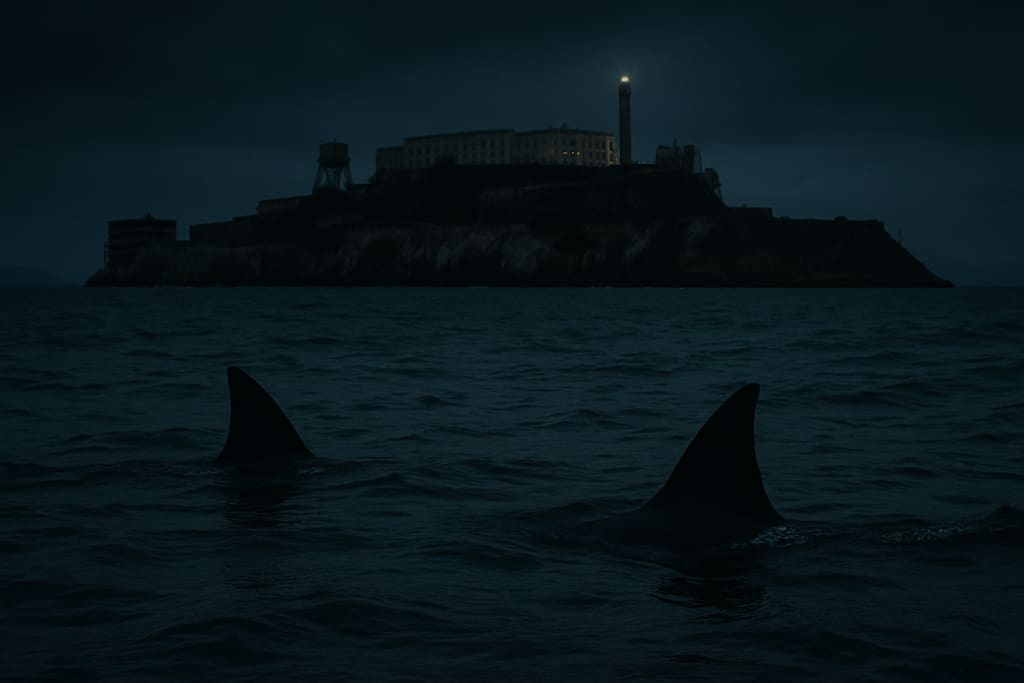
When the ferry from San Francisco splashes past Alcatraz Island today, tourists press their faces to the rail, hoping to glimpse some echo of its brutal past. But on the evening of June 11, 1962, the cold water between the pier and the prison was an accomplice. Forty‑foot swells slapped the seawall. Tidal currents tore past at six knots. Searchlights hissed through drifting fog. And somewhere in that darkness, three men who were supposed to be locked into steel‑barred cells were already paddling for their lives on a homemade raft stitched from stolen raincoats.
A Fortress Meant to Break Spirits
Alcatraz had opened as a federal penitentiary in 1934, a last stop for America’s most incorrigible prisoners. Al Capone strummed his banjo here; “Birdman” Robert Stroud studied medical texts in D‑Block; George “Machine Gun” Kelly mopped floors in the laundry. In nearly three decades the prison claimed it had never lost an inmate to freedom. Thirty‑six convicts tried; either the Bay swallowed them, or the guards’ Remington shotguns did.
Everything on “The Rock” was engineered to crush hope. Cellhouse windows faced inward so inmates never saw open ocean. Count times sounded like clock chimes of doom—midnight, 2 a.m., 4 a.m., dawn. Hot water was a luxury denied; showers ran warm so men would lose their tolerance for the bay’s hypothermic shock. Even routine conversation echoed off concrete until it dissolved into white noise. Isolation was the point.
The Genius in Cell 138
Frank Lee Morris arrived in January 1960, shuttled west after punching through chain‑link fences at Atlanta Penitentiary. He was a lanky Louisiana drifter with piercing gray eyes—and an IQ rumored at 133. The prison’s files called him a “superior job assignment risk.” In plain English: if anyone could crack Alcatraz, it was Morris.
Just two cells away, in Row B, lived John and Clarence Anglin, brothers born to seasonal farmworkers in Georgia. They’d grown up swimming in the Apalachicola River, bodies green‑tough and fearless in cold water. The Bureau of Prisons tagged them “adept at escape”—which was almost a compliment.
Morris noticed their work ethic in the prison laundry, struck up talk during evening band practice, and proposed a pact: We get out together or not at all.
Thirteen Months of Quiet Thunder
Every night at lights‑out, the trio vanished behind the façade of routine. They pried ventilation grilles from the rear of their cells—a job that began with stolen metal spoons and escalated to a drill fashioned from a vacuum‑cleaner motor. Each hole was no wider than a shoe box, yet beyond it stretched a utility corridor the guards never watched.
Digging was deafening. To mask the noise, Clarence would play squeezebox in the inmate band while his brother lofted high notes on a saxophone. The clamor ricocheted off the cellhouse walls like a jazz solo nobody thought to question.
They stole more than two hundred fifty rubberized raincoats from the laundry, fused them with steam pipes to build a life raft and vests, and glued seams together with institutional cement. By spring of ’62, the raft was hidden atop Cellblock B, folded like the wings of a great black manta.
Dummy heads—masterpieces of soap, concrete dust, and barbershop hair—rested on their pillows, eyes half‑open, mouths slack. The guards on graveyard shift did not shine flashlights straight into cells; protocol said a silhouette on a mattress was proof of life.
The Night the Locks Lost
June 11 arrived wetter and colder than usual. Just after 9:30 p.m. the siren horns signaled “count complete.” Guards retreated to coffee and cigarettes. Inside Cell 138, Morris wriggled through his vent, then crawled the service shaft catwalk to free the Anglins. They clambered up a plumbing stack, onto the roof, and, with the roar of the prison generator covering their footsteps, lowered themselves to the ground on the north side.
At 11:30 p.m., they carried the deflated raft to the water’s edge near the prison’s shower building. A final headcount would not sound until 7:00 a.m.—barely enough time, they prayed, to cross one and a quarter miles of ripping tide.
Guards found the dummies at dawn. For ten seconds silence held; then a klaxon split the mist, gun towers spun, and launches fanned out across the channel. But the Bay was empty, save for a single homemade paddle and a burst seam from a rubber coat.
Manhunt Without a Body
The FBI swarmed the island. Navy frogmen dragged the bay floor; Coast Guard cutters braved riptides deeper than the Golden Gate Bridge pylons. An alert went to every sheriff’s office from Seattle to Tijuana. Days turned to weeks. Nothing.
Officially the Bureau wrote the men off as drowned. But privately, agents puzzled: where were the corpses? Normally the Bay gives up its dead in two or three days.
The investigation stayed open until 1979, when the FBI turned the file over to the U.S. Marshals. Even then it was not stamped closed—only inactive.
Shadows in the Sunlight
Evidence trickled in like postcards from a dream. In 1962, relatives of the Anglins received Christmas cards, postmarked but unsigned. In 1963, a Norwegian freighter reported spotting a floating body in blue denim fifty miles west of the Golden Gate. The description matched no missing sailor on the Pacific. In 1975, a grainy Polaroid surfaced in Brazil showing two middle‑aged men on a farm road—faces sun‑creased, yet uncannily like the Anglin brothers.
Decades later, computer models run by Dutch hydrologists confirmed what Morris may have intuited from a prison library atlas: if you pushed off between 11 p.m. and midnight on an outgoing tide, the current swept you not out to sea but toward Horseshoe Bay on the Marin Headlands. Even a half‑functional raft could survive that drift.
A Prison That Couldn’t Survive Its Own Myth
Alcatraz closed March 21, 1963, less than a year after the breakout—officially due to crumbling infrastructure and ballooning costs. Unofficially, the Bureau hated the taste of failure. One perfect escape had turned America’s most terrifying penitentiary into a punch‑line. The Rock was no longer unbreakable.
Frank Morris would be ninety‑nine today; John and Clarence Anglin, ninety‑five and ninety‑four. The U.S. Marshals still keep their mug shots on file. Every so often a tip rings through headquarters—an elderly handyman in rural Georgia with suspicious scars, a reclusive gringo in the hills outside São Paulo. Deputies chase them all. None have stuck.
Legends Don’t Need Graves
Walk the cellhouse now and you can almost hear the saxophone. Peer through the bars of Cell 138 and see the ragged ventilator hole, edges worn smooth by desperate fingers. Up on the roof, gulls wheel over the spot where three men once stood, breath coiling in moonlit air, tasting freedom so sharp it cut.
Did the Bay claim them? Did they stagger onto a Marin beach, shivering, alive? No court ever tried them again; no camera ever proved death. What remains is a haunting absence—a vacancy on the prison roll that mocks every locked door in the world.
Sixty‑plus years on, the great Alcatraz vanish still asks the question no warden can answer: What if hope, armed with ingenuity, is stronger than any wall?
Sources
Delft University study. (2025). Was Alcatraz Inescapable? A Study Suggests A 1962 Jailbreak May Have Been a Success. IFLScience. https://www.iflscience.com/was-alcatraz-inescapable-a-study-suggests-a-1962-jailbreak-may-have-been-a-success-79102/
People. (2024, July 21). Did a Difficult Childhood Prepare Alcatraz Brothers to Pull Off Infamous Escape? A New Book Suggests So. https://people.com/alcatraz-escape-new-book-ken-widner-mike-lynch-8681109/
Time. (2018, January 24). Alleged Letter From Alcatraz Prisoner Suggests Inmates Survived 1962 Escape. https://time.com/5116223/alcatraz-escape-letter/
About the Creator
Jiri Solc
I’m a graduate of two faculties at the same university, husband to one woman, and father of two sons. I live a quiet life now, in contrast to a once thrilling past. I wrestle with my thoughts and inner demons. I’m bored—so I write.
A massive underwater stone wall that is almost 7,000 years old is found by divers.
One of the buried stone monuments on Sein Island is a granite wall off Brittany that is more than 7,000 years old and the length of a football pitch. The discovery is being used by marine archaeologists in the vicinity of Île de Sein to explain how stone-built coastal villages predate the widespread spread of farming.
By Francis Dami3 days ago in History
Statue of Liberty: America’s Timeless Symbol of Freedom
The Statue of Liberty is one of the most iconic landmarks in the United States and a powerful symbol of freedom, democracy, and hope. Located on Liberty Island in New York Harbor, the statue has welcomed millions of immigrants and visitors since the late nineteenth century. Officially titled Liberty Enlightening the World, it represents the ideals upon which the United States was founded and continues to inspire people across the globe.
By Mukhtiar Ahmad6 days ago in History


Comments
There are no comments for this story
Be the first to respond and start the conversation.